B&B Hotel Arezzo
Arezzo - Einstein 4
Book now
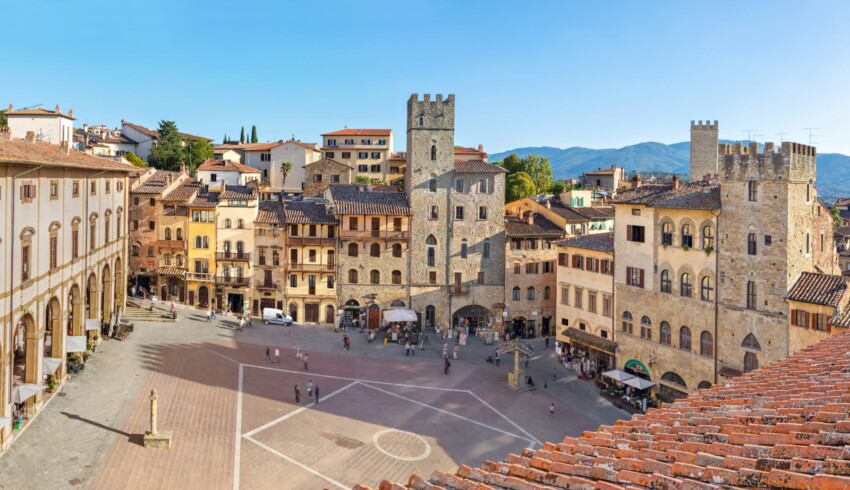
Arezzo is a breath of fresh air. A surprising destination that’s often overlooked in classic Tuscan itineraries, yet it’s brimming with art and beauty just like all the region’s more famous tourist hotspots.
It has given birth to some key figures in Italian art history, literature and science: the names of Francesco Petrarca and Piero della Francesca alone would be enough to grab your attention, but the list of illustrious Arezzo natives also includes architect and art historian Giorgio Vasari, biologist Francesco Redi and music theorist Guido Monaco.
Its squares and churches are treasure chests holding absolute masterpieces; its parks are restorative green oases just a stone’s throw from the centre.
Arezzo is severely disadvantaged compared to other Tuscan art cities because the town centre suffered heavy damage during the Second World War. Ironically though, it’s events from that period that introduced Arezzo’s beauty to the wider public: it was right here in Arezzo that the key scenes of “Life Is Beautiful” were filmed, the celebrated film by Roberto Benigni that recounts the tragedy of the Holocaust in a touching and fairy-tale manner.
Give it some thought. Divided into two parts—the historic upper town perched on a hill, the lower part with bars and shops—Arezzo is a doubly enthralling city, capable of both whisking you back to Tuscany’s period of greatest splendour and immersing you in modern-day dynamism.
It sits amid four splendid valleys (Valtiberina, Casentino, Valdarno and Valdichiana), in an ideal location as a base for a holiday in south-eastern Tuscany: villages, spas, countryside and great food await you. Umbria is not far away: you can even make a day trip to Lake Trasimeno!
Things to do on a walking tour of Arezzo’s centre? It depends on how much time you have: half a day is enough to see the main attractions, but with more time you can explore churches and museums inside.
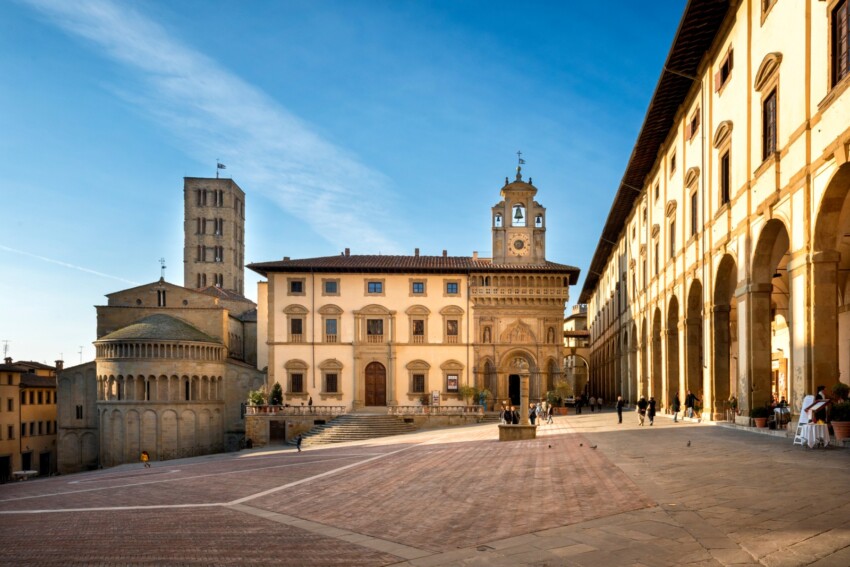
As in many Italian cities, the beating heart of Arezzo’s civic life is the main square, known as Piazza Grande or Piazza Vasari.
It stands out from other elegant piazzas in Italy for its unusual trapezoidal shape and its slope, the latter carefully designed to aid rainwater drainage. The total difference in height between the lowest and highest points is about 10 metres.
Magnificent historic buildings from different periods overlook the square: the buildings on the southern and eastern sides date back to the Middle Ages, the northern side is lined with Renaissance structures from the 16th century, and the western side features buildings from the 15th century. The overall effect of great harmony is truly astounding when you consider the different architectural styles from these various eras.
Among the finest buildings overlooking the square are undoubtedly the Loggiato Vasariano, the Pieve di Santa Maria and the Palazzo della Fraternita dei Laici.
Piazza Grande provides a spectacular backdrop for the Giostra del Saracino, Arezzo’s most important traditional event: beloved by locals, it’s a historical re-enactment held twice a year with a night-time edition in June and a daytime one in September.
Another event that animates the square, this time on a monthly basis, is a popular antiques market.
The Palazzo delle Logge designed by Giorgio Vasari, known as the Loggiato Vasariano, is the elegant and imposing building situated on the highest side of Piazza Grande. You’ll immediately recognise it by its fine portico, which nowadays hosts restaurants and bars with outdoor seating.
The Loggiato Vasariano was built in the second half of the 16th century and is considered one of the most important works by the celebrated architect, so much so that it took his name rather than that of its patron, Cosimo I de’ Medici.
Neither of them lived to see the work completed: construction of the palace and its magnificent loggias finished in 1595, about twenty years after both their deaths.
The Palazzo della Confraternita dei Laici encompasses three styles and three eras: a lower section in Gothic style built in the 14th century, a Renaissance section, and a bell tower with a clock added in the 16th century. The bell tower was designed by Giorgio Vasari whilst the clock is the work of Felice da Fossato.
The clock still works today and displays the hour, day and lunar phases according to the Ptolemaic conception of the universe, that is with the earth at the centre with the sun and moon revolving around it. It’s considered a true masterpiece of horology.
You can visit the palace interior: after serving as the seat of the Court for many years, it now houses a museum that opened to the public in 2010. During your visit to the Museo della Fraternita you’ll be able to walk through the palace rooms, admire a fine collection of artworks, enjoy splendid views over Piazza Grande and get a close look at the elaborate mechanisms of the astronomical clock in the bell tower.
Despite being squeezed into a cramped space between the start of Corso Italia and the end of via dei Pileati, the Church of Santa Maria della Pieve certainly doesn’t go unnoticed. It’s a magnificent church in Romanesque style with a façade of three portals; construction work began around 1140 and was completed in the early 14th century.
An unusual detail: the part of the Pieve di Santa Maria overlooking Piazza Grande is not the façade but rather the rear, a semicircular apse with small single-light windows. The windows opening from the bell tower are, however, twin-light windows, which earned it the nickname “tower of a hundred holes”.
The church interior houses precious artworks—notably the Polyptych by Pietro Lorenzetto, a masterpiece dating back to the 14th century—and the relics of San Donato, the city’s patron saint.
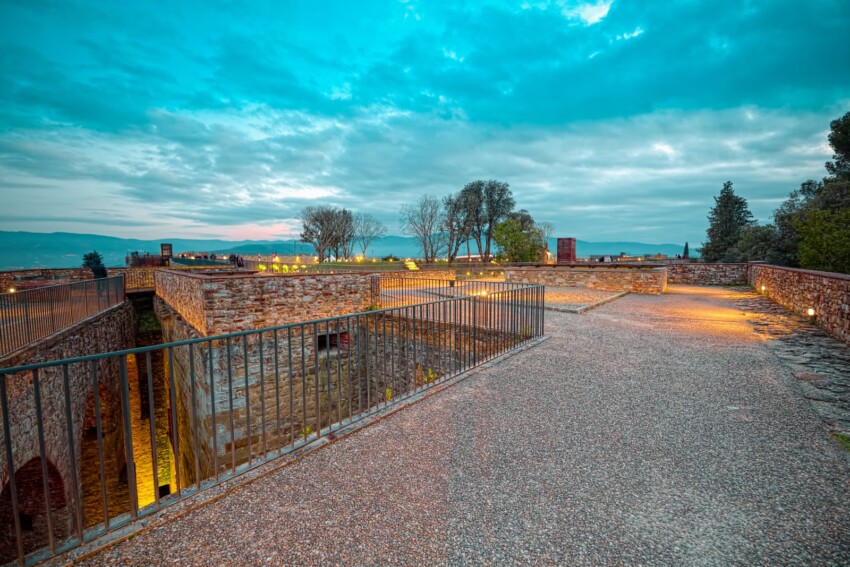
The Fortezza Medicea is a stone defensive structure standing in the north-eastern part of Arezzo, at the top of San Donato Hill.
A fortified citadel from the medieval period probably once stood on this spot. It was the Medici who wanted a more imposing fortress in the 16th century, and they’re responsible for its current appearance with its five-pointed star shape and bastions of varying heights to suit the terrain. The design is by Giuliano and Antonio da Sangallo.
From a military structure, the fortress has become a popular gathering and leisure spot for locals. Inside there’s one of Arezzo’s most beautiful and most frequented city parks.
The fortress can be reached on foot from Piazza Grande by first heading to the Giardini del Prato and then continuing along the Passeggio del Prato.
Il Prato is Arezzo’s green oasis, situated at the top of a hill between the Cathedral and the Fortezza Medicea. It’s where locals enjoy a leisurely stroll and is often animated by open-air concerts and events.
For visitors, it’s the ideal spot for a break; due to its position, it’s also a lovely viewpoint from which to observe the historic centre and the surrounding countryside.
At the centre of the park stands a square dedicated to Francesco Petrarca.
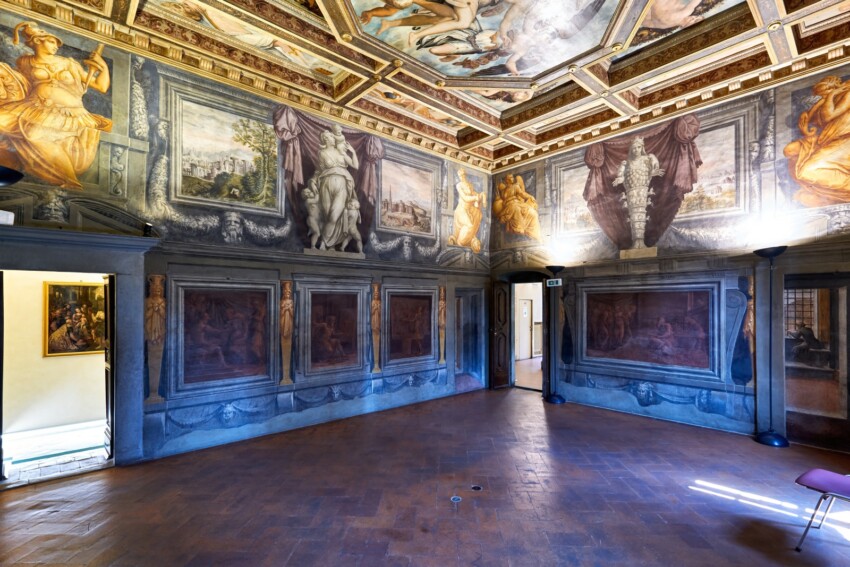
Giorgio Vasari is one of the most influential painters and architects of 16th-century Italy, famous for writing one of the most important texts on art history in Italy. Several of Arezzo’s finest monuments are his work: it’s no wonder his house is now a museum dedicated to him.
The Vasari House Museum in Arezzo is housed in a small palace that the artist purchased in 1541 and used as a family residence; don’t confuse it with the Vasari House in Florence, which he rented during his periods of work in Tuscany’s capital.
The residence is laid out over three floors; the principal apartment occupies the second floor: decorated by the artist himself and still well preserved, it represents one of the finest examples of an artist’s home with Mannerist taste in Italy. The house is surrounded by a lovely geometrically-laid-out garden, also open to visitors.
Another house-museum not to be missed in Arezzo is the one dedicated to one of the fathers of Italian literature, Francesco Petrarca; again, there’s potential for confusion with another house-museum, that in Arquà Petrarca in the Veneto region, which was the poet’s last home before his death.
The Petrarca House in Arezzo is housed in a 17th-century palazzo that internally contains the remains of a house three centuries older: according to tradition, this is the birthplace of Francesco Petrarca. Historical documents confirm that the poet was indeed born in Arezzo, but there is no conclusive proof about the address of his birthplace. Still, it remains a worthwhile attraction.
The palazzo houses a museum open to the public and the Accademia Petrarca di Lettere, Arti e Scienze, a centre that promotes historical studies linked to the poet and organises numerous cultural events.
The Basilica of San Francesco in Arezzo can certainly not compete for grandeur with the one in Assisi, but this small stone church has an ace up its sleeve.
The interior walls of the main chapel are entirely decorated with a cycle of 15th-century frescoes considered a masterpiece that shaped Italian art history. We’re talking about the cycle “The Legend of the True Cross” by Piero della Francesca, inspired by a well-known medieval legend connected to the wood from which the cross of Jesus was made.
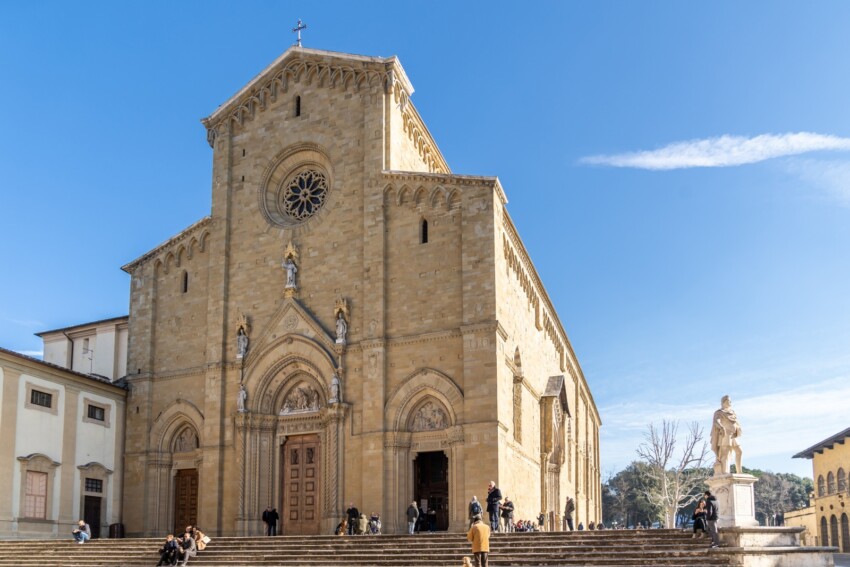
Another interesting church to visit in Arezzo is the Cathedral, or Cathedral of Saints Peter and Donato. Overlooking its namesake square, it was built on the remains of an earlier Early Christian church following the death in Arezzo of Pope Gregory X in 1275. The exterior façade remained incomplete for centuries: its current appearance dates from the 20th century.
The Cathedral’s artistic masterpiece is the seven stained-glass windows of the Marcillat cycle, created in the 16th century. Here too we can find works by Piero della Francesca (the fresco decorating the left nave) and Giorgio Vasari (the wooden choir and the organ base).
Palazzo dei Priori is a magnificent 14th-century building flanked by a square-based tower that dominates Piazza della Libertà, another key point in Arezzo’s centre. It currently serves as the Town Hall.
In the following map you can see the location of the main places of interest mentioned in this article.
Arezzo’s historic centre has been an exceptional film set for two blockbuster films in Italian cinema history: the moving and award-winning “Life Is Beautiful” by Roberto Benigni and the hilarious comedy “An Fantastic Coming and Going” by Leonardo Pieraccioni.
The tourism authority has created two maps showing the locations where filming took place: below we outline the stops on the two film location itineraries.
You can use them as a guide for an unusual walking tour of Arezzo, to hunt down the spot where Benigni performed his now-famous “Buongiorno principessa” greeting for the first time, or to relive Pieraccioni and company’s amusing gags.
The locations from “Life Is Beautiful” are: Cathedral, Palazzo della Provincia, Piazza Grande, Palazzo della Fraternita dei Larici, Cartolibreria Orefice, Badia delle Sante Flora e Lucilla, Via Garibaldi, Scuole elementari Gamurrini, Basilica di San Francesco, Caffè dei Costanti and Teatro Petrarca.
The locations from “An Fantastic Coming and Going” are: Piazza della Libertà, Il Prato, Teatro Piero Aretino, Piazza Grande, Piazza San Francesco, Via Mazzini, Via Borgunto, Via Madonna del Prato, Piazza Sant’Agostino and Piazza San Jacopo.
Arezzo isn’t the most popular choice for a Tuscany break, which has two important consequences—both negative and positive—for the accommodation on offer.
On one hand, you won’t find the same variety of hotels and B&Bs as in the more visited art cities; on the other, prices are generally lower, quality is usually excellent, and rooms aren’t hard to come by. The exception is during major events, when Arezzo’s hotels fill up completely.
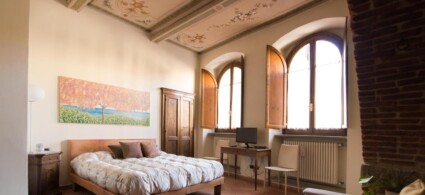
The most charming accommodation is concentrated in the historic centre: you’ll find apartments and guesthouses housed in historic palaces and thoughtfully furnished, as well as more budget-friendly options.
If you have a car, you can head a few kilometres out from the centre in any direction to find modern business hotels, including some from major international chains, or charming farm stays and country houses.
Arezzo enjoys excellent transport links thanks to its position on major road and rail routes, making it straightforward to reach.
To drive, simply take the A1 Milan–Naples motorway, exit at the Arezzo junction and follow signs towards the centre for roughly 10 km.
The railway station in Arezzo sits on the Rome–Bologna line, served by intercity and high-speed trains, plus numerous regional services to Florence and other Tuscan destinations. If you’re taking trains to Arezzo from Rome or Florence, check which station you’re departing from, as sometimes it’s not the main station—it could be Tiburtina in Rome or Rifredi in Florence.
An excellent alternative to the train is the coach: Arezzo is served by long-distance buses connecting it to the main towns in south-eastern Tuscany, plus some national services to other parts of Italy.
The train and bus stations in Arezzo are located in the lower part of the city. It’s not far to the centre—you can walk, though bear in mind it’s uphill. Alternatively, hop on a local bus.
What's the weather at Arezzo? Below are the temperatures and the weather forecast at Arezzo for the next few days.
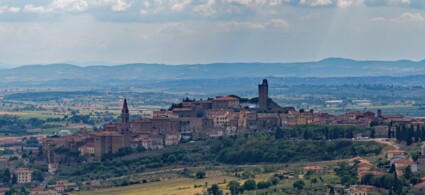
Arezzo is a town in south-eastern Tuscany and the capital of its province. It lies approximately 75 km from Florence, 70 km from Siena and 175 km from Pisa; the nearest major landmark is Lake Trasimeno, just 60 km away.
 Hotel
Hotel 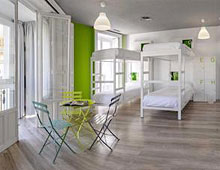 Budget accommodations
  Apartments
  Family Hotel
 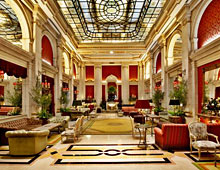 Luxury Hotel
 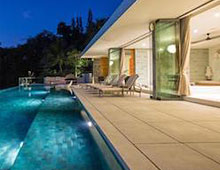 Resorts