Antica Dimora del Pellegrino
Anghiari - Loc. Bagnolo del Ponte alla Piera 14
Book now
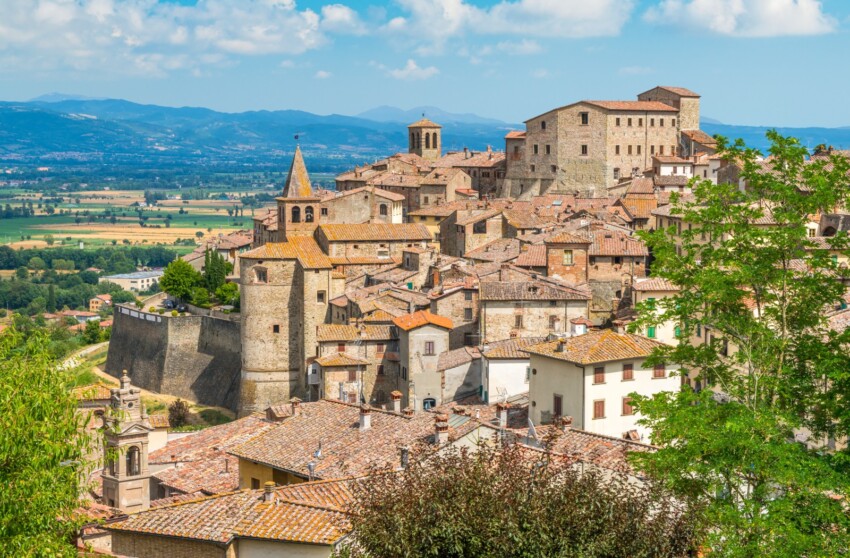
The charming village of Anghiari lies in the province of Arezzo, at the easternmost point of Tuscany, not far from the border with Umbria. It was here that the legendary Battle of Anghiari took place between the republics of Florence and Milan, immortalised by a mural painted by Leonardo da Vinci that is now lost to history.
Though its glorious reputation has faded with time, Anghiari is now an important tourist destination in Tuscany: come here to take in all the sights worth seeing in the town centre and surroundings, breathe in the fresh air and enjoy the magnificent rolling landscapes that have made the region famous across the globe. Amongst vineyards and olive groves, you can alternate cultural visits with gastronomic tours, to experience Tuscany in all its glory, straddling the Casentino and the Upper Tiber Valley.
A stay in Anghiari, or even just a weekend break, should be savoured without rushing, which is why the town is part of the Slow Cities movement (towns dedicated to the good life). But Anghiari’s accolades don’t end there: it’s also part of the select club of Italy’s most beautiful villages, and has been awarded the Orange Flag by the Italian Touring Club.
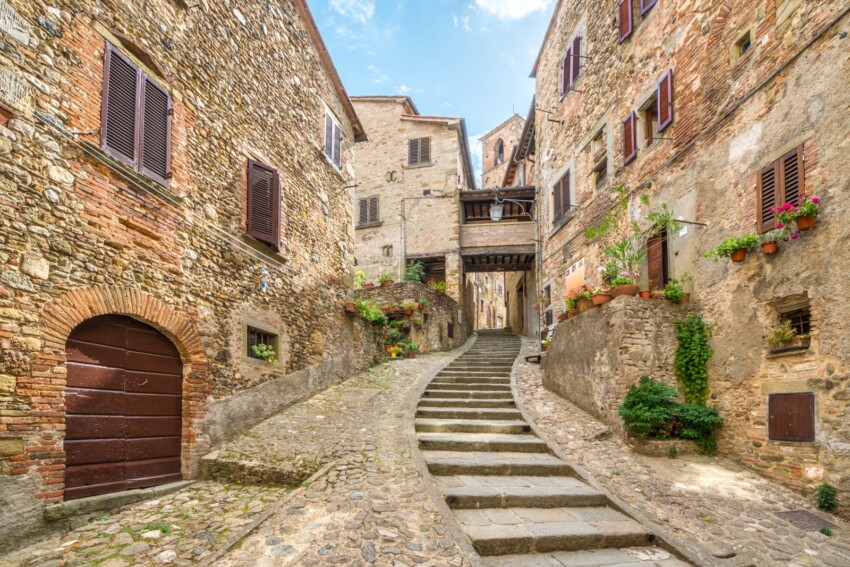
The main attraction in Anghiari is its historic village. Explore it thoroughly, first discovering the main streets and then the side roads. Wander aimlessly for a while, then focus on its principal sites of interest. After that, venture out to explore the surrounding area.
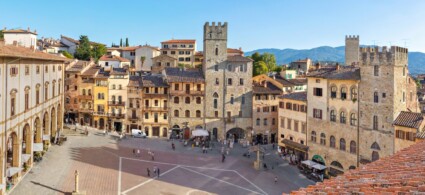
The Palazzo Pretorio in Anghiari, now home to the Town Hall, stands in Piazza del Popolo and is an ancient building dating back to the 14th century that was the heart of the town’s original nucleus.
On the façade are displayed in bas-relief the coats of arms of the podestà who administered Anghiari on behalf of the Florentine Republic; on the ground floor there is also a beautiful 15th-century fresco, probably by Antonio di Anghiari, a pupil of Piero della Francesca.
The history of the Palazzo Pretorio is long and turbulent, so much so that in the 19th century it was used as a prison. Furthermore, on the ground floor a Roman artefact was discovered: a wine vat.
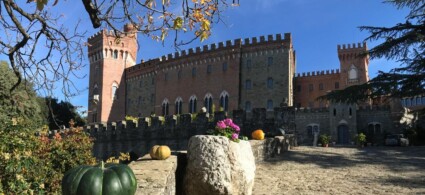
The imposing Castello di Montauto, located in the La Scheggia area, is a medieval castle owned by the Barbolani family, one of Italy’s oldest aristocratic families.
Built at the end of the 1100s, it was partially reconstructed in the mid-16th century and today shows elements of Renaissance and late 19th-century style.
It sits on the Montauto hilltop, at almost 800 metres above sea level, in a commanding position and difficult to access. For this reason, it held strategic importance throughout its history.
The castle of Montauto housed the habit of Saint Francis of Assisi for three centuries, from autumn 1224 to 1503, when it was stolen by the Florentines and taken to Florence and then, in 2005, to La Verna.
The castle is private and not open to the public, but it is a renowned venue for weddings and events.
Inside Palazzo Marzocco, in Piazza Mameli in the historic centre, you’ll find the Museum of the Battle and Anghiari, established in 2000. It is Anghiari’s principal historical museum and houses numerous collections spanning from prehistory to the 18th century.
From Neanderthal stone tools, to Roman sculptures and firearms created during the French Revolution, the museum showcases humanity’s resourcefulness in finding solutions.
Considerable space is dedicated to the Battle of Anghiari, exploring Leonardo da Vinci’s unfinished painting, displayed alongside all its copies through a digital system.
The Museum of the Battle and Anghiari is open from 1 April to 1 November daily from 9:30am to 1pm and from 2:30pm to 6:30pm; from 2 November to 31 March afternoon opening times are reduced by an hour. The museum is closed on Christmas Day.
For a day trip between Anghiari and Sansepolcro, don’t miss the Monti Rognosi Nature Reserve, established in 1998. Covering 156 hectares, it is part of the Monti Rognosi, designated a site of community importance.
Within the reserve you can walk through rough, untouched mountain terrain, rich in flora and fauna. The marked trails can be walked, cycled or ridden on horseback, and you can also wander through woodlands, fields and minor roads.
There are some historically significant trails, such as the one called “la via delle miniere” (miners’ path), others dedicated to nature, and even one dedicated to Saint Francis of Assisi and his habit.
The ancient Church of Santo Stefano is located in Anghiari on Via della Battaglia and is one of the few surviving examples of early medieval religious architecture to reach us today. It dates back to the 7th century, so truly ancient, and stands outside the village walls, in the direction of Sansepolcro.
Visit it from the outside to admire the austere lines of medieval style, influenced by Byzantine features, whilst inside there is a beautiful painting by Domenico di Michelino, Madonna with Child and Saints.
Anghiari and other centres in the Valtiberina were under Lombard rule in the first half of the 11th century: from this period dates the phenomenon of castle-building at strategic points in the Sovara Valley, the Tiber Valley and the Singerna Valley.
The Castello di Montauto, Galbino and Sorci are particularly notable as the finest and best-preserved examples of fortifications around Anghiari.
Also worth mentioning are the castles of Pianettole, Toppole and Valialle, all part of the fortification system defending the right side of the Sovara Valley, and the remarkable fortified villa of La Barbolana.
As all these buildings are privately owned, they can only be viewed from the outside; for visits to the interiors, it is advisable to contact the Anghiari Museum System offices to make arrangements with the owners.
Located between a tributary of the Sovara and the Libbia provincial road, Galbino was an ancient castle whose origins date back to the year 1000, when it was a fief of Count Ranieri. Transformed into a noble residence, the castle today features a small tower at the centre of the roof and cylindrical turrets at the corners of the square plan. A splendid loggia with stone columns runs the length of the façade. It is clearly visible from the road connecting the Tavernelle hamlet with the former Convent of San Niccolò a Gello (a modern facility for welcoming groups and religious communities).
In 1268 it was destroyed by German soldiers following Conradin of Swabia, who was fighting against Charles of Anjou. Later falling under Florentine rule, it became the home of the condottiero Baldaccio d’Anghiari. At that time, the fortress was defended by around thirty men-at-arms and a formidable outer wall complete with moat. In subsequent centuries the castle underwent renovations, eventually taking on the appearance of a 17th-century villa, in which the tower it incorporated still stands out.
Converted into a farm, today the Castello di Sorci is home to one of Italy’s most authentic restaurants, well known for the celebrities who regularly dine there (film actors, television presenters, singers, journalists, writers…).
It is worth noting that its rooms inspired the screenplay for the film “Nothing Left to Do But Cry” directed by and starring Roberto Benigni and Massimo Troisi, who were guests of the castle’s lord at the time. On summer evenings, beneath the starlit sky, some claim they can still hear the clanking of Baldaccio’s armour, whose ghost is said to roam his ancient fortress.
Dating from the 8th-9th century, this is a pre-Romanesque building with three apses located a short distance from Anghiari, on the road leading to Arezzo (Via Libbia). The influence of the Camaldolese on the church’s layout (11th-12th century) is documented internally by the tower that once jutted out from the central part of the façade, showing strong French influence.
A baptismal church in the early Christian period and subsequently, after being owned by the counts of Galbino, under Camaldolese jurisdiction. Inside are preserved fragments of early medieval sculptures, traces of 14th-century frescoes, a canvas attributed to the Aretine painter Niccolò Soggi (Madonna with Child between Saints Peter and Jerome) and the panel with the Assumption attributed to Giovan Battista Naldini.
In the following map you can see the location of the main places of interest mentioned in this article.
In 1440 Florentines and Milanese clashed near Anghiari in a bloody battle that has gone down in history. The clash was also crucial to the geopolitics of the era, and was won by the Florentine Republic with the help of knights from the Venetian Republic, who blocked the Milanese advance guard. The Papal States also stood with the Florentine Republic. The defeat for the Duchy of Milan was decisive and swift: everything happened in less than 24 hours.
However, despite the remarkably brief duration of the conflict, its story has reached us today thanks to its depiction by Leonardo da Vinci, who around 1503 created a mural on the walls of the Hall of Five Hundred in Palazzo Vecchio. Sadly, no trace of the work survives today, as Vasari completely redecorated the hall some 60 years later; however, it has been suggested that Leonardo never completed the work and in fact never even began the painting stage, as he stopped at the wall’s preparatory phase, which revealed various problems due to a plaster defect.
However, numerous autograph studies remain today, which Leonardo carried out over more than a year of work with six assistants, on the basis of which various artists have created copies. Among these, the most famous is undoubtedly that of the Flemish painter Peter Paul Rubens, now displayed in the Louvre.
In the centre of Anghiari and its immediate surroundings there are two hotels and some apartments; staying here is ideal for having the beautiful historic village within reach, visiting it comfortably on foot without needing to use your car.
But venture just a few kilometres from the town and you’re already in the heart of the Tuscan countryside. In this splendid setting you’ll find many farmhouses, villas and resorts, all high-quality properties converted from significant renovations carried out over the last 20 years.
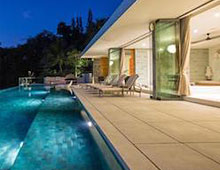
Nowadays, staying in a Tuscan country house is a winning choice, allowing you to best enjoy both the typical scenery of rolling hills and vineyards, and to relax fully in a peaceful and laid-back environment, perhaps by the pool, finishing the day in style at the restaurant, where the menu often features local specialities cooked fresh.
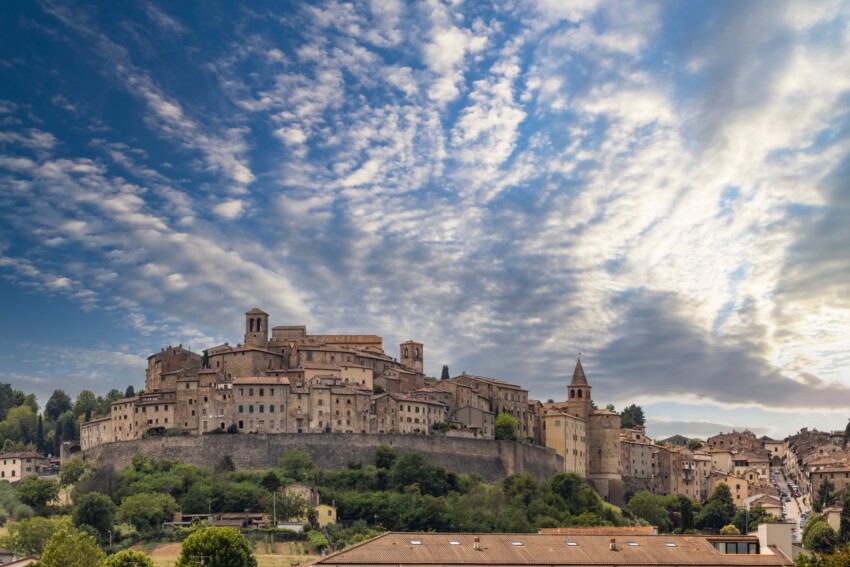
Geographically Anghiari is located in the heart of Italy, but considering only Tuscany, it sits at the far east end, in a rather remote position, and therefore is not always easy to reach.
From Florence for example it takes almost two hours: you travel along the A1 motorway to Arezzo, and once you reach the provincial capital, continue along the SP43 provincial road. The final stretch, between Arezzo and Anghiari, takes about 30-35 minutes.
Reaching Anghiari from Siena means covering a distance of about 100 kilometres along the SS715 national road passing through Taverne d’Arbia and Rapolano Terme, then crossing into Arezzo province near Lucignano and continuing via Monte San Savino on the SS73 national road. The journey takes just under an hour and a half.
Anghiari is also far from the sea, which means the journey from Tuscany’s coastal towns such as Pisa and Livorno is quite lengthy: close to 3 hours, covering more than 100 kilometres. From both Pisa and Livorno you first arrive at Florence, then continue towards Arezzo before reaching your destination.
For those travelling by public transport, the only option is the bus departing from Arezzo Terminal on Via Marconi, near the main railway station. The relevant service is the SI381 Arezzo-Sansepolcro-Città di Castello-Lerchi line, operated by Sitabus, which reaches the destination in under an hour. Of course, you need to get to Arezzo first, which you can do conveniently by train from any province in Tuscany.
What's the weather at Anghiari? Below are the temperatures and the weather forecast at Anghiari for the next few days.
Anghiari is located in the province of Arezzo, close to San Sepolcro, not far from the Umbrian border.
 Hotel
Hotel  Budget accommodations
  Apartments
  Family Hotel
  Luxury Hotel
  Resorts