Locanda Dei Baroni
Camaldoli - Via Di Camaldoli 5
Book now
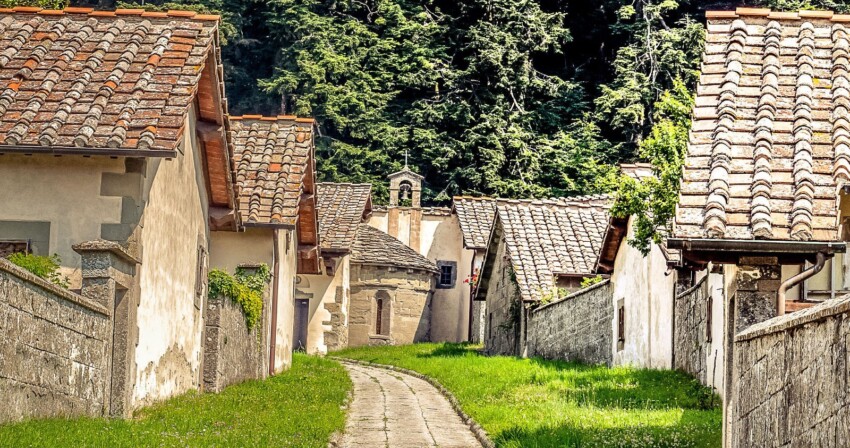
The small village of Camaldoli, situated within the municipality of Poppi, in the heart of the Casentino forests, is a genuine surprise. Here you’ll find a community of monks founded at the very beginning of the year 1000 by Saint Romuald of Ravenna and still active today. The monks live their life of prayer between the monastery and the hermitage, two elegant complexes separated by around four kilometres, which are the main reason for a visit.
But there’s more, because visiting Camaldoli also means immersing yourself in the lush nature of the Casentino Forests, Monte Falterona and Campigna National Park, which stretches between Tuscany and Emilia-Romagna and encompasses the village and its surroundings entirely. You can therefore take walks along the trekking trails, or cycle through them, and then explore the beautiful surrounding area, since the Casentino, the valley below, is truly rich in things to see.
Once you’ve climbed to the 840-metre altitude where Camaldoli is situated, besides the natural beauty of the surroundings, the main attractions to visit are 3: the hermitage, the monastery and the lovely Traversari lake.
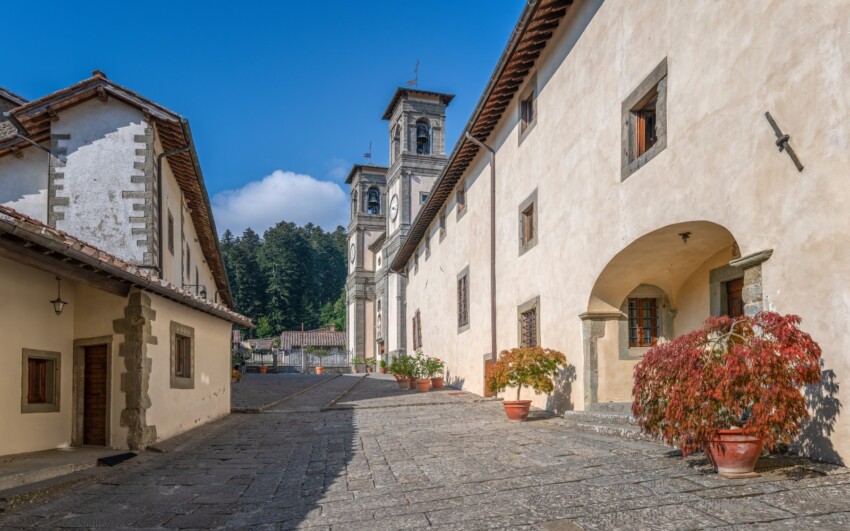
Be amazed by the Camaldoli hermitage and its Romanesque-Baroque architecture. Of ancient origins, it was consecrated in 1027 thanks to the enormous work of Saint Romuald, founder of numerous eremitic communities.
The hermitage is still used today by the Benedictine monastic community here for personal contemplation, and is even permanently inhabited by 9 monks. Beyond the main gate, you enter the inner courtyard, overlooking which is the guest house, where guests and pilgrims can stay, the small church dedicated to Saint Saviour Transfigured, and the cell of Saint Romuald, where the saint spent much of his day studying and praying. This is the only cell in the hermitage that’s open to visitors; the others are private residences for the monks.
Around the Camaldoli hermitage spreads the Camaldoli Biogenetic Reserve, managed by the Italian state but cared for for centuries by the monks; the reserve also extends into Romagna territory, and within it live and reproduce deer, fallow deer, roe deer, wild boar and wolves.
The Camaldoli Code
Inside the monastery, in July 1943 — discreetly, away from the spotlight of a country at war — discussions took place that led to the drafting of the Camaldoli Code. Organised by the FUCI (Italian Catholic University Federation), the meeting brought together young Catholic intellectuals including Aldo Moro, Giorgio La Pira and Giuseppe Lazzati. The Code addresses themes of social life — family, work, economics — from the perspective of the Church’s social doctrine, and provided inspiration for Christian Democracy’s action in the post-war period.
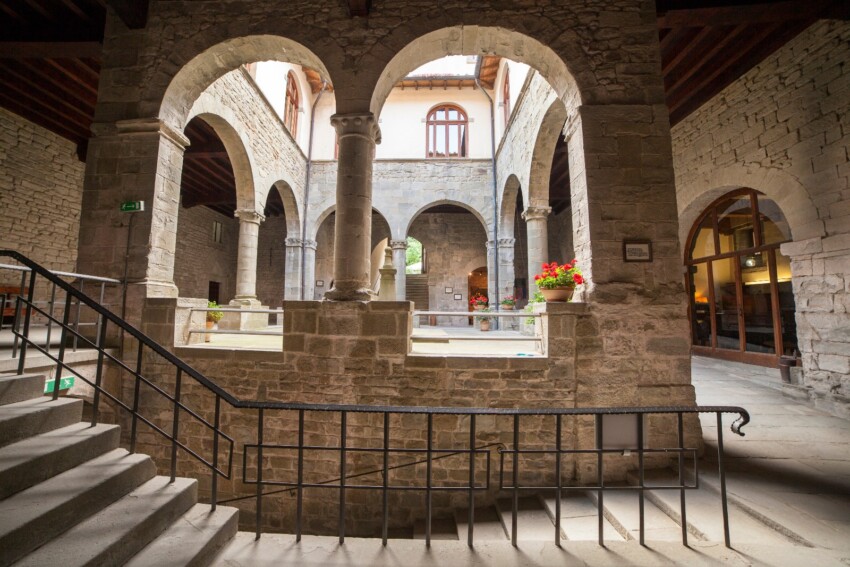
In the centre of the Camaldoli village stands the Camaldoli monastery, on the banks of the Archiano river. The monastery is part of a single large architectural complex that also includes a church and a hospice, or guest house. As with the hermitage, the monastery’s origins too are very ancient: it was built starting from 1046, on the occasion of the construction of a small hospital by the monks. Over the centuries it expanded until it assumed its present form, dating back to the 16th century.
The monastery is built around the central cloister, decorated with arches and columns; there is a refectory with a coffered ceiling furnished with walnut stalls, and on one wall hangs a canvas by Pomarancio, depicting Christ served by angels.
The church of the Camaldoli monastery is dedicated to Saints Donato and Ilariano. The structure was rebuilt and transformed several times over the centuries — undergoing radical renovation in the 18th century — but has preserved the wonderful works of sacred art inside, including 7 panels by Giorgio Vasari, including the Deposition of Christ from the Cross on the high altar, the Nativity of Christ and the Virgin enthroned with the Child and saints John and Jerome in the side chapels.
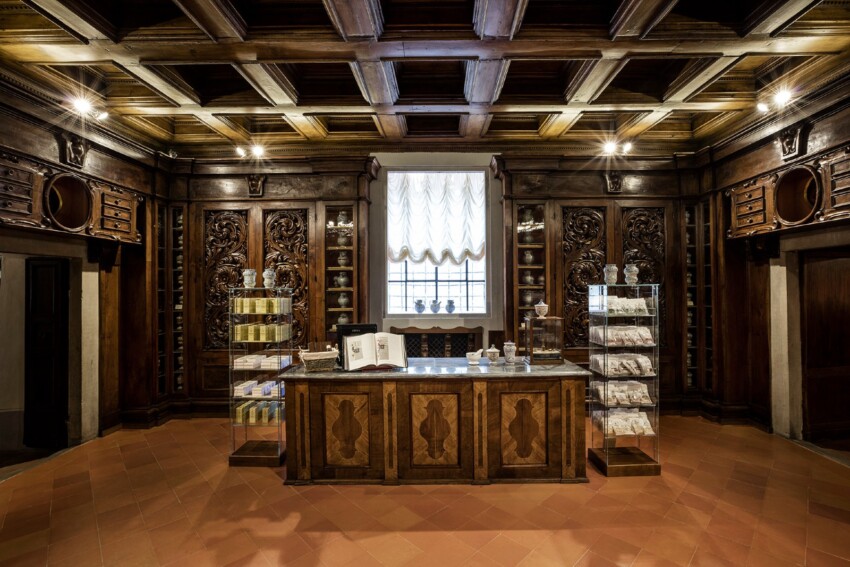
Don’t miss the Ancient Pharmacy of the Camaldoli Monks for anything in the world. Originally it was an integral part of the ancient hospital founded in 1046, whilst today it is the only remaining testament to this ancient structure.
In reality, what remains of the hospital is not quite the ancient pharmacy itself, but rather the galenic laboratory, that is the area where herbs were prepared to make medicines.
In a room furnished with 17th-century furniture, topped by a wooden coffered ceiling, you can admire numerous original books and recipe collections dating back to the 15th century and many ancient instruments such as stills, mortars, copper distillers, wooden presses, oil jars and a hot grinder.
Upon entering you’ll literally step back in time and immediately perceive the mystical aura of the place. Admission to the Ancient Pharmacy of Camaldoli is free and the shop sells natural pharmaceutical products made by the monks.
After visiting the artistic and religious treasures of Camaldoli, it’s time to admire its wonderful surrounding scenery. Head, for example, to the charming Traversari lake, a small artificial lake dating back to the early 15th century, and thus now completely naturalised. The lake originated to give the monks the opportunity to farm fish, the only source of animal protein for those who didn’t eat meat.
Today the lake is home to numerous animal species, including some protected ones, such as the spotted newt, protected by the Bern Convention, and the alpine newt, listed in the WWF Red Book among species at risk of extinction.
In the following map you can see the location of the main places of interest mentioned in this article.
Camaldoli is situated in a rather remote location and is a genuinely small village, so don’t expect a wide choice of accommodation; near the monastery there are only two, a small hotel and a campsite, whilst in the hermitage area there is nothing.
In the neighbouring hamlets there are, however, some interesting alternatives: in Serravalle, for example, there are some farmhouses, smallholdings, country houses or beautifully renovated barns converted into apartments, equipped with all facilities including kitchens, gardens, swimming pools, private parking and children’s play areas.
You can naturally stay in Poppi or in Soci, the two Casentino municipalities closest to Camaldoli, which have significantly more services and accommodation options, but keep in mind that from both you’ll need to travel around 10 kilometres to get there.
Camaldoli is in a very isolated location, in the heart of the Apennines between Tuscany and Romagna, and is therefore not always the easiest to reach.
From Florence, although the distances aren’t excessive (just under 70 kilometres), it takes over an hour and a half, travelling along the SS67 Tuscany-Romagna road past Compiobbi, Sieci and Pontassieve, then climbing along the SR70 for the narrow and winding roads of the Consuma pass, at 1,050 metres altitude. You thus enter Arezzo province, particularly the Casentino area, and descend until you reach Poppi, from which Camaldoli is around 10-15 minutes away.
Even from Arezzo city centre, distances are not short: around an hour’s travel, for a distance of just over 45 kilometres. In this case you travel north along the SR142 regional road towards Subbiano in the direction of Bibbiena, and thus reach Soci and then Camaldoli.
Reaching Camaldoli from Tuscan coastal towns is certainly not short: from both Pisa and Livorno it takes between two and a half and three hours, first travelling towards Florence and then taking the same route described above.
From Siena city centre to Camaldoli takes around two hours, covering 100 kilometres. You travel through inland Tuscany, passing through Taverne d’Arbia, Pietraviva, Ambra, Bucine, Levane, Laterina, Rassina and Bibbiena, from which you officially enter Casentino. From here to Camaldoli takes another 20-25 minutes.
What's the weather at Camaldoli? Below are the temperatures and the weather forecast at Camaldoli for the next few days.
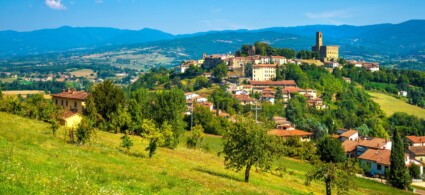
Camaldoli is located in the province of Arezzo, in the heart of the Casentinesi Forests, Monte Falterona and Campigna National Park, just a short distance from the Emilia-Romagna border.
 Hotel
Hotel  Budget accommodations
  Apartments
  Family Hotel
  Luxury Hotel
  Resorts