Hotel Da Giovanna
Chiusi della Verna - Viale San Francesco 33
Book now
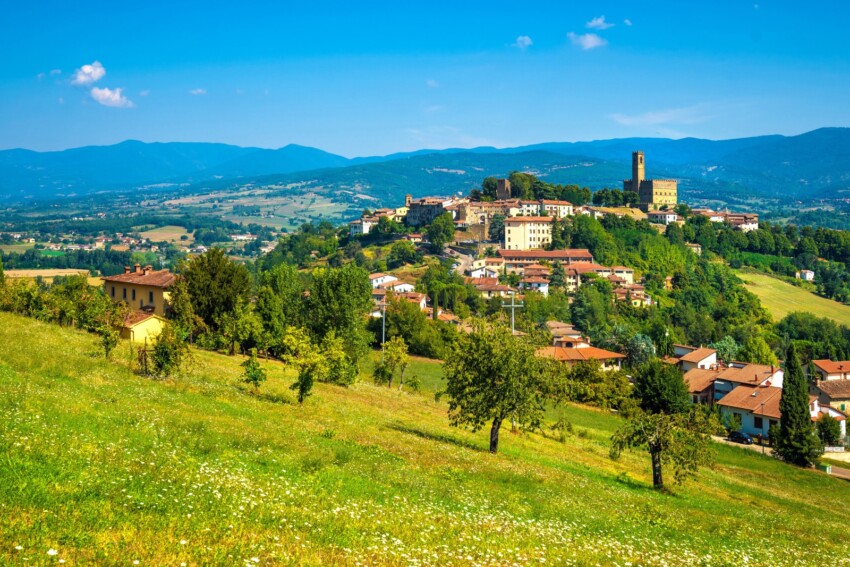
The Casentinesi Forests, Monte Falterona and Campigna National Park spans Emilia-Romagna and Tuscany, stretching across the provinces of Arezzo, Forlì-Cesena and Florence, covering an area of approximately 36,000 hectares: one of Italy’s most extensive and best-preserved national parks, recognised in 2021 on the IUCN Green List as a protected area managed exemplarily on a global scale.
An immense expanse of woodland and a natural sanctuary hidden for centuries by religious communities who established hermitages and monasteries here. The marks of human habitation remain in the landscape, but frozen by abandonment: houses, wayside shrines, bridges and mule tracks guide visitors through a civilisation—that of so-called “Romagna Toscana”—with its own distinctive character. It is precisely the Hermitage and Monastery of Camaldoli, the Sanctuary of La Verna and the natural setting in which they are immersed that offer visitors the most intense experiences.
The park is divided into 4 zones, identified by the letters A, B, C and D, in descending order of protection. In zone A, the integral reserve, the natural environment is preserved in its entirety, extending through to zone D, which encompasses urban and tourist centres.
Given the park’s vast expanse, flora and fauna are highly varied, with over 1,357 plant species catalogued. As for animals, this is home to the most significant wolf population in the entire northern Apennines, monitored constantly using non-invasive techniques by the Carabinieri Forestali from the Carabinieri Biodiversity Unit in Pratovecchio. Red deer, roe deer, fallow deer, wild boar and golden eagles also live here: spotting them is far from difficult, particularly in the evening hours. In October, the rutting call of red deer attracts hundreds of birdwatching and nature enthusiasts to the park’s clearings each year.
The Park, established in 1993, extends across a vast territory straddling Romagna and Tuscany. The network of footpaths exceeds 600 kilometres of routes for all difficulty levels, suitable for hikers, mountain bikers and families with children.
The Tuscan side, much gentler and carved by the valleys of Arno tributaries, also includes a portion of the Mugello region and the Casentino, which is the upper Arno Valley territory from which the forests take their name.
To the south the protected area extends as far as the striking limestone ridge of Monte Penna, with the celebrated Franciscan sanctuary of La Verna, whilst to the north, right on the border between the two regions, rise the fairytale waterfalls of the Acquacheta, already described by Dante in his Divine Comedy.
In Romagna the Casentinesi forests comprise the valleys of the Montone, Rabbi, Bidente and Tramazzo rivers and distinctive locations such as Campigna, Ridracoli and Corniolo.
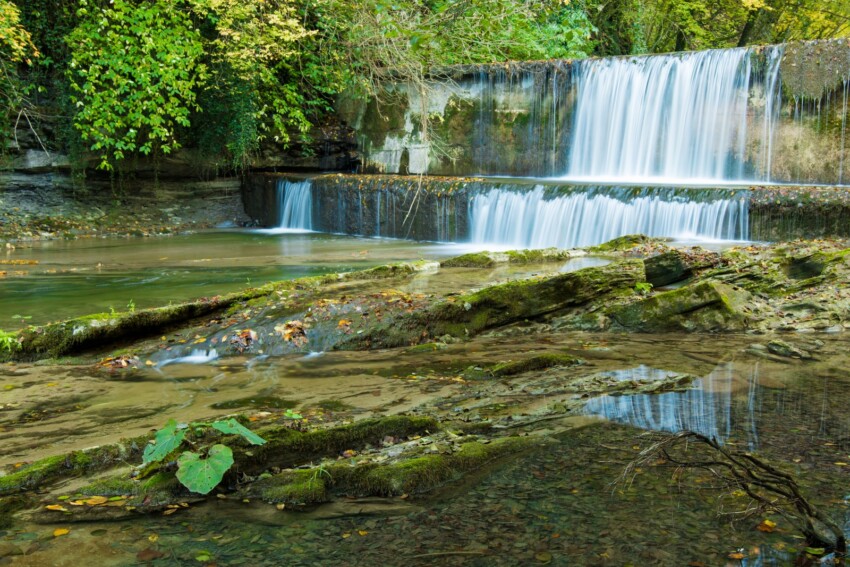
The waters of the Acquacheta stream make a drop of approximately 70 metres, flowing rapidly over rock and, in places, plunging from overhanging sandstone ledges.
On the plateau above the waterfall, which originated from the silting of an ancient lake, sits the hamlet of Romiti, which arose in the 15th century on the ruins of the hermitage of the monastery of S. Benedetto in Alpe, where Dante found refuge during his exile from Florence (the 16th canto of the Inferno contains a celebrated description of the waterfall).
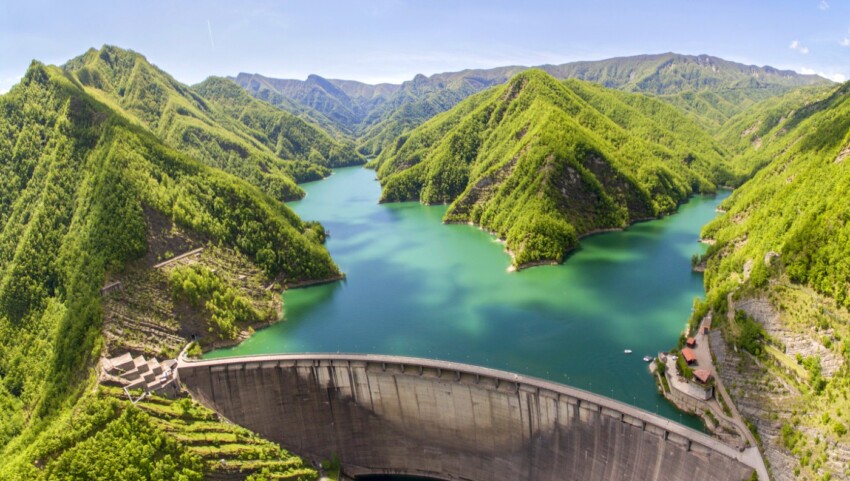
The settlement of Ridracoli preserves a fine example of a humped-back bridge that once served an ancient palazzo, now a hotel, beside which stands the Natural History Museum of the Bidente Valley.
Following the valley upwards, the ruins of a medieval castle can be seen on a hilltop, and continuing further you reach the impressive dam, completed in 1982 to provide power and water to the towns of the Romagna plain.
Of particular hiking interest is the Sasso Fratino Integral Nature Reserve, the first established in Italy in 1959 and now a UNESCO World Heritage Site (recognised in 2017 along with the ancient beech forests surrounding it, covering approximately 7,700 hectares in total). Access to the integral reserve is restricted to the public to preserve its integrity, but the large surrounding area—also part of the UNESCO recognition—can be explored via the park’s network of footpaths. Within it survive beech trees over 500 years old, among the oldest in Europe.
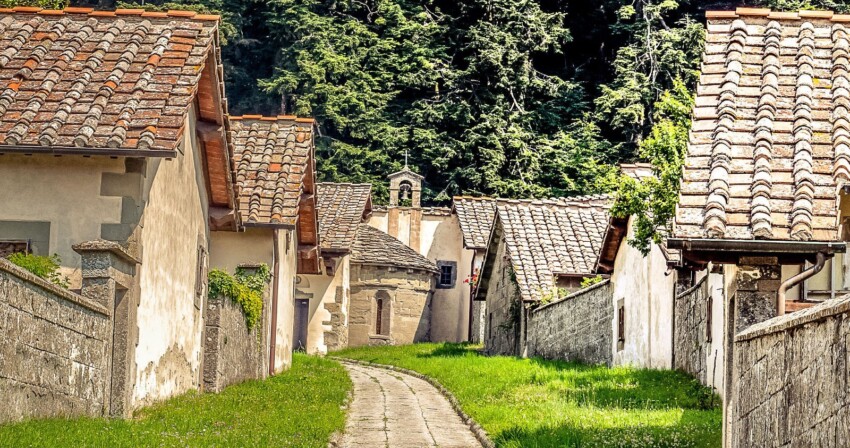
Founded after the year 1000 as a hospice on the site of the castle of Fontebuona, once owned by Count Maldolo, it later became a monastery of the Camaldolese. In the 16th century a printing works operated here, producing the Camaldolese Constitutions, which contained regulations for forest management. Noteworthy are the cloisters and the church of Santi Donnino and Ilariano, with fine paintings by Vasari; on one side of the monastery the ancient pharmacy preserves alembics, mortars, furnaces and precious texts from the monks’ galenic laboratory.
The 18th-century Grand Ducal palazzo, now converted into a hotel, was until the last century the hunting residence of the Lorena family. The headquarters of the local forest station, as also at Camaldoli and Badia Prataglia, hosts a small natural history museum open on request. A short distance away, a columnar trunk of silver fir lying on the ground bears witness to the majesty and considerable value once possessed by the Campigna Forest.
In winter Campigna becomes a destination for snow lovers: cross-country skiing, snowshoeing and snowy walks through the woods are the most popular activities in the cold season.
The Apennine ridge, rising gradually from the eastern side, forms the park’s principal mountain group. Monte Falco (1,658 m) is the highest peak in the entire park, whilst nearby Monte Falterona (1,654 m) is famous for hosting on its southern slopes, at an altitude of 1,358 m, the spring known as Capo d’Arno, considered the source of Tuscany’s major watercourse.
One of the most striking paths to conquer these peaks starts from the small settlement of Castagno d’Andrea. Further east lies the gentle grassy depression called Lake of Idols, a significant archaeological site where numerous Etruscan statuettes have been found.
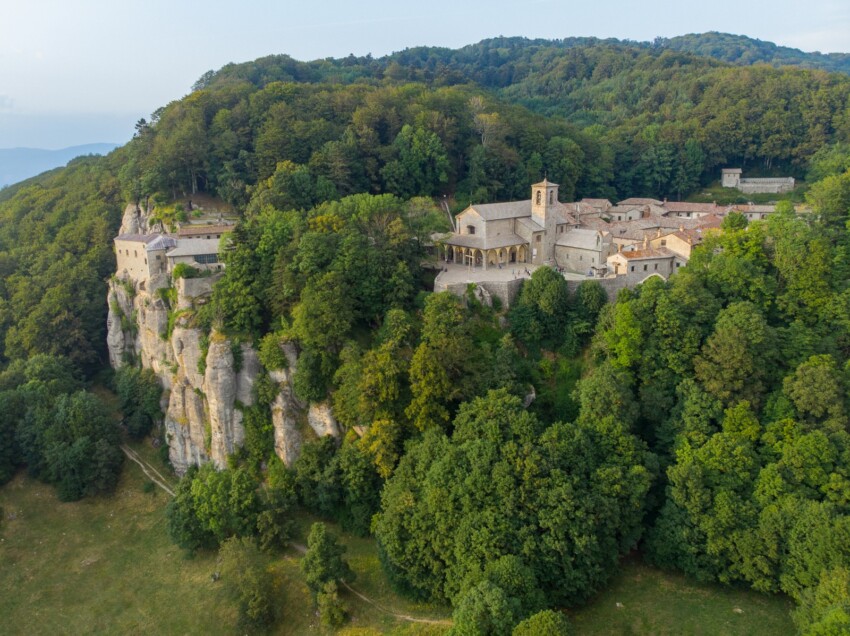
Perched on the steep southern face of Monte Penna stands the celebrated Franciscan sanctuary of La Verna, a constant pilgrimage destination, immersed in a silent and dark forest that was the companion of the saint in his hermitic life. The limestone nature of the mountain has created harsh topographies, with numerous crevices and natural cavities that open in the shade of majestic mountain maples, ash trees, elms and beeches; the saint and the friars chose some particularly evocative settings as places of prayer.
The mountain was donated to Saint Francis in 1213 by the Casentinese count Orlando Cattani, now buried in the small church of Santa Maria degli Angeli, to whose construction he had contributed. It was at La Verna, in September 1224, that the miracle of the stigmata occurred, recalled by Dante in Paradise and still commemorated with a solemn festival.
Badia Prataglia is one of the main access points to the park from the Tuscan side and an ideal starting point for numerous hiking routes. The hamlet, at 1,015 metres elevation, takes its name from the ancient Camaldolese abbey founded in the 11th century, now incorporated into the parish church of Santa Maria Assunta, which still retains some original Romanesque structures. The Park Visitor Centre, located in the village, is a recommended stop before venturing into the forest: it provides up-to-date information on footpaths, wildlife and weather conditions, as well as educational materials on the protected area’s history and ecology. Nearby is the Badia Prataglia Biogenetic Nature Reserve, home to some of the most beautiful and accessible beech forests in the entire park. In summer Badia Prataglia is popular with families seeking a cool escape from the heat of the plain; in winter it becomes a base for snowshoe excursions.
Stia, a municipality at the gates of the park in the northern Casentino, is the natural access point for those wishing to reach Monte Falterona and Lake of Idols. The latter is a small boggy depression at 1,385 metres altitude where between the 19th and 20th centuries over 650 Etruscan votive bronzettes were recovered, now preserved in Florence’s National Etruscan Museum and partly in the local museum: one of the most important Etruscan cult sites in the Apennines, testament to how these mountains were frequented and revered some twenty-five centuries ago.
Stia is also the capital of Casentino Cloth, the prized woollen fabric with its characteristic curly reverse that for centuries clothed shepherds and mountain dwellers throughout the region. The Museum of Wool Art tells the story of this artisanal production with period machinery and historical documents. Stia’s historic centre, with its arcaded square and the Pieve of Santa Maria Assunta, deserves a stroll before heading off to the mountains.
San Benedetto in Alpe is a small hamlet on the Romagna side of the park, famous above all as the starting point for the footpath leading to the Acquacheta Waterfall in about an hour’s walk on a well-marked trail. However, the hamlet has its own historical and literary significance: here stood the ancient Benedictine monastery of Sant’Alberico—later known as San Benedetto in Alpe—where, according to tradition, Dante Alighieri found refuge during the early years of his exile from Florence. The poet remembered the places with such attention to detail that he described the Acquacheta waterfall with precision in the 16th canto of the Inferno, a detail that Dante scholars have used to confirm his presence in this valley.
Little remains today of the medieval monastery, but the small parish church preserves some ancient architectural elements. The hamlet has remained virtually unchanged over time and offers a genuine welcome, with a few farmhouses and the tranquillity typical of places far from mainstream tourist circuits.
The Casentinesi Forests are more than just a natural park: their territory bears the profound marks of World War II and partisan resistance. The Apennine ridge dividing Tuscany and Emilia-Romagna largely coincided with the Gothic Line, the German defensive line that split Italy in two from autumn 1944 to spring 1945.
The park’s passes—Passo dei Mandrioli, Passo della Calla, Passo di Serra—were traversed in those years by partisans, evacuees, escaped prisoners and families seeking to reach the territory already liberated by the Allies. The Freedom Trail today retraces some of these historic routes, becoming a trekking experience that combines landscape beauty with the story of a dramatic and courageous chapter in Italian history. Along the route are plaques, commemorative stelae and the remains of partisan settlements: small monuments deserving attention and respect.
In the following map you can see the location of the main places of interest mentioned in this article.
The park offers different experiences in each season and there is no single best time in absolute terms: it depends on what you’re looking for. Spring (April–May) is the time of flowering and wildlife awakening, with woods returning to tender shades of green. Summer guarantees pleasant temperatures even on the warmest days, thanks to the altitude, and the footpath network is fully accessible.
Autumn is the most spectacular season: the beech foliage transforms the park’s slopes into an explosion of reds, oranges and yellows that reaches its peak between mid-October and early November. October is also the month of the red deer rut, the nocturnal calling of stags during the mating season, one of the Apennines’ most thrilling natural spectacles. Winter brings snow and opens the door to snowshoeing and cross-country skiing, particularly in the Campigna area and the Romagna side of the Casentinesi Forests.
An excellent base for exploring the Casentinesi Forests is the nearby Bagno di Romagna, a renowned tourist resort with numerous hotels and restaurants as well as excellent thermal baths.
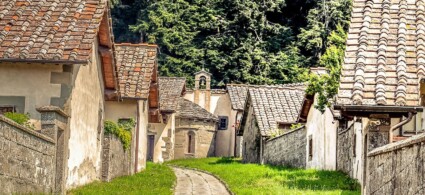
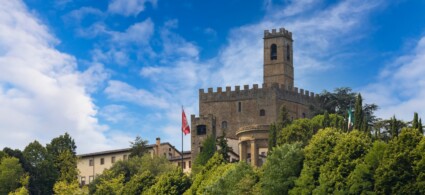
If you prefer to venture into the small villages within the park itself, you’ll find numerous farmhouses and family-run accommodation scattered throughout the various hamlets of Poppi, Camaldoli, Ridracoli, Campigna, Corniolo or San Benedetto in Alpe.
 Hotel
Hotel  Budget accommodations
  Apartments
  Family Hotel
  Luxury Hotel
  Resorts