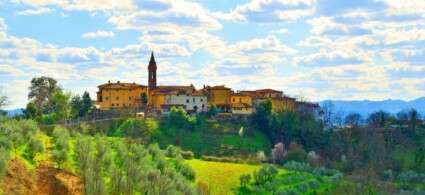
Borgo La Capraia
Castelfranco Piandisco - Località La Capraia 45, Frazione Pulicciano
Book now
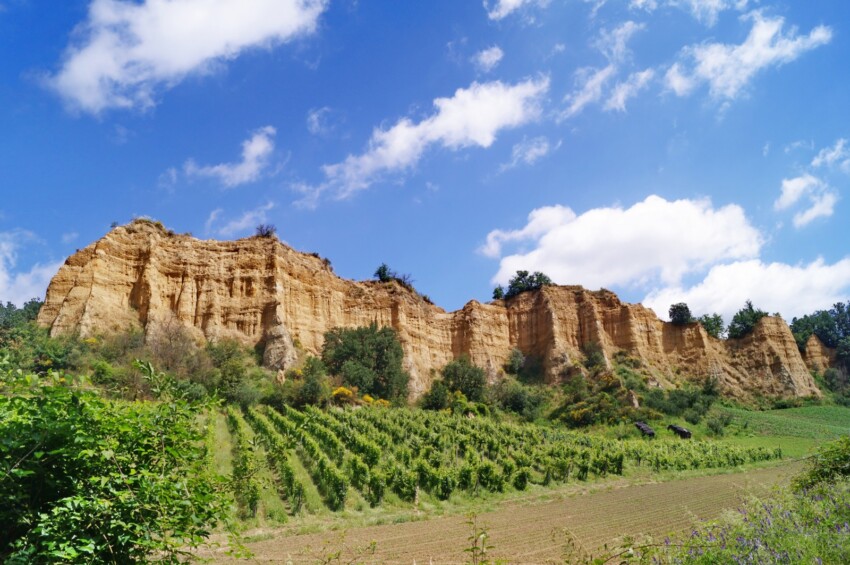
The ravines and badlands of the Valdarno between Florence and Arezzo captured the scientific attention of Leonardo da Vinci, who used them as backdrops in various paintings and drawings. Particularly striking are the ravines of Acqua zolfina, situated not far from the scenic Sette Ponti road, where at its intersection with the provincial road to Botriolo, you can spot the medieval tower of Castelfranco framed by the badlands.
Like the other “terre nuove” (new towns), Castelfranco di Sopra boasts an urban layout that mirrors the Roman castrum, with orthogonal streets and a central piazza overlooked by seats of power: the palazzo del podestà and the Church of San Pietro, now lost. Plot sizes are multiples of the Florentine braccio, and as you move outward from the centre, buildings decrease in height and streets narrow accordingly. According to Vasari, the renowned architect Arnolfo di Cambio was responsible for designing the town, and you can still see the Florentine imprint, not only in the urban layout but also in some dwellings along the opening stretch of via Maestra, dating from the town’s foundation period and remarkably similar to the terraced houses in Florence’s historic centre.
In the piazza, Palazzo Comunale retains its original ground floor, which houses intact prison cells. The facade displays the coats of arms of former podestà, and in the council chamber you can admire a fresco of the Madonna del latte (late 14th century). Descending from the piazza along via Cavour, you’ll find the Church of San Filippo Neri, presenting a 1761 facade, though the original oratory was constructed in 1631 and enlarged in 1666. The 17th-century high altar bears a panel painting of San Filippo by Florentine artist Matteo Rosselli, but equally notable is the Virgin and Child from the school of Andrea del Sarto in a side chapel.
At the far end of via Cavour stands Torre d’Arnolfo, also known as Porta Campana, the sole surviving tower bearing carved inscriptions of Florence’s lily and the date of its construction, 1300. Casa Campa on via Piave displays a carved image of a horse alongside the Florentine lily on its facade, indicating it was once a posting station where horses were changed. Opposite lies the Cappella della Compagnia dei Bianchi, remodelled in the 16th century.
The route along via Arnolfo is particularly interesting, where the only surviving stretch of walls retains its complete walkway. Another building worth visiting is the 18th-century Palazzo Sassolini on via Veneto, which also features remains from the 15th and 16th centuries. Via Roma is home to the Teatro Comunale, dedicated to Wanda Capodaglio, which holds considerable importance for the local community.
The countryside above Sette Ponti road is dotted with farmhouses, fortified dwellings, small settlements and remnants of feudal castles. Throughout, a landscape of olive groves and orderly agricultural terracing. Beneath Setteponti lies the Balze area, where our journey began.
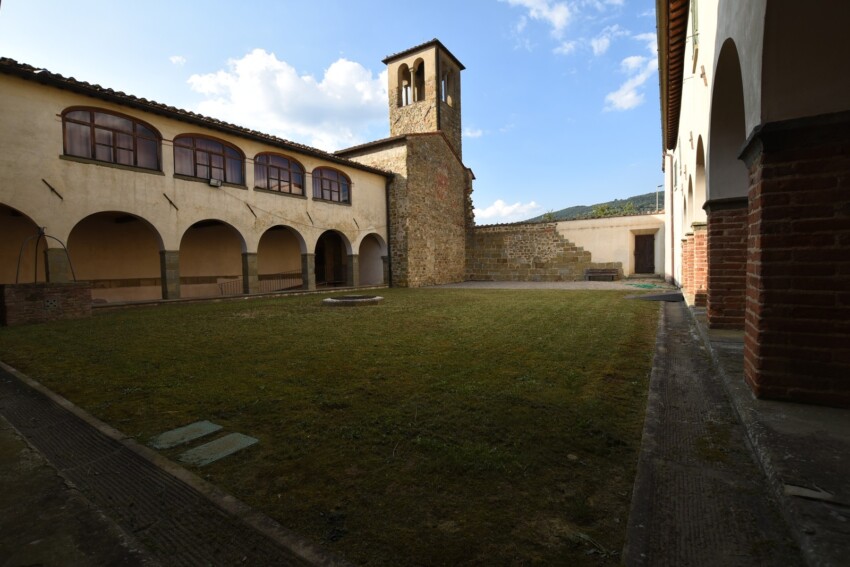
Situated right on Castelfranco’s doorstep yet fortunately remaining isolated and nestled amongst olive groves and vineyards, the complex of Badia di San Salvatore a Soffena today makes an extraordinary first impression for those arriving in town via Setteponti road. The complex comprises the church, cloister and convent. The Badia is already mentioned in a 1014 document and in 1090, following a papal bull issued by Pope Urban II, it was entrusted to the Vallombrosani monks along with other possessions. In 1394 the church was completely rebuilt, as evidenced by its present Gothic architectural characteristics.
In the early decades of the 1700s, however, the Badia suffered rapid decline; it was converted to agricultural use with the consequent loss of artistic works and damage to the frescoes. After 1960 the State acquired the building and began restoration work; it removed the frescoes (which had been damaged by hammer blows), restored the roof, returned the cloister to its original form and restored the church interior and bell tower.
The church features a Latin cross plan with a square apse and groin vault ceiling. The 15th-century frescoes inside the church are by artists such as Paolo Schiavo, Maestro Liberato da Rieti and Bicci di Lorenzo. Particularly notable is “The Annunciation” by Masaccio’s brother Giovanni di Ser Giovanni, known as lo Scheggia. Currently, restoration work is underway for the creation of an archive, library and museum of archaeological finds discovered during excavations in 1991.
To see all the facilities and book accommodation in Castelfranco di Sopra use the form below, entering the dates of your stay.
 Hotel
Hotel  Budget accommodations
  Apartments
  Family Hotel
  Luxury Hotel
  Resorts