Hotel Park
Castiglion Fiorentino - Via Umbro Casentinese 88
Book now
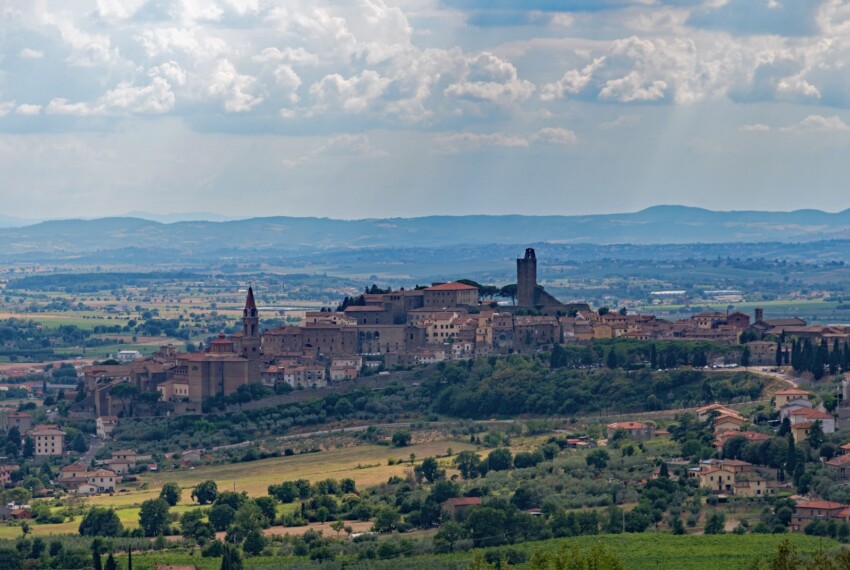
The area around Castiglion Fiorentino has been inhabited since prehistoric and proto-historic times. The settlement developed during the Etruscan period, between the late Archaic (6th–5th century BC) and Hellenistic periods (from the 4th century BC onwards). Once the Romans conquered the Aretine territory, they organised agricultural production in the form of villas.
Under the reign of Augustus, the Valdichiana entered a period of decline. The local population, threatened by marshland encroaching on the valley, relocated to safer, healthier hillside settlements. This marked the construction of the pievi (parish churches), positioned along a route at the foot of the hills and following the valley road of the Val di Chio. The settlement first appears in documents under the name of Castiglione in the 10th century, when it was a fief of the Marquises of Monte S. Maria.
In the centuries that followed, whilst nominally under imperial protection, it effectively belonged to the Diocese of Arezzo. The formation of the Comune began in the second half of the 12th century but faced constant opposition from larger city-states. Following Arezzo’s defeat at Campaldino (1289), Castiglione came under Florentine rule. In 1303 it was conquered once again by the Aretines and Sienese, led by podestà Uguccione della Faggiola. Bishop Guido Tarlati, who became lord of Arezzo and its territory, enlarged the town walls and restructured the urban layout.
After the death of Tarlati, Castiglione Aretino briefly returned to Florentine rule (1336–1344). In 1344 it was conquered by the Perugians, becoming Castiglione Perugino. In 1369 the population rebelled against Perugia, placing itself under the protection of the Papal States. From 1384 onwards the town passed definitively to Florence and from this point on, renamed Castiglion Fiorentino, it followed Florence’s fortunes.
The early 15th century saw a period of crisis brought about by plague epidemics and resulting famines. During the conflict between Florence and the Sienese Republic, Castiglione fell into the hands of Piero Strozzi, before returning to Florentine control shortly afterwards (1554). Medici rule was followed by that of the House of Lorraine (1765), who, through land reclamation of the Valdichiana, created the conditions for significant population growth and social change, as well as considerable economic stimulus. In 1774 the town underwent administrative reorganisation with the incorporation of the communes of Montecchio, Mammi and la Montanina.
Florentine rule ended in 1799, when the Tree of Liberty was raised in Piazza del Mercato. From 1800 to 1814 the town was occupied by Napoleonic forces. Following the fall of the French government, the Lorraine dynasty returned in 1814 and continued the land reclamation works in the Valdichiana. Subsequently Castiglion Fiorentino shared in the fortunes of Tuscany and the Italian State. The passage of the front during the Second World War caused considerable damage to both the historic centre and much of the municipal territory.
The first medieval town walls date from the 13th century; in the following century they were enlarged and the “Muro dell’Ala” (Wing Wall) was built to connect the Cassero to the outer walls. Around the mid-14th century, the Perugians, who controlled the settlement, carried out further restructuring. During the 1600s, the towers lost their defensive function and were partially demolished.
The main entrance to the historic centre is through the Porta Fiorentina (Florentine Gate), which formed part of the 13th-century wall circuit. In its present form it is the result of 19th-century reconstruction. Outside, there is an outer gate; to its left are the remains of a Medici coat of arms, whilst the tower on the right is what remains of the original Torre degli Assi (Tower of the Asses).
Inside the gate is a fresco depicting the Madonna and a relief showing St Michael, the city’s patron saint.
To the left, the walls bend towards San Francesco. In this section, called the “Pisan” walls due to the participation of the Pisan Republic in their construction, the exterior corresponds to Piazzale Garibaldi and throughout this stretch you can see remains of other towers. Continuing towards the present-day Porta San Giuliano, the walls descend to encircle the ecclesiastical complex of the Collegiata, before continuing towards Porta Romana, rebuilt after the war on the ruins of the 14th-century Porta di Sant’Angelo. Above the latter is a niche containing a terracotta statue of St Michael.
Proceeding further, various buildings are built against the walls, including the old hospital and the Municipal Theatre. The final section reconnects to Porta Fiorentina.
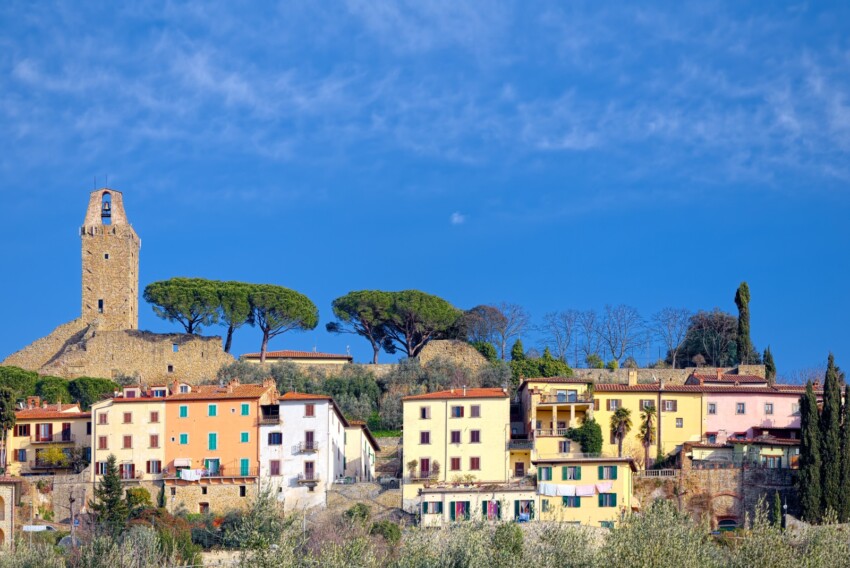
Recent archaeological excavations have uncovered sections of an Etruscan city wall (circa 4th century BC) made of large stone blocks, whilst earlier discoveries had revealed the remains of a city gate from the 4th century BC. Next to the Palazzo Pretorio, ongoing excavations reveal a sacred area that was in use from the end of the 5th century BC until the 2nd century AD.
As part of the transformations carried out by Bishop Guido Tarlati, around 1325 the Cassero was cleared of internal buildings to serve solely as a fortress, which was later completed by the Perugians; during their rule (1345–1368) the opening of the Porta del Soccorso (Relief Gate) on the western side of the walls is attributed to them, as well as the construction of the Muro dell’Ala to connect, via a walkway, the Cassero to the outer circle.
The Perugians around 1350 built or raised the Casseretto, a sort of smaller fortification within the larger one, and the tower also appears to date from this period, though it is clearly set upon an earlier base that should be contemporary with the lower part of the Casseretto itself.
This still presents itself as a square-plan structure of which the perimeter walls remain, featuring a round-arch portal, and here, just beyond the extremely deep well, is a narrow stone staircase that ends before a portal which provides access to the tall tower.
A wooden staircase, now renewed, leads to the top, allowing you to progressively discover the different aspects and construction stages: the opening that allowed access to the parapets of the Porta del Soccorso; the four large round-arch windows with small square openings; four loopholes; the mechanism of the 18th-century weighted clock.
In the upper part of the tower, where traces of the corbels supporting the balconies and crenellations remain visible, stands a gabled bell tower with a round-arch single window in which, in 1804, the large bell “Calfurnia” was placed; today it strikes the hours via an electric hammer to prevent the oscillations from compromising the stability of the structure.
During the 11th century the first nucleus of Castiglione developed here. At the time of Tarlati rule, the early decades of the 14th century, the area was developed into a proper fortress with the construction of the Casseretto in 1367 and the well in 1368. The Perugians connected the Casseretto to the outer circle of walls via the so-called “Muro dell’Ala”.
Subsequently the area became property of the Florentine Republic, which in 1421 sold it to the townspeople of Castiglione. In the 16th century, the nuns of San Girolamo used part of it for their convent. In the 19th century some structures were converted into prisons and in 1845 the portcullis and drawbridge over the eastern gate were demolished.
The palace was built around the middle of the 15th century on an ancient medieval building, to serve as a courthouse and jail. Currently, after restoration work, it houses the Municipal Library, whilst on the ground-floor rooms materials discovered during excavations in the Piazzale are on display. Notable among these is a decorated pediment cornice with lilies and rose buds, and polychrome terracotta antefixes in the shape of lion heads. Etruscan and Roman artefacts found in the vicinity of Castiglion Fiorentino are also on display. It is possible to visit these rooms through the Pinacoteca.
The Pinacoteca, besides the rooms used for exhibitions, includes the Church of Sant’Angelo. Records of a chapel dedicated to Sant’Angelo exist from the 12th century onwards. The church was built in Romanesque style between 1229 and 1239. In 1532 it was granted to the nuns of San Girolamo.
Significant modifications date from this period: the original orientation of the church was reversed, so much so that the original portal was closed and the entrance was moved to the southern side; in the original apse a “Choir of the Nuns” was built. Following the Leopoldine suppression of convents (1785), the church underwent various uses: hospital, wine cellar, workshop.
Inside you can admire a Painted Cross of the Umbrian School (second half of 13th century), two Panels by Jacopo del Sellaio (second half of 15th century), the Virgin and Child with Saints by Giorgio Vasari. From the church you proceed to the room where precious goldwork pieces are kept. Among these are the Reliquary of Sant’Orsola from the 14th century, a Staurotheca (late 12th–early 13th century) and a Holy Cross (circa 1260). From this room, via a staircase, you descend to the crypt of Sant’Angelo.
Returning to the entrance, you climb to the first floor, where in the large hall are displayed: a Painted Cross (early 13th century), a Saint Francis (13th century) by Margarito of Arezzo, a Madonna and Child (circa 1328) by Taddeo Gaddi, panels from the Sienese School, the Stigmata of Saint Francis (1486) and Saint Michael (circa 1480) by Bartolomeo della Gatta, a Madonna and Child with Saint John the Baptist (mid-16th century) from the workshop of Michele di Ridolfo del Ghirlandaio, a Madonna and Child with Saint Anne (first half of 16th century) by Papacello, the Ecstasy of Saint Teresa (1723) by Gian Domenico Ferretti.
In the showcase at the centre of the hall some Reliquaries and goldwork objects from the 13th to 16th centuries are kept. The upper floor is occupied by the Tower Room, with coats of arms and plaques found in the Cassero area, which offers splendid views of the Val di Chio.
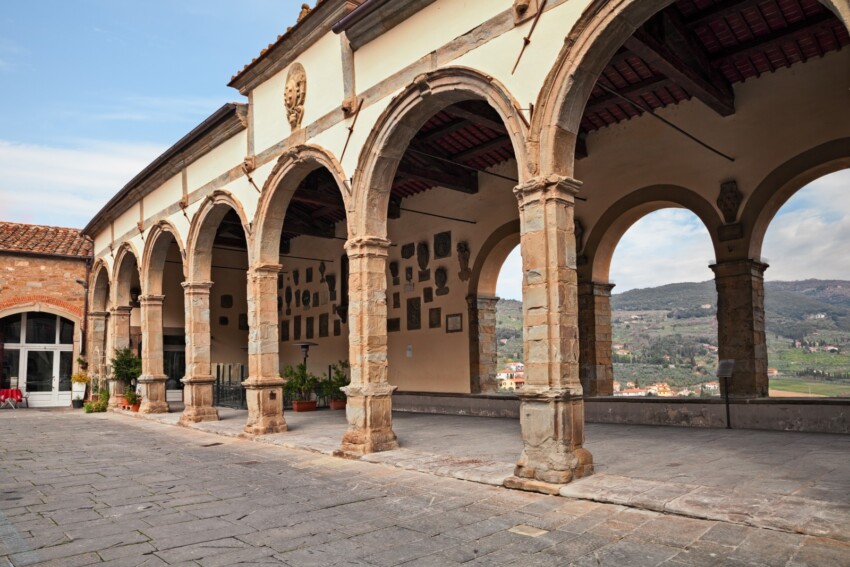
The nine-arched construction dates to 1513, as part of the redesign of the entire main square. The traditional attribution to Vasari is justified by the restoration work carried out between 1560 and 1570, the period when the Medici coat of arms was added. In 1773, for structural reasons, the three arches facing the Val di Chio were bricked up, then reopened in 1922.
The Church of San Francesco was built by the Franciscan friars on a previous church, beginning in 1256. The sandstone façade is the original: above the portal is a terracotta relief depicting Saint Francis, a work by the local artist Antonio Brogi (1946). The internal architectural layout displays the simplicity typical of Mendicant orders’ architecture.
Notable on the walls are:
Built during the 17th century in Tuscan Doric order, on a previous 13th-century cloister, it has a rectangular form. The ground floor consists of round-arch arcades and cross-vaulting, whilst the loggia of the upper floor is formed by columns supporting the eaves. The frescoes of the lunettes, heavily damaged, are by Pelliccioni da Colle and depict scenes from the Life of Saint Francis (1627).
What's the weather at Castiglion Fiorentino? Below are the temperatures and the weather forecast at Castiglion Fiorentino for the next few days.
To see all the facilities and book accommodation in Castiglion Fiorentino use the form below, entering the dates of your stay.
 Hotel
Hotel  Budget accommodations
  Apartments
  Family Hotel
  Luxury Hotel
  Resorts