Cortona Resort & Spa
Cortona - N. A. Campaccio 5/8
Book now
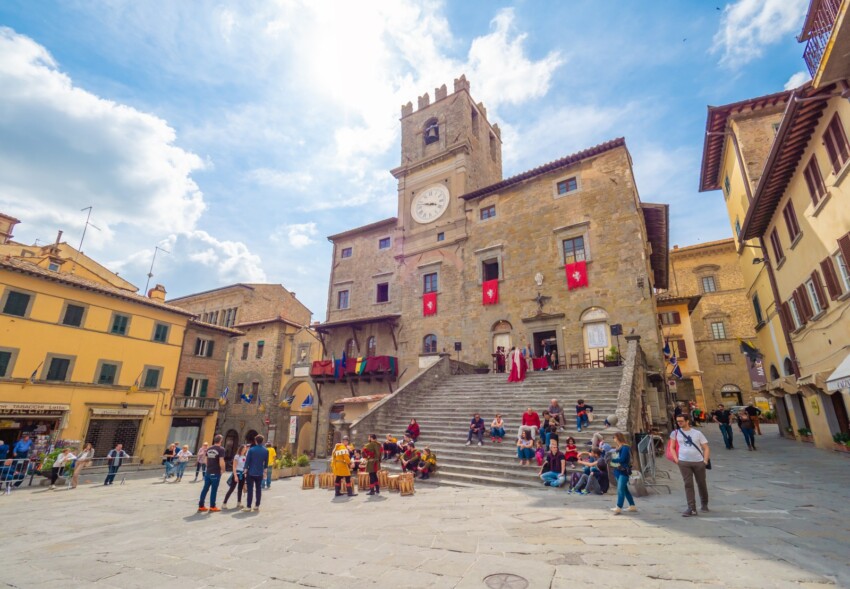
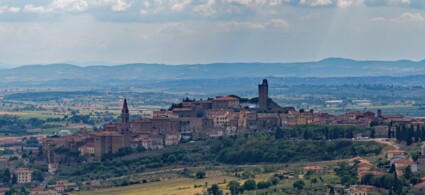
Perched on a hilltop at approximately 500 metres above sea level, commanding the Val di Chiana, Cortona is a medieval gem of Tuscany that deserves a visit. Located in the province of Arezzo, very close to the Umbrian border, a proximity that has even influenced the local dialect.
Cortona has appeared in numerous Italian films since the 1950s, but only gained international fame more recently as the filming location for scenes in Life Is Beautiful by Roberto Benigni (1997) and Under the Tuscan Sun by Audrey Wells (2003). The town also hosts a wealth of events that draw visitors from across Tuscany; the most important runs from July to September each year – Cortona on the Move, an international visual narrative festival.
From a tourism perspective, Cortona is a truly important destination for the entire province of Arezzo and the region as a whole, thanks to the abundance of sights in the centre and the beauty of the surrounding countryside.
There are truly plenty of things to see in Cortona. Fortunately, they’re almost all within the historic centre, which you can comfortably explore on foot as it’s very compact, although the streets are nearly all hilly. Here’s what’s worth visiting to leave thoroughly satisfied.
Begin your Cortona visit in its splendid historic centre, with its medieval character and excellent state of preservation. Its beating heart is the central Piazza della Repubblica, overlooked by elegant historic palaces, foremost among them the palazzo comunale (town hall), dating from the XII century, with its fine bell tower, and the palazzo del Capitano del Popolo (Palace of the People’s Captain), or palazzo Passerini, named after the family who long inhabited it.
Once the intersection of the two main streets of the Roman town, the cardo and decumano, Piazza della Repubblica is today undoubtedly the first thing to see in Cortona; several of the centre’s most important streets also branch from here, including via Guelfa, via Ghibellina and via Nazionale.
In Piazza Signorelli, adjacent to Piazza della Repubblica, you’ll find the fascinating MAEC museum, dedicated to Etruscan art. The unique feature of the exhibition is its location in the underground chambers of a thirteenth-century palazzo. The collections are of considerable historical and artistic value, and alongside an extensive section devoted to the Etruscans, who lived here for nearly 1,000 years, there are also artefacts from the Roman period, plus a section dedicated to ancient Egypt where you can find two mummies.
The jewel of the MAEC is undoubtedly the Tabula Cortonensis, a bronze tablet dating from the II century BC recording the sale of agricultural land. Also of great interest are the artefacts recovered from ancient Etruscan tombs in Cortona, including statues and burial furnishings, with bronze objects, vases and oil lamps.
Entry to the MAEC requires a ticket – full price, concession or combined ticket, which also includes access to the archaeological area. The museum is open daily from 10 to 19.
Taking via Santucci and via Berrettini from Piazza della Repubblica, you’ll reach this haven of peace that is the San Francesco Convent, another essential sight in Cortona; be sure to enjoy the interior, where you can admire splendid paintings and ancient frescoes.
The church, built in Italian Gothic style with a single nave, is rich in works of art and relics, including the remains of Brother Elias, exhumed for scholarly purposes in 1966. Also striking is the Annunciation painting by Pietro da Cortona, created in the mid-17th century for the local nobleman Antonio Alfieri.
The church is maintained by Franciscan friars; the convent houses some relics of St Francis of Assisi, including a habit, a pillow and a gospel book.
The Cortona Cathedral, officially the Concattedrale di Santa Maria Assunta, is the city’s most important church. Built in Romanesque style from the XI century onwards, it was completed about 400 years later, when it was declared a Cathedral by Pope Julius II.
The exterior is striking for its austere yet intriguing façade in medieval Romanesque style, whilst on the right side there’s a 16th-century extension, a loggia completed by a pietra serena (local stone) portal. The bell tower was built later, designed by Francesco Laparelli.
Once inside, the Cortona Cathedral presents itself as a Renaissance church, with a fine barrel vault covering the central nave; the division between naves is created by splendid columns with capitals, inspired by Brunelleschi. Among works worth visiting, the funerary statue of Giovanni Battista Tommasi, last Grand Master of the Sovereign Military Order of Malta, a native of Cortona, stands out, along with the Transfiguration by Raffaello Vanni and a Madonna and Child dating from the 16th century, though of unknown artist.
Among Cortona’s many churches, besides the cathedral, we mention the Basilica of Santa Margherita, dedicated to the city’s patroness. It’s a most evocative church, with a façade featuring three portals and a large rose window at its centre; altogether it creates a very harmonious ensemble, undoubtedly making it one of the city’s most beautiful monuments.
The basilica’s interior is also interesting and certainly worthy of a visit, if only to see the marble funerary monument to Santa Margherita, who rests in the centre of the basilica above the high altar. The ceilings are particularly striking, painted a vivid blue, whilst the plaster statues of St Francis, St Louis, St Elizabeth and St Clare, positioned on corresponding pillars, lend the church an impressive air.
The Church of San Benedetto is one of the places you mustn’t miss when visiting Cortona, due to its truly unique form with an elliptical floor plan. Set in a highly scenic setting, it has a round façade without render, with exposed brick, three large frameless windows and a fourth positioned above the entrance door.
Inside, the wealth of decoration is astonishing: stuccos and marbles make the interior of the Church of San Benedetto truly evocative. Of interest is the statue of Christ Flagellated, positioned at the central altar, dating from the 17th century.
Below the town of Cortona lies the Sodo Archaeological Area, within the Cortona Archaeological Park. Here you can observe three Etruscan tumuli (burial mounds), informally known as “melons” because of their shape; they are called Tumulus I, Tumulus II and the Tumulus of Camucia.
Of these, Tumulus II is the largest and most interesting: state-owned, it has a diameter of 64 metres and a series of tombs and minor burials. Tumulus I is managed by the park operators and is the oldest, dating to around the VII century BC; the Tumulus of Camucia is located a few kilometres further south, is the smallest and is only visitable by appointment.
It’s possible to enter inside the tombs, but the artefacts they originally contained have been moved to the MAEC museum in central Cortona.
In the following map you can see the location of the main places of interest mentioned in this article.
Cortona’s historic centre is full of bed and breakfasts, hotels and apartments where you can stay. Choosing accommodation in the centre is the right choice for being very close to the city’s main points of interest and having a wide range of restaurants for dinner, plus bars for aperitivos and shops for shopping within easy reach. On the other hand, Cortona’s centre is entirely pedestrian, with steep hilly streets, and therefore isn’t ideal if you arrive with lots of luggage.
In such cases, it might be better to choose accommodation outside the centre for maximum convenience when parking your car, and reach the town either by public transport or by car, parking it in the equipped car parks just outside the city gates. Outside Cortona’s centre there are indeed many beautiful facilities, including farm stays and resorts with swimming pools, overlooking the beautiful Tuscan countryside.
Cortona is quite straightforward to reach by car, being well served by the A1 Milan-Naples motorway. The relevant exit is Valdichiana, from which Cortona’s centre is approximately 20 minutes away, first taking the A1 Bettolle-Perugia motorway link, then the provincial road SP32.
The distance from Florence is approximately 120 kilometres, covered in an hour and a half, whilst from Pisa it takes just over 2 hours and 20 minutes. Given its location, Cortona is also easy to reach from the south: from Rome, for example, it takes only 2 hours and 15 minutes, including time to navigate the capital’s traffic.
Reaching Cortona by public transport is very straightforward, as it’s located near the Florence-Rome railway line. To be precise, the town is served by two stations: Terontola-Cortona, the larger of the two, where intercity trains also stop, and Camucia-Cortona, where only regional trains stop. Once you’ve left the train, whichever station you’ve used, you can easily reach the town centre by taking buses operated by Etruria Mobilità.
What's the weather at Cortona? Below are the temperatures and the weather forecast at Cortona for the next few days.
 Hotel
Hotel  Budget accommodations
  Apartments
  Family Hotel
  Luxury Hotel
  Resorts