Hotel Forum
Foiano della Chiana - Via Farniole 37
Book now
The Municipality of Foiano bears in its coat of arms a “golden Florentine lily on a red field”. The earliest documented record of Foiano’s heraldic arms, “the Florentine lily without leaves”, dates to the 15th century and is represented by a fine bronze seal preserved at Arezzo’s State Museum of Medieval and Modern Art. In 1453, the Republic of Florence granted the territory of Foiano the right to bear Florence’s own coat of arms and the title of “nobiles viri”, in recognition of the steadfast resistance shown by the people of Foiano during the lengthy siege of their castle by Neapolitan forces the previous year. According to some historians, the symbol also alludes to the ancient name of the place, recorded as “Floriano”.
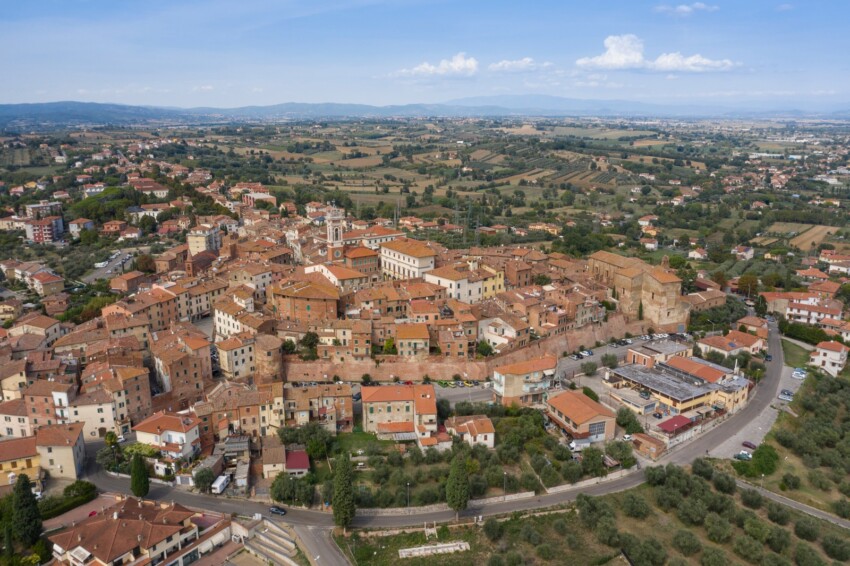
The historic centre, enclosed by two rings of walls, bears the hallmarks of Renaissance art. Worth visiting are the Church of SS. Trinità, which houses a canvas by Pomarancio, and the 15th-century Church of Santa Maria della Fraternita, which preserves a glazed terracotta attributed to Luca and Andrea della Robbia. Beyond the first circle of walls stands the Collegiata di San Martino, featuring a panel depicting the Coronation of the Virgin with Angels and Saints, a late work by Luca Signorelli, and a glazed terracotta, Madonna della Cintola, attributed to Andrea della Robbia. A few kilometres from the historic centre, towards Pozzo della Chiana, rises the isolated Temple of Santo Stefano della Vittoria, dating from the 16th century, commissioned by Cosimo I as a symbol of victory over the Sienese in the Battle of Scannagallo. The historic centre of Foiano becomes the stage for one of Italy’s oldest Carnivals during February and March.
Built in the late 15th century, it houses an altarpiece in terracotta by Andrea della Robbia.
Built in the 16th-18th centuries, it preserves a glazed terracotta by Andrea della Robbia, Madonna della Cintola, and a Coronation of the Virgin and Saints by Luca Signorelli.
A few kilometres from the historic centre, towards Pozzo della Chiana, stands the isolated Temple of Santo Stefano della Vittoria, a 16th-century building commissioned by Cosimo I as a symbol of victory over the Sienese in the Battle of Scannagallo.
Built in the 15th century and reworked in the 17th, it preserves a Madonna of the Rosary by Lorenzo Lippi (17th century) and a terracotta by Andrea and Giovanni della Robbia depicting the Ascension.
Dating from the 16th century, with a coffered ceiling of fine craftsmanship, it houses a glazed terracotta by Andrea della Robbia, Madonna with Child.
Originally a small oratory, the church was rebuilt in the 16th century and enlarged in the 17th century.
To see all the facilities and book accommodation in Foiano della Chiana use the form below, entering the dates of your stay.
 Hotel
Hotel  Budget accommodations
  Apartments
  Family Hotel
  Luxury Hotel
  Resorts