Relais Villa Belpoggio
Loro Ciuffenna - Via Setteponti Ponente 40
Book now
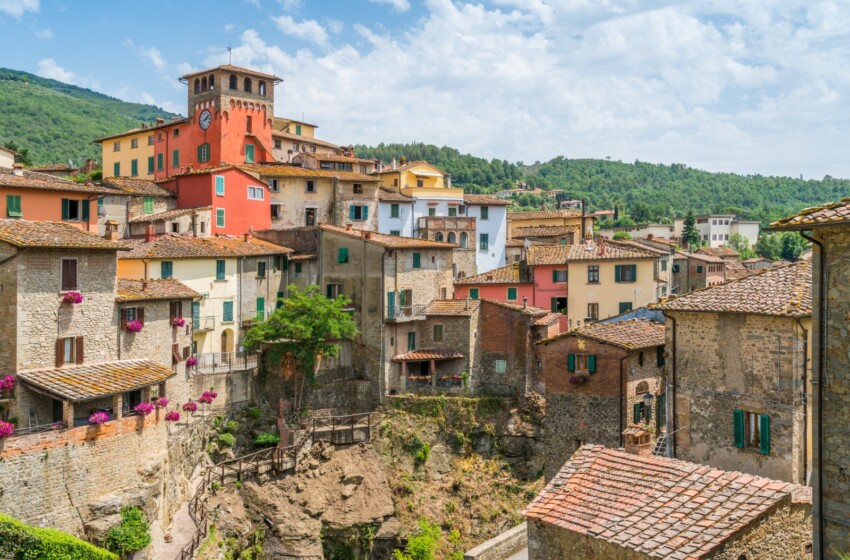
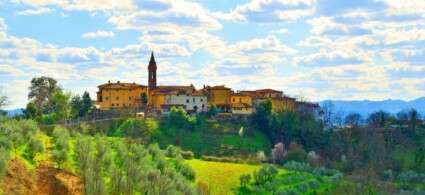
The castle of Loro (328 m) is first documented in the early second millennium, in a document from 1065. It was a fortified borough at the confluence of two streams, crossed by two bridges corresponding to two gates in the perimeter walls: one, buried in the mid-20th century and recently rediscovered by a flood, crossed the rio della Madonna; the other, still clearly visible and passable today, with its high arch above the Ciuffenna which runs in the gorge below the town; both allowed the route of the ancient Via Cassia to skirt and then cross the castle during the Middle Ages, continuing towards Pian di Sco and later Castelfranco and Terranova. Of the castle’s medieval fortifications, traces remain embedded in the buildings overlooking Piazza dello Scoglio, in one of which a gate topped by a tower is still visible: exiting from this, the road led to the old bridge, near which traces of the customs officer’s barracks are still visible across the river. In later times the borough continued to expand towards the old bridge and the river, forming the Fondaccio settlement – the name seems to derive from fondaco, referring to merchants’ warehouses with houses built above them – leading to the opening of postern gates in the perimeter walls, still visible. The gate visible today and the tower upon it – partially rebuilt in 19th-century style – belong to a gradual urban restructuring over the centuries, when the defensive function had become obsolete with the establishment of Florentine peace.
The settlement is documented as early as 939, when its possession was donated to the Abbey of Santa Fiora by a deed of Kings Hugo and Lothair, later confirmed in 996 by Otto III and in 1022 by Henry II. At the centre of a substantial crown of castles and fortresses positioned on the slopes of Pratomagno – allies more or less loyal, or adversaries, depending on circumstances – it was first ruled by the restless Valdarno nobles – the Ubertini, the Guidi – and finally by the Commune of Florence; and it was always caught up in intrigues and wars, until the definitive establishment of Florentine power (1293–1306). As a Commune, the statutes of 1462 – subsequently reformed – are preserved at the Florence State Archive. In 1646 the Grand Duke of Tuscany Ferdinand II conferred the fief of Loro with the title of marquis to Piero Capponi; the fief remained with the family until 1665, when it returned to grand ducal possession.
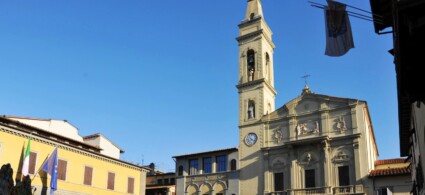
In the medieval layout, the fortress held great importance, located where the parish church of Santa Maria Assunta now stands in the upper part of the town; the church, originally smaller and arranged perpendicular to its current position, was enlarged – perhaps following destruction or partial collapse, as can be observed in many medieval buildings in the area – occupying part of the original fortress, no longer necessary in the new political arrangement: its imposing presence remains perceptible, despite the stately buildings subsequently constructed on the mountainside. The church square is occupied on one side by its right wall, in which opens the entrance gate – set to the side of the building – corresponding to the gate of the original church; the latter occupies the far end of the current church, and the apse constitutes the baptismal chapel.
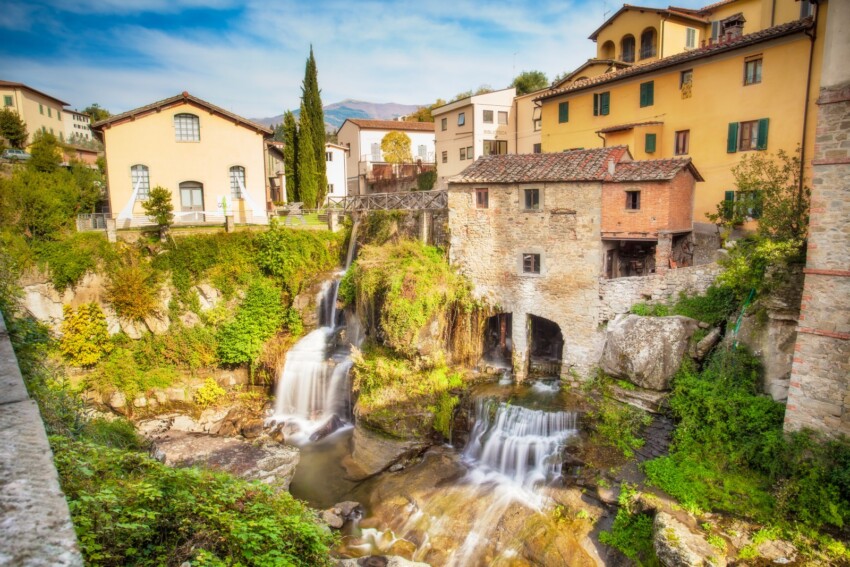
A mill, still in operation, must have served the Loro population since ancient times: it is located right in the town, as is a more recent silk mill, now home to the municipal Media Library. The ancient borough retains its original characteristics, which the restoration work certainly highlights. The town has developed further outside its walls since centuries past: just outside the gate stands the Municipal Palace – with the Venturino Venturi Museum and the civic Library – and the true town centre. A new bridge has recently replaced the old one, on which vehicle traffic has now been prohibited, and overall urban restructuring has been completed, creating entirely new neighbourhoods. The mountain and hill hamlets have gradually emptied out – second homes of many Loro natives remain there – with residents moving to the main town for easier access to workplaces in the vibrant and flourishing Valdarno area.
Just outside Loro, on the Seven Bridges road towards San Giustino, a right turning 1,300 m along, which after 800 m from the junction encounters on the left a paved section of the Via Cassia, leads to the village of Gropina (381 m). The earliest mention of San Pietro a Gropina is found in a deed of donation – apocryphal but testifying to a real event – to the abbot of the Nonantola monastery in Emilia, of the church of Gropina and its possessions, by Charlemagne in the year 780. The first authentic document, however, dates from 1016. In 1191 Henry VI granted the entire territory of San Piero di Gropina to the Guidi, who held it until 1316.
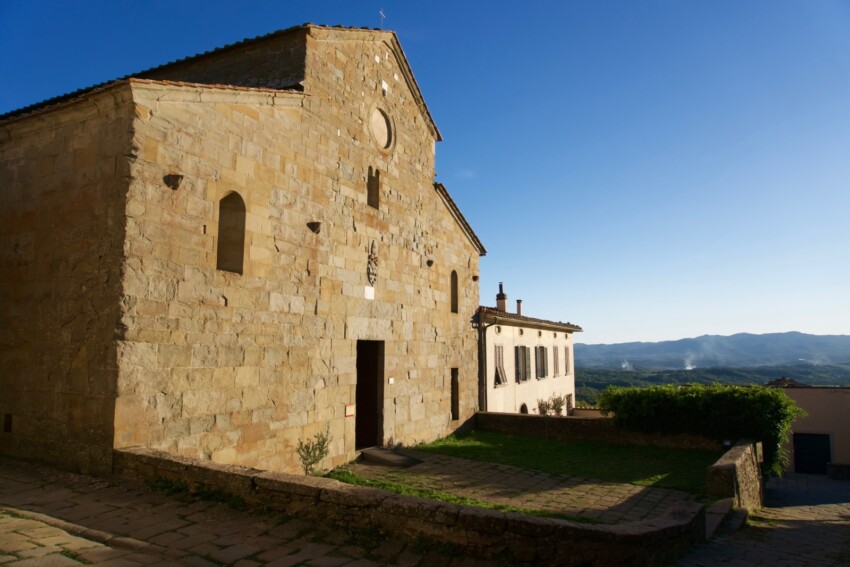
Towards the end of the 15th century Innocent VIII had granted the Gropina pieve as a benefice to Agnolo Poliziano; Leo X transferred it in 1515 to the Chapter of Florence Cathedral. The façade is built in large, well-ordered stone blocks, though they show signs of later modifications and restoration: indeed, the entrance gate itself and the biforate window above it appear misaligned with respect to the circular window and the cusp, just as the two single-light windows corresponding to the side aisles seem inconsistent with the overall design. On the door’s architrave is the date 1422, probably relating to one of the restoration works. The seraph carved there dates to the period of the pieve’s transfer to the Florence Chapter; the coat of arms of Leo X above the architrave bears the date 1522.
The interior is divided into three aisles with an apse adorned by two rows of small arches supported by extremely elegant small columns. The aisles are divided by two rows of columns with sculpted and figured capitals: on the left-hand columns episodes from the Old and New Testament are depicted, appearing less archaic than those on the right-hand columns, which recall pre-Christian, Etruscan and Oriental art. The central aisle is twice the size of the side aisles, though the left one is slightly wider than the right, and is roofed with a gabled roof supported by timber trusses. The apse has three single-light windows and six oculi, through which filters a soft light. In the right aisle of the church, a staircase allows access to the undercroft, made accessible after floor restoration work in the church revealed the foundations of pre-existing buildings, specifically of two successive smaller churches, one with a single aisle and one appearing to have two aisles with two unaligned apses and remains of Roman and Longobard buildings.
Leaning against a column of the right aisle is the celebrated circular pulpit, with its richly sculpted decorations in grey pietra serena stone, supported by two fluted columns, a motif that also appears in the central column of the external decoration of the apse, which repeats the internal arrangement of small arches supported by columns with caryatids supporting the platform. The exterior continues the severe style of the interior, with an extremely elegant apse and a squat bell tower, possibly built on a Longobard tower foundation. Against the right wall of the church is the rectory, now showing 17th-century forms, but at the rear displaying a small Romanesque-style door set against the bell tower. Above the external apse, a clear offset in the gabled roof’s ridge is visible, evidence of ancient collapse or subsidence events. The whole constitutes a monument of absolute quality and immediate legibility, rightly making it the focal point of the entire area.
It is the most important hamlet of the municipality, situated at its far end towards Castiglion Fibocchi and Arezzo, on the Seven Bridges road, not far from the junction with the Casentino road. Its origins date back to the 12th century, when the pieve that had previously been located along the old Via Cassia was rebuilt at its current location.
In San Giustino the Festival of Forgiveness is celebrated annually on the third Sunday in July. There are also active craft workshops specialising in goldwork and ceramics, and several farms that sell their products directly.
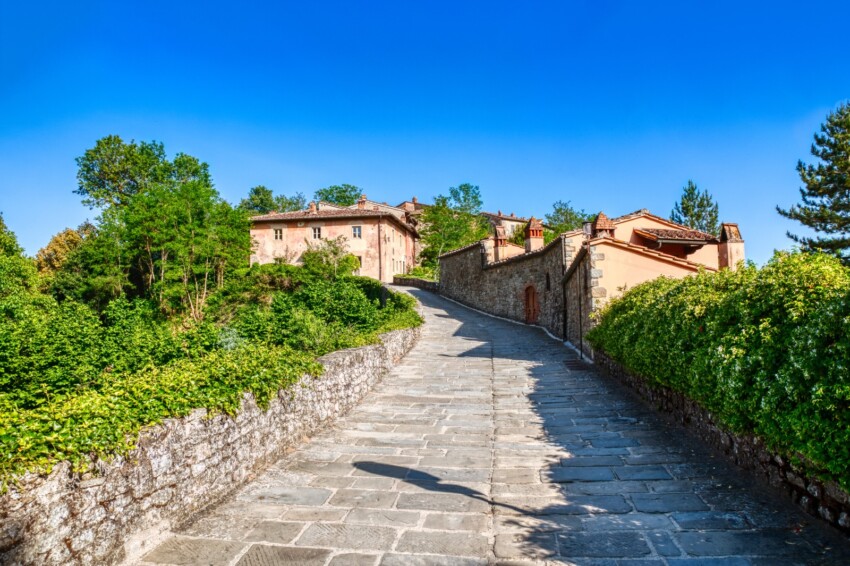
This ancient fortified borough, with houses built in mixed masonry of stone and brick, surrounded by natural ditches – accessed, as it still is, by a bridge now made of stone, previously of wood – is documented as early as 1039, and we see it actively involved in the complex events of history and warfare that affected the castles of the Loro area and Valdarno, oscillating between Arezzo and Florence influence, to which they had to yield in 1344. Even then it had no peaceful existence until 1384, when the Florentines conquered Arezzo, bringing all the castles between the two cities under their control. The Medici grand dukes invested it as a fief in 1644 to Alessandro dal Borro with the title of marquis, so the castle returned, after centuries, to the family that had anciently possessed it. It subsequently passed to the Capponi, the Medici Tornaquinci, the Della Torre, the Hohenlohe, and most recently to the House of Savoy-Aosta. Today it has been purchased, together with the Borro estate, by Salvatore Ferragamo.
Of the fortified perimeter wall little remains but a few ruins; access to the castle was via a steep road, ending at the drawbridge mentioned, beneath which the Via Cassia is said to have passed, of which a section of the route still appears not far away, on the uphill stretch towards the plateau overlooking Castiglion Fibocchi.
The parish church of San Biagio is documented at least from 1344, when its inhabitants gathered there to decide on submission to Florence. Belonging to the San Giustino pieve, the San Biagio parish depended on a now-vanished church of Sant’Apollinare near Monticello, along the Via Cassia route, documented at least from 1390, whose foundations were discovered in the mid-19th century; as well as the church dedicated to the Holy Martyrs Hippolytus and Cassian, in the Politi locality. In the castle is the oratory of Santa Maria Maddalena – to which an infirmary with two beds, one for women and one for men, was formerly attached – richly endowed; and the Confraternity church, with a 16th-century painting and a 17th-century processional cross.
In the borough – besides groceries and household goods shops, gift items, antiques – there is an alley with workshops of goldsmiths and ceramicists. In some ancient rooms, an animated story of Pinocchio and a nativity scene are displayed.
What's the weather at Loro Ciuffenna? Below are the temperatures and the weather forecast at Loro Ciuffenna for the next few days.
To see all the facilities and book accommodation in Loro Ciuffenna use the form below, entering the dates of your stay.
 Hotel
Hotel  Budget accommodations
  Apartments
  Family Hotel
  Luxury Hotel
  Resorts