Il Baraccotto
Lucignano - Via Mario Luzi, 1
Book now
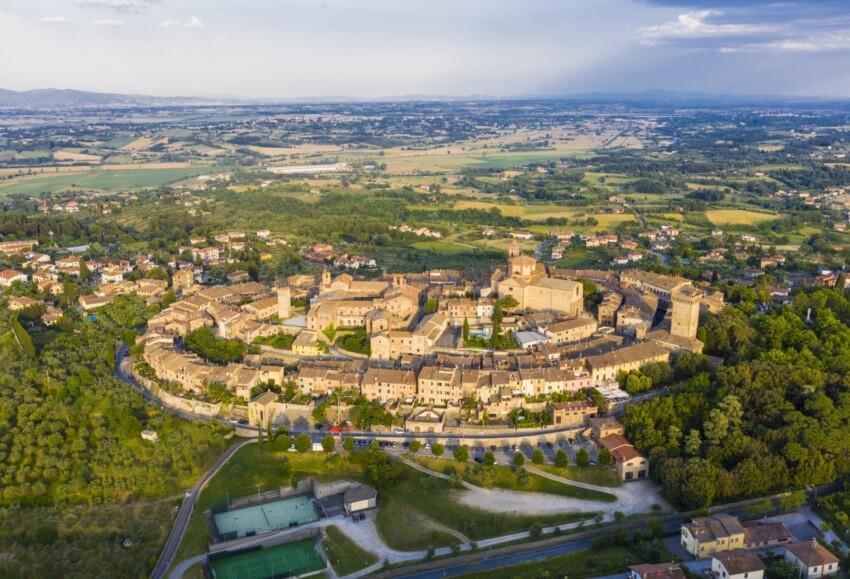
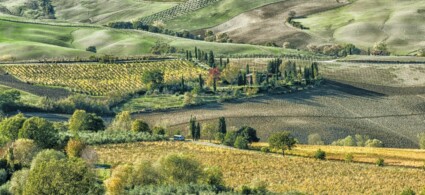
Lucignano is one of Tuscany’s most fascinating towns, notable for its distinctive elliptical castle layout, encircled by walls and towers. Located in Arezzo province, south of the provincial capital, the beauty of its surroundings alone justifies a visit.
The ancient village is part of the Most Beautiful Villages in Italy association and has earned the Orange Flag award from Touring Club Italiano. It’s a charming place to explore and developed during the medieval period thanks to its strategic hilltop location at 414 metres, commanding views over the Valdichiana and the main road connecting Siena and Arezzo – which made it constantly hotly contested. Walking through the perfectly preserved streets, you’ll admire the Town Hall, dating from the 13th century, which houses a splendid museum featuring paintings from the Sienese and Aretine schools, along with several churches and civic buildings.
The creativity and ingenuity of Lucignano’s residents shine through each spring during the Maggiolata Lucignanese festival, where the sounds and colours of flowers bring a richly historic and musical tradition back to life.
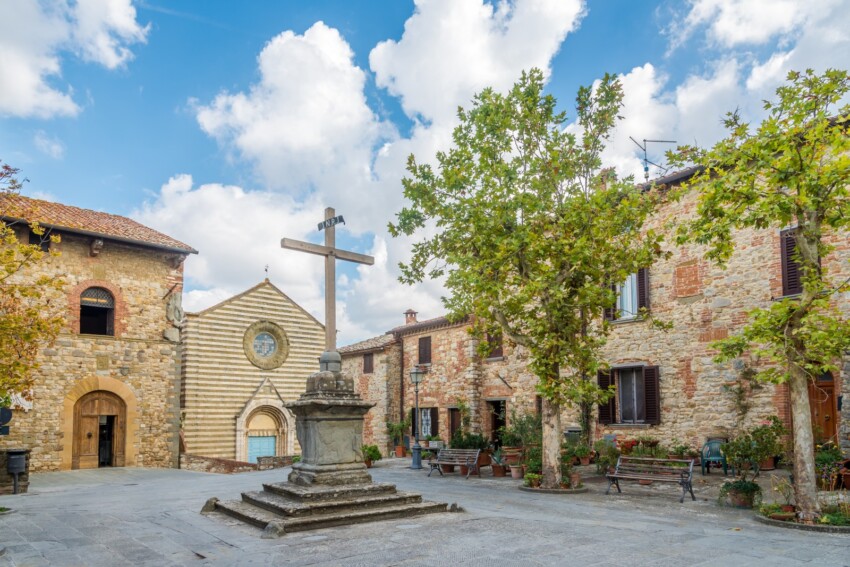
Despite being a tiny village, Lucignano offers plenty of interest for visitors. Here are the main attractions.
The Lucignano Municipal Museum is housed on the ground floor of the Town Hall. You enter through the palace’s entrance hall via a door leading into a barrel-vaulted corridor, off which open two connected side rooms and a former tribunal chancellery chamber.
It contains a wealth of artworks. For example, a display case near the corridor’s end showcases various sacred objects: a silver censer and incense boat dated 1628, from the Madonna della Querce Sanctuary; a bone and wood-inlaid casket from the Church of San Francesco; a 14th-century panel depicting a Madonna in Majesty, from Sant’Anna Hospital; and a wooden cross painted on both sides (16th century). On the rear wall hangs an oval canvas of unknown authorship depicting St Catherine of Siena in the Tuscan style, datable to the mid-18th century.
Particularly striking is the so-called Tree of Lucignano, a 14th-15th century reliquary standing over 2 metres tall from the Church of San Francesco. From a central trunk extend 12 branches, six on each side, topped by a Crucifix and a pelican. The branches are adorned with decorated leaves and small reliquary shrines, with medallions at their tips that once held miniatures and rock crystals, rimmed with coral sprigs representing Christ’s blood. The tree’s appeal lies in its uniqueness – an exceptional example of Sienese-Aretine goldwork crafted by Ugolino da Vieri and Gabriello D’Antonio.
Built to designs by Orazio Porta in the 16th century, the Collegiate Church of San Michele Arcangelo on Via San Giuseppe houses works by 16th and 17th-century artists including Giacinto Gimignani and Matteo Rosselli, a fine marble altar designed by Andrea Pozzo, and a splendid 14th-century wooden crucifix.
Curiously, its façade was never completed, so to this day only the lower section is finished, with the stonework still proudly visible in the upper part.
The Church of San Francesco sits in its namesake piazza and was built in the 13th century in the Gothic style. The interior is beautifully decorated with outstanding frescoes by Sienese artists from the 14th and 15th centuries, including Taddeo di Bartolo and Bartolo di Fredi.
Among the earliest and most striking frescoes is the scene on the right nave wall of the Triumph of Death, a work by Bartolo di Fredi.
A walk around the ancient medieval walls is essential during your visit to Lucignano. Built in the 14th century, they remain in excellent condition, encircling the historic centre in an elliptical shape. Three gates provide access: the two main ones being Porta San Giovanni and Porta San Giusto, whilst the third gate, simply known as Porta Murata, was closed for many years before reopening to visitors in recent times.
Within the historic village of Lucignano there are a handful of places to stay, mostly period residences, apartments and bed and breakfasts. They share the characteristic of being converted from ancient houses or historic palaces, and are tastefully renovated in classical medieval style, with period furnishings, flooring and ceilings.
Of course, they’re equipped with all modern comforts, but if you’re seeking something different for your Tuscany holiday, venture a few kilometres beyond the historic centre and you’ll find numerous country villas, farm stays and rural properties, many with extensive grounds, swimming pools and in-house restaurants.
Conventional hotels are almost entirely absent. You’ll need to travel several kilometres to find them, towards Foiano della Chiana or Monte San Savino.
Despite appearing quite remote, Lucignano is conveniently connected to the rest of Tuscany thanks to its proximity to the A1 motorway. It sits roughly equidistant from two junction points: Monte San Savino (for travellers from the north) and Valdichiana-Bettolle-Sinalunga (for those from the south).
From Florence for instance, it takes just over an hour, taking the A1 motorway to Monte San Savino, then continuing along provincial road SP19 to Lucignano. From Tuscany’s coastal cities, such as Pisa or Livorno, the journey takes around 2 hours: you arrive in Florence first, then proceed as already described.
From Arezzo to visit Lucignano, allow approximately half an hour, following the Grosseto-Fano state road.
Lucignano is also easily accessible by public transport, being connected to Arezzo via bus 138 departing from the central station, so it’s simply a matter of arriving in Arezzo by train and continuing by bus, which takes just over 30 minutes.
From the 13th to 16th centuries, Lucignano changed hands repeatedly between Siena, Arezzo, Florence and Perugia – from which it received the honour of bearing the Winged Griffin coat of arms, to which a star was added. The name ‘Lucignano’ probably derives from a Roman fort founded by consul Licinius of the eponymous family, becoming Lucinianum after Lucius Sulla’s conquest in the 1st century BC; the settlement’s antiquity is confirmed by significant Etruscan archaeological finds discovered throughout the area.
The hilltop where the original castle stood was gradually transformed into the centre of political and religious power. In 1371, under Sienese rule, fortification work was completed with the finishing of the defensive perimeter wall, substantial sections and towers of which remain, along with three gates: Porta San Giusto, Porta San Giovanni and the so-called Porta Murata. A few years later, the Rocca, or Sienese Citadel, was constructed.
The Rocca is square in form and was built by Bartolo Bartoli astride the city walls to reinforce the town’s defences. From its steeply scarped walls rises a formidable and towering square tower, equipped with projecting defensive apparatus, whilst a smaller tower, also with crenellated parapet, rises from the north-east corner, overlooking the city and the Collegiate Church below. The complex is privately owned and undergoing restoration [it previously housed a cinema] with work well advanced.
In 1554 Lucignano passed under Medici rule and major urban development began, including the construction of the Fortress, commissioned by Cosimo I in 1558 and attributed to Bernardo Puccini, the Madonna della Querce sanctuary, attributed to Vasari and sited outside the historic centre (1568), the Capuchin friars’ convent (1580), and the churches of Misericordia (1582) and the Collegiate (1594).
The Fortress, standing isolated [today opposite the new cemetery] on the hill opposite the urban settlement, comprises two unequal bastions facing Siena and connected by a curtain wall [the round towers rising above were later additions for windmills]. The whole is built in loose stonework except for the transition ring between the sloping base and the vertical wall, which is of limited extent. Construction remained unfinished and today the structure is in poor condition and partially overgrown with vegetation.
What's the weather at Lucignano? Below are the temperatures and the weather forecast at Lucignano for the next few days.
Lucignano lies in the province of Arezzo, several kilometres south of the provincial capital, not far from Monte San Savino and Foiano della Chiana.
 Hotel
Hotel  Budget accommodations
  Apartments
  Family Hotel
  Luxury Hotel
  Resorts