DormiVeglia B&B
Monte San Savino - Via Aretina, 12
Book now
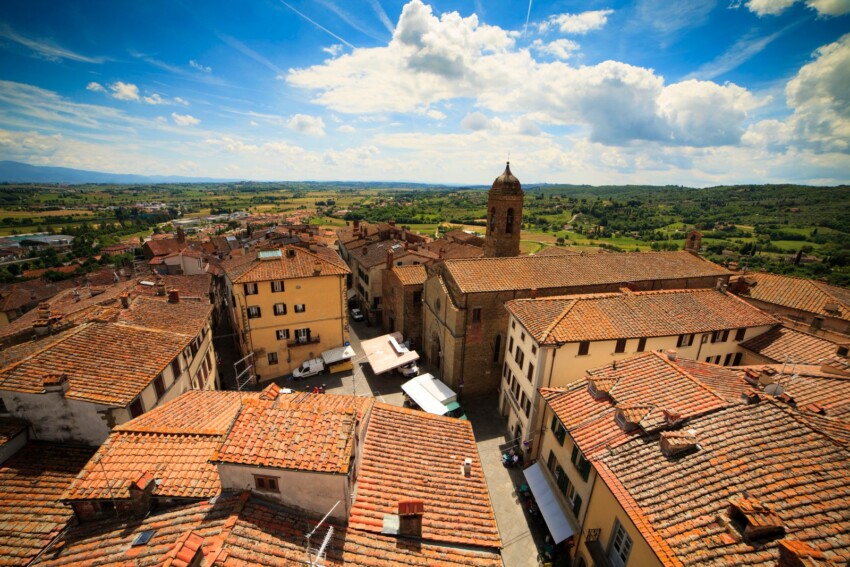
This is the birthplace of the great Renaissance sculptor Andrea Contucci, known as Sansovino, and of Pope Julius III. The historic centre develops from the Cassero, an ancient fourteenth-century fortress, then along Corso Sangallo, flanked by the Renaissance Logge dei Mercanti attributed to Sansovino, the Palazzo di Monte, now home to the Town Hall, the Palazzo Pretorio with its tower, the Pieve and the church of Sant’Agostino, which houses a beautiful Assumption by Giorgio Vasari. Not far from the historic centre stands the Sanctuary of Santa Maria delle Vertighe, a church documented as early as the eleventh century. A notable summer event is the Popular Theatre Festival “Il Giogo”, held annually in Montagnano during July.
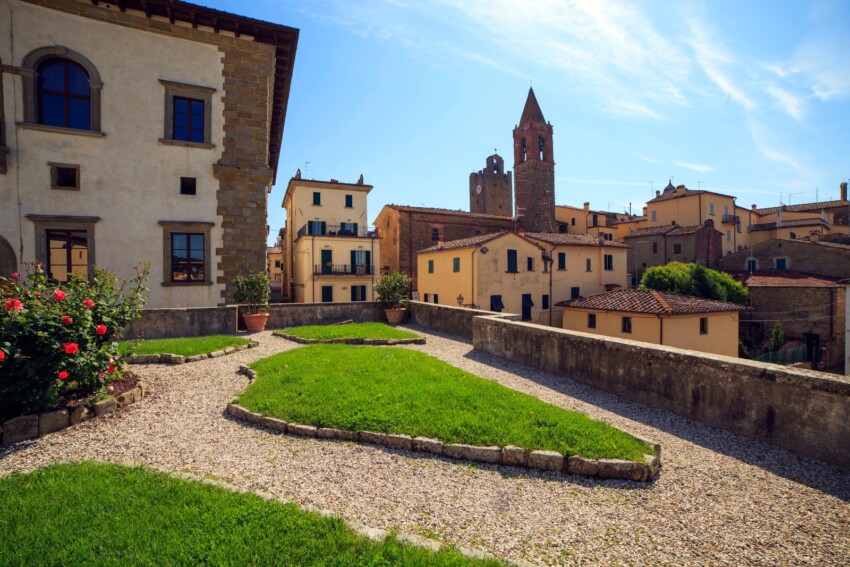
The Palazzo di Monte (the town hall) features rusticated pietra serena stone on the ground floor and Ionic order on the first floor, with windows topped by triangular and curved pediments. The internal courtyard with its three-arched loggia has two distinctive wells. The rear section, overlooking an attractive hanging garden, is of a later date: commissioned by Giovanni Maria Di Monte, nephew of Antonio, it is the work of Nanni di Baccio Bigio. Inside the palace, once magnificently furnished, you’ll find a precious sixteenth-century door carved by Fra’ Giovanni da Verona, now in the Council Chamber (which is decorated with frescoes of the coats of arms of the most notable Savinese families), and along the corridors of the upper floor, a small gallery of portraits of illustrious figures from Monte San Savino and members of Tuscany’s ruling families, with the oldest works dating back to the mid-seventeenth century.
The Cassero is the fortress (fourteenth century) of the ancient citadel, a sturdy three-storey structure with four turrets and a keep, once surrounded by a moat, now incorporated into more recently built structures. On the façade, above the entrance portal, is the Florentine lily (1384).
Over the centuries it served as the seat of the Monte Pio and later as a poorhouse. Inside, perfectly preserved and restored during the 1970s, you’ll find various works of sculpture, a Museum of Popular Ceramics, exhibition spaces for temporary shows and a conference room.
Built by the Perugians in the fourteenth century, it currently houses the headquarters of the International University.
Built in the mid-fifteenth century, it houses an interesting panel by Margarito and Ristoro d’Arezzo, depicting the Madonna and Child enthroned with four scenes from the life of the Virgin (thirteenth century).
Two other important religious buildings in Monte San Savino overlook Piazza Di Monte: the church of Sant’Agostino and the baptistry of San Giovanni. Built in the fourteenth century in Gothic-Umbrian style by the Augustinians, the church of Sant’Agostino underwent various alterations over the centuries, including one by Sansovino who in 1525 added a Gothic-style choir loft to the counter-façade. The interior contains numerous artworks: first and foremost, a beautiful rose window with stained glass by G. de Marcillat depicting Sant’Agostino; at the high altar, a signed Assumption by Vasari; various paintings by Orazio Porta including a Nativity and an Adoration of the Magi; fifteenth-century frescoes on the counter-façade and side walls by Giovanni d’Agnolo di Balduccio and P. Schiavo. On the left wall of the nave you can see Sansovino’s tombstone, he was buried in this church (1529).
The design of the adjoining cloister is also attributed to Sansovino, executed with great skill by the artist who, despite working on a highly irregular plan, managed to create an admirable harmony and composed architectural forms. The portal of the Baptistry of San Giovanni is also Sansovino’s work, originally the church of the Confraternity of the Black Penitents: executed in Doric style, the portal (and thus the entrance to the oratory) was originally located inside the cloister and only after 1583 was its orientation changed. Inside the church are Late Mannerist works by local painters Orazio Porta and Ulisse Giocchi.
The church probably arose at the end of the twelfth century and was completely rebuilt in the eighteenth century. Inside you can see the tomb of Fabiano del Monte, a sculpture attributed to the local artist Andrea Sansovino (sixteenth century).
To see all the facilities and book accommodation in Montesansavino use the form below, entering the dates of your stay.
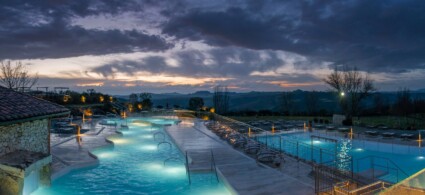
 Hotel
Hotel 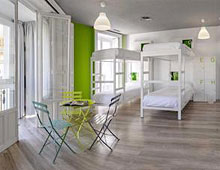 Budget accommodations
  Apartments
  Family Hotel
 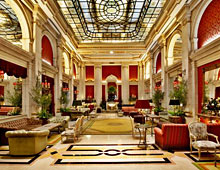 Luxury Hotel
 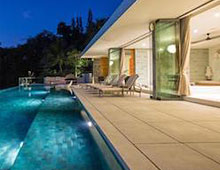 Resorts