Albergo San Lorenzo
Poppi - Piazza Bordoni 2-5
Book now
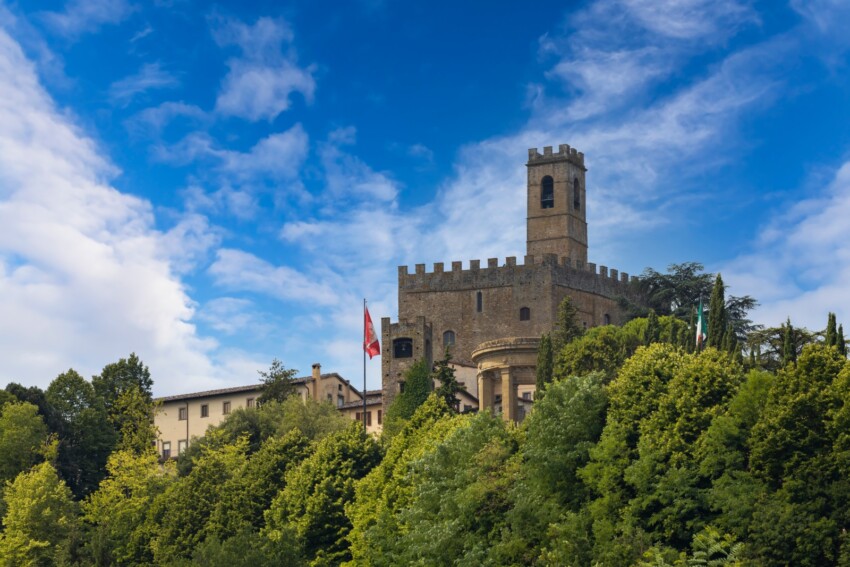
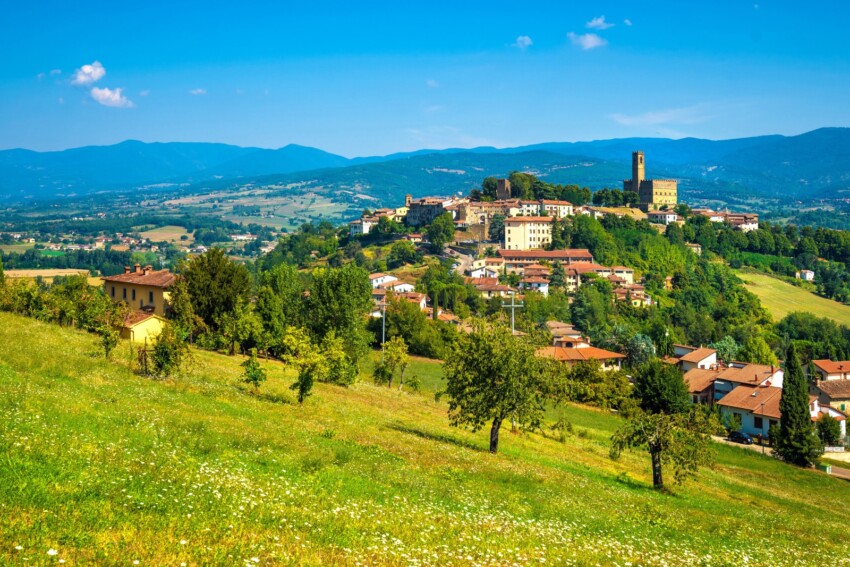
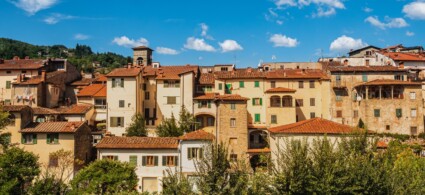
Poppi sits at the heart of the Casentino (475 m above sea level), a secluded valley in Tuscany spanning the provinces of Arezzo and Florence, now part of the Casentino Forests National Park. The valley has remained virtually untouched in its artistic and natural beauty, precisely because tourism here has never become overdeveloped. Poppi is among Italy’s Most Beautiful Villages—a distinction its porticoed alleyways, medieval castle and sweeping views across the Arno valley richly deserve.
The medieval village of Poppi is a rare walled town crowned by the Castle of the Guidi Counts, built from 1274 onwards and regarded by many historians as the “prototype” for Florence’s Palazzo Vecchio. Thanks to constant restoration over the centuries, the castle is now in excellent condition and fully open to visitors. The village is also inseparably linked to Dante Alighieri, who took part in the Battle of Campaldino fought at the foot of the hill on 11 June 1289, and who stayed at the castle between 1307 and 1311 during his exile from Florence.
The earliest documented record of the castle dates to 1191, though its defensive origins are thought to be earlier, traceable to the period between the Lombard and Frankish invasions. The major transformation came in 1274, when Count Simone da Battifolle, following his alliance with the Florentine Republic, commissioned the castle’s reconstruction, converting it from fortress into a noble residence. The right section of the building was the work of Lapo di Cambio, whilst the more recent part is attributed to Arnolfo di Cambio. It was Vasari himself, in his Lives, who cited the Guidi Counts’ palazzo as the exemplar and “prototype” for Florence’s Palazzo Vecchio, with its tall crenellated tower and biforate windows on the facade.
Access to the castle comes through the Lion Gate, surmounted by a leonine bas-relief dating from the fifteenth-century restoration by Turriani. The inner courtyard preserves the wooden superstructures of staircases and balconies that make it one of the rarest surviving examples in Italy, embellished with the coats of arms of successive Florentine vicars. The stone staircase leading to the upper floors was built in 1477 by Jacopo di Baldassarre Turriani.
Among the castle’s treasures stands the Rilliana Library, named after Count Fabrizio Rilli Orsini, who in 1825 donated his book collection to the Poppi community. Today the library holds over 25,000 volumes, including more than 700 incunabula—one of Italy’s major collections of fifteenth-century printed works—and 800 manuscripts, many of them illuminated and dating from the eleventh century. In 1866, following the laws suppressing religious orders, the collection was further enriched by the libraries of the Camaldoli Hermitage and the Capuchins of Poppi.
The castle’s absolute jewel is the Chapel of the Guidi Counts, decorated with a cycle of fourteenth-century frescoes attributed to Taddeo Gaddi (Florence, c. 1290–1366), one of Giotto’s principal pupils. The cycle, dating to 1330–1340, depicts six sacred scenes: two episodes from the life of Saint John the Baptist, two from the Virgin Mary, and two from Saint John the Evangelist. Below runs a band of half-length saints along the walls; on the vault, four roundels with the Evangelists complete the decoration.
The frescoes show clear debts to Giotto, with notable affinities to the scenes in the Peruzzi Chapel in Florence’s Santa Croce. Yet Gaddi adds his own distinctive sensitivity to chromatic and decorative values: tiny ornaments, never repeated, run across architecture and garments, shifting from blue to violet, pink to pale green. Particularly striking is the small niche with two ampullae, a refined example of Gaddian trompe l’œil among the earliest in Italian painting.
Within the castle, one room houses a museum and scale model of the Battle of Campaldino, meticulously reconstructing the famous battle of 11 June 1289, fought between Florentine Guelphs and Arezzo Ghibellines at the foot of the hill on which Poppi stands. The Florentine victory proved decisive for Tuscany’s political balance, and among the Guelph ranks fought a young Dante Alighieri. The poet himself stayed at the castle between 1307 and 1311, a guest of the Guidi Counts during his exile from Florence—tradition holds that he composed part of the Comedy here. A bust of Dante welcomes visitors at the castle entrance.
The visit concludes with the climb to the tower: 104 steep steps separate the balcony of the noble floor from the bell chamber at the top, from which an extraordinary panorama unfolds across the entire Casentino valley and the forests surrounding it.
Coming down from the castle, you encounter the Propositura of Saints Mark and Lawrence (18th century), which houses works by Ligozzi and Morandini. In front of it, in the main square, stands a rare example of “Tuscan Baroque”: the Oratory of the Madonna del Morbo (17th century), a hexagonal-plan building with a scale-patterned dome of great formal elegance.
Continuing along the main village street, flanked by arcades that allow covered visits in any weather, you reach the ancient Abbey of San Fedele (11th century), rich in notable artworks including a Giottesque crucifix and paintings by Ligozzi, Portelli, Davanzati, Morandini and Solosmeo.
The Monastery of the Augustinian Sisters (16th century) preserves fine Robbia terracottas worthy of a stop. Your visit to the village can conclude with a stroll along the entire medieval city walls, from which you can admire one of Tuscany’s most characteristic views: the Casentino valley, with its forests and villages, seen from atop the ancient battlements.
Poppi is one of the best bases for exploring the Casentino: well connected, well-serviced and delightful to experience even in the evening, when day-trippers depart and the village returns to the leisurely rhythms of country life. Accommodation is varied and covers all budget ranges.
In the historic centre are several B&Bs and small hotels housed in historic palazzi—the ideal choice for those wanting to soak in the village’s medieval atmosphere and step directly onto the arcaded street in the morning. At Ponte a Poppi, the valley-floor hamlet, the offer expands with larger facilities easier to reach by car. For those seeking contact with nature, the countryside and hills around Poppi are dotted with agriturismos nestled in the forest or Casentino pastures, many featuring pools and producing their own oil and wine.
Poppi is also an excellent base for visiting Camaldoli, the Sanctuary of La Verna and Bibbiena, all reachable in under 20 minutes by car.
From Arezzo the most direct route follows the SR71 northbound towards Bibbiena and then Poppi: approximately 40 km, taking 40–45 minutes. From Florence you can choose between two roads: the most convenient is the A1 motorway to the Arezzo exit, then continuing on the SR71 (roughly 1 hour total); alternatively, the more scenic route is the SR70 which climbs from Pontassieve to the Passo della Consuma (1,060 m) and descends into the Casentino valley floor. This latter is longer in terms of time but rewards you with extraordinary glimpses of the Park’s forests.
Poppi has its own railway station, served by the Arezzo–Stia line operated by Trasporto Ferroviario Toscano (TFT). From Arezzo trains take approximately 50–55 minutes, with services throughout the day. The station is in the valley floor, around 15 minutes’ walk from the castle or reachable by local buses. Those arriving from Florence must first take a regional train to Arezzo (approximately 1 hour) then change to the Stia line.
From Arezzo buses run by Autolinee Toscane depart hourly (Monday to Saturday) reaching Poppi in approximately 50–55 minutes, with a stop at Piazza Risorgimento. This is the most convenient option for those without a car already in Arezzo.
What's the weather at Poppi? Below are the temperatures and the weather forecast at Poppi for the next few days.
Poppi is located in the heart of the Casentino valley, approximately 40 km from Arezzo and 60 km from Florence, and is easily accessible by car, train or bus.
 Hotel
Hotel  Budget accommodations
  Apartments
  Family Hotel
  Luxury Hotel
  Resorts