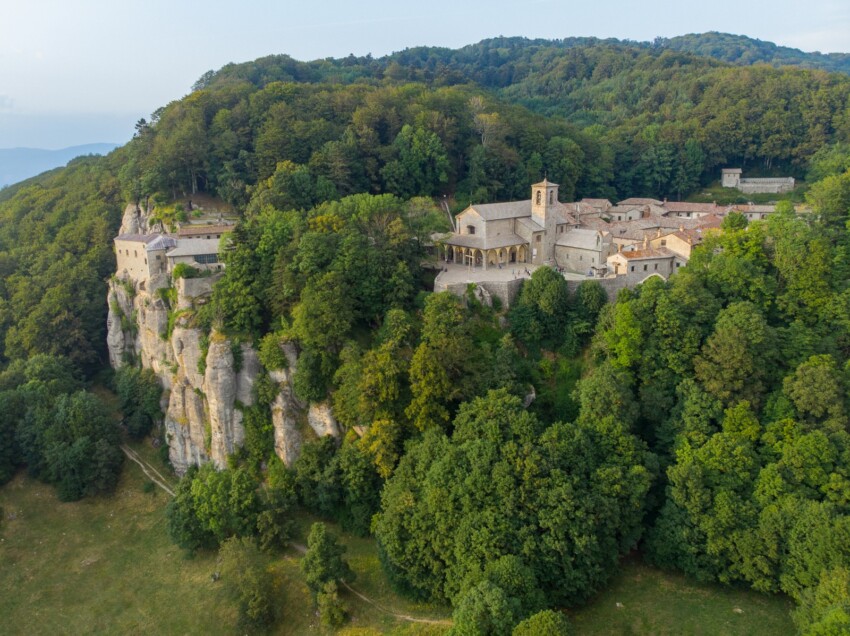
In the heart of the Casentino, between the valley floor and the Appennines, lies one of Tuscany’s countless hidden treasures: the Sanctuary of La Verna, a celebrated Franciscan sanctuary located within the municipality of Chiusi della Verna. This is in the province of Arezzo, nestled within the Casentino Forests National Park, in an area of significant natural interest, surrounded by woodlands, mountains and charming valleys.
The Sanctuary of La Verna is a renowned pilgrimage destination because it was here that St Francis is said to have received the stigmata in September 1224. Situated at 1,128 metres above sea level, on the flank of Monte Penna, it is constantly visited by pilgrims who come here to reflect and pray.
Beyond the sanctuary itself, it’s well worth exploring the numerous religious buildings on site, including the Chapel of Santa Maria degli Angeli and the Basilica Maggiore. Don’t miss the beautiful La Verna monumental forest, carefully maintained over the centuries by Franciscan monks — a vast woodland of firs and beeches that surrounds the entire sanctuary and can be explored on foot via an extensive network of trails.
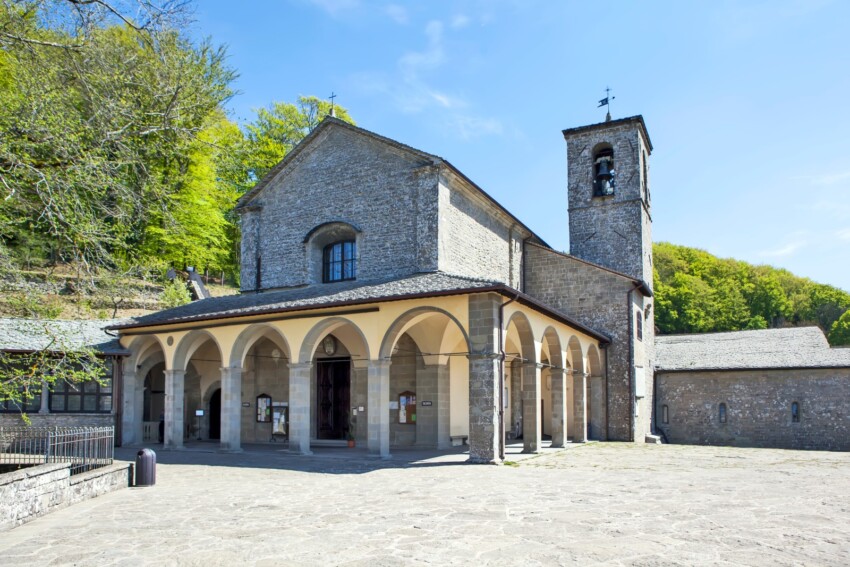
Visitors who make the journey to this remote corner of Tuscany come primarily for the Sanctuary, but there are numerous other attractions worth seeing, both religious and natural. Once you arrive, you’ll find yourself in the Quadrante, the main terrace overlooking the sanctuary buildings. It takes its name from the sundial on the basilica’s bell tower, which faces the plaza.
On the Quadrante you’ll also find a wooden cross planted in the rock and a 16th-century well-cistern built by Franciscan monks. Thanks to its elevated position with panoramic views, you can enjoy a magnificent vista across the Casentino valley and its forests.
Elevated to the status of minor basilica in August 1921 by Pope Benedict XV, the Sanctuary of La Verna overlooks the so-called Quadrante, the handsome plaza in front of the building. The original nucleus was consecrated in 1260 in Gothic style, with a late Renaissance portico added between 1536 and 1538 and the bell tower built between 1486 and 1490 — the result is a layered complex bearing the marks of nearly eight centuries of history. It is without doubt the most famous convent in the Casentino.
It is among the most important sites in Franciscanism, as it was thanks to the saint that an early hermitic settlement was founded in this area, complete with small cells and a small church, that of Santa Maria degli Angeli. It was here that in September 1224 St Francis received the stigmata while he was praying; from that moment onwards, La Verna became sacred ground.
Franciscan monks still reside at the Sanctuary of La Verna today. Silence and respect are therefore requested.
The Chapel of Santa Maria degli Angeli represents the original nucleus of the hermitic complex, desired by St Francis himself in 1216. Initially a small church, from 1250 onwards, at the behest of Cardinal Rainaldo da Segni and Pope Innocent IV, it was enlarged to its current proportions and was then consecrated in 1260.
Inside are a series of truly interesting religious artworks, all relating directly or indirectly to St Francis, from various periods. Of note are the canvases by Ferdinando Folchi from 1877, and the relief of the Nativity with St Francis and St Anthony by Andrea della Robbia.
The Basilica Maggiore, built adjacent to the Chapel of Santa Maria degli Angeli, was begun in 1348 and only completed in 1509. Dedicated to the Assumption of the Virgin Mary, it is entered through a beautiful late Renaissance portico. Inside you’ll find a fine nave with cross vaults, and you can admire numerous works and reliefs by renowned artists such as Andrea della Robbia and Piero di Zanobi — including the celebrated Annunciation, considered one of the sculptor’s masterpieces.
Within a side chapel lie the remains of the friar Giovanni della Verna, who was proclaimed blessed. Other chapels are dedicated to St Francis (including one containing his habit and a relic of his blood) and to the prince Piero Ginori Conti, dating from several centuries later.
It is the episode of St Francis’s stigmata that gave the greatest impetus to the Sanctuary of La Verna: this is evidenced by a series of structures dedicated to the event, including the Stigmata Corridor, located behind the portico of the Basilica Maggiore, which displays a striking collection of sacred artworks — paintings, reliefs, majolica, sculptures and frescoes dedicated to St Francis.
Along the corridor, a Stigmata Procession has taken place every day since 1431 at 3pm, also known as the “Nona Hour Procession” because the time corresponds to the ninth canonical hour. At the end of the corridor stands the Stigmata Chapel, the true heart of the sanctuary, built on the spot where the miracle is said to have occurred.
Within the convent complex is the Verna Museum, a journey through the ancient life of the convent set up in large 15th-century rooms. The museum houses precious liturgical objects, gilded copper reliquaries, paintings from the Florentine school of the 15th and 16th centuries and numerous other artworks. Particularly fascinating is the “common fire” hall, where the friars would gather on cold winter evenings — an almost untouched space that immediately conveys the daily life of monastic existence centuries ago.
Covering an area of approximately 200 hectares, the La Verna monumental forest is a mixed woodland of white fir and beech that covers the entire Monte Penna, on which the sanctuary stands. Beautiful to explore on foot along the trails that wind through it, the monumental forest is home to a rich and varied wildlife, as well as caves, crevices and natural cavities that shelter numerous species of plants and flowers.
Walking along the path from the Sanctuary of La Verna up to the summit of Monte Penna, you’ll notice at a certain point an enormous boulder positioned as if hanging over a precipice. This is the Sasso di Frate Lupo (Stone of Friar Wolf), named after the episode in which St Francis met the brigand Lupo, whom he converted to Christianity.
The boulder has a very distinctive shape, and its position on the cliff edge, combined with the legend of St Francis and the brigand, makes it one of the most popular natural attractions for tourists who venture this far.
David Badii was a young novice friar who lived at the Sanctuary of La Verna in the late 1980s and would regularly withdraw to pray in the monumental forest. One evening when he didn’t return to the convent, the other friars became concerned and began to fear the worst.
Sadly, their fears were confirmed as he was found dead in the woods. A large boulder that forms a cavity, presumably his prayer spot, has become known as Frà David’s Cave, accessible on foot from the sanctuary in a short time. Inside the small cave you can still see the young friar’s sandals today, and a plaque with his photograph commemorates him.
Below is all the useful information for visiting the Sanctuary of La Verna.
The sanctuary is open to visitors every day from 6.30am to 9.30pm, whilst the Stigmata Chapel opens from 8.00am to 7.00pm from April to October, and from 8.00am to 5.00pm from November to March.
The sanctuary’s shop, which sells souvenirs, books and products from the ancient pharmacy, is open every day from 10.00am to 6.00pm.
Masses are celebrated every day at 8.00am, 11.00am and 4.00pm, whilst on Sundays and public holidays there are also services at 10.00am (July and August only), 12.15pm and 5.30pm (April to December only). Additionally, Eucharistic adoration is held on Thursdays at 6.00pm, and the rosary is celebrated on Saturdays at 6.30pm.
Guided tours of the Sanctuary of La Verna are available on a donation basis, lasting approximately 45-60 minutes. It’s also possible to request a meeting with a member of the clergy to discuss a particular theme, which can only be held between 9.00am and 12.30pm or between 3.30pm and 6.00pm.
The Sanctuary of La Verna has a number of facilities for guests, including a guest house with 72 heated rooms with en-suite bathrooms and showers. There is also a refectory with 600 seats, open every day for lunch from 12.30pm to 2.00pm and dinner at 7.30pm.
Excellent bases for visiting the Sanctuary of La Verna and the Casentino Forests area are the towns of Poppi, Bibbiena, Camaldoli or Pieve Santo Stefano.
The Sanctuary of La Verna is located in a rather isolated position, in the heart of the Casentino Forests. From Florence it takes approximately 2 hours, driving along the steep SR70 Consuma road, which crosses the Consuma Pass from Pontassieve to enter the Casentino, or you can take the more comfortable but longer motorway option, exiting Florence South and leaving at Arezzo, then continuing towards the Casentino.
Journey time from other Tuscan cities varies between 2.5 and 3.5 hours. In many cases you’ll need to reach Florence first and then proceed with one of the options mentioned above.
For those travelling by public transport, reaching the Sanctuary of La Verna is difficult but not impossible. You’ll need to reach Chiusi della Verna, which is connected by bus to Bibbiena, where regional trains from Arezzo stop. The entire journey from Florence to Chiusi della Verna takes approximately 4 hours, including waiting times for connections.
The final stretch from Chiusi della Verna to the sanctuary is the Via del Santuario della Verna, which climbs along the side of Monte Penna with a height gain of approximately 200 metres: it can be walked in less than an hour, covering just over 3 kilometres.
The Sanctuary of La Verna sits in the municipality of Chiusi della Verna, in the province of Arezzo, nestled in the heart of the Casentinesi forests.

 Hotel
Hotel  Budget accommodations
  Apartments
  Family Hotel
  Luxury Hotel
  Resorts