B&B del Lago
Sansepolcro - Via della Ginestra n. 14 Frazione Gragnano
Book now
Sansepolcro occupies a privileged position, standing at the intersection of four Italian regions: Tuscany (of which it is part), Umbria, the Marches and Emilia-Romagna. This charming town in Arezzo Province, whilst somewhat off the beaten tourist trail, certainly has much to offer. Indeed, if you base yourself here, you’ll have the opportunity to explore four regions of Italy!
Focusing on Tuscany alone, you’ll discover that Sansepolcro boasts a pleasant historic centre well worth exploring, with its characteristic medieval and Renaissance character, several interesting museums and beautiful surroundings where nature is the undisputed star.
Moreover, Sansepolcro is a land of art, notably as the birthplace of Piero della Francesca. His influence on the town remains so strong that there is a foundation dedicated to him, which promotes research and dissemination of his works. The foundation is housed in his birthplace, located at Via Aggiunti 71.
Although compact, Sansepolcro’s historic centre has plenty to offer. Here are the town’s main attractions.
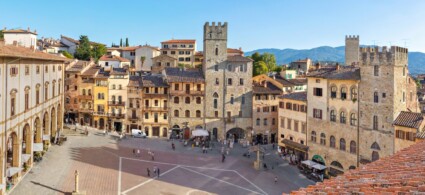
At the heart of Sansepolcro lies Piazza Torre di Berta, named after the medieval tower that once stood isolated in this public space before being destroyed during the Second World War. The square is surrounded by numerous buildings of interest, all of which have been transformed or restored over time.
Among them are Palazzo Pichi, with its rusticated windows; Palazzo Giovagnoli, a 13th-century building built on the foundations of a tower-house with Renaissance windows; Palazzo Pichi-Sermolli, dating from the 15th century; and finally the surviving truncated medieval tower on the north-western side.
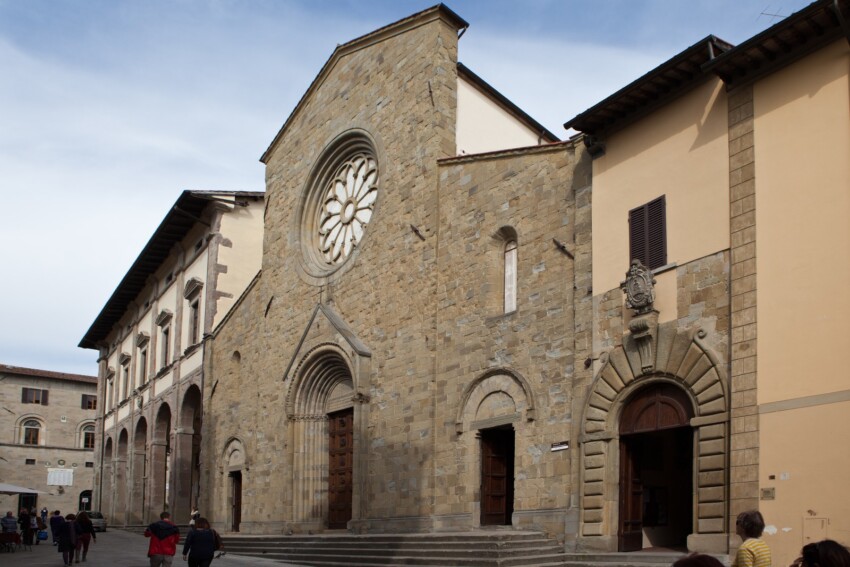
From Piazza Torre di Berta, heading down Via Matteotti, you immediately come upon Sansepolcro Cathedral, dedicated to St John. The building we see today is the result of renovations carried out between 1301 and 1350 of the original 11th-century Camaldolese abbey, dedicated to St John the Evangelist. Inside are extraordinary works by artists such as Perugino, Bartolomeo della Gatta and Santi di Tito, as well as a 10th-century wooden crucifix known as the Volto Santo.
Adjacent to the Cathedral stands Palazzo delle Laudi, now the town hall. Commissioned from architect Alberto Alberti, the building dates from the early 17th century and features a fine interior courtyard, designed by another local architect, Antonio Cantagallina. The façade is enhanced by a spacious loggia that also served as a covered market.
On the opposite side of the Cathedral, the elegant Via Matteotti continues, lined with 14th and 15th-century houses, the early 17th-century Palazzo Aggiunti, and the building housing the rich Municipal Picture Gallery. The street is closed off at the far end by the 14th-century Palazzo Pretorio (currently the seat of the Arezzo Court’s satellite office), connected by a large arch to the Picture Gallery building.
The building where Piero della Francesca was born is an elegant 15th-century palazzo. Its architectural design features Michelozzo-style details in the portal and windows.
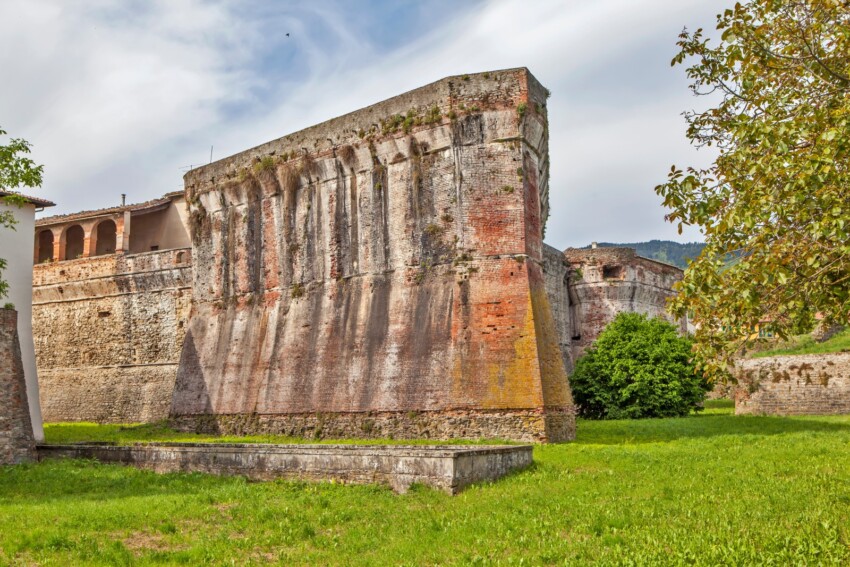
Sansepolcro’s Medici Fortress, conceived in the 16th century, is situated in the eastern part of the town walls, which still stand today. The design was by Giuliano da Sangallo, who incorporated the existing fortifications into the new bastions. Architect Alberto Alberti also participated in the construction. When Cosimo I ordered the building of the fortress, he also wanted to strengthen the town walls, which were restructured with four corner bastions, one of which is located within the Medici Fortress itself.
Easily reached on foot from one another, Sansepolcro boasts three interesting museums: the civic museum, the herb museum and the ancient glass museum.
With 10 rooms spread across two floors plus a basement, Sansepolcro’s civic museum is one of the must-see places in town for art lovers. Opened in 1975, it is now focused on the works of Piero della Francesca, of whom four magnificent paintings are on display.
Beyond the works of this illustrious Sansepolcro native, the civic museum also houses works by artists of the calibre of Pontormo, the Alberti brothers, terracottas by the Della Robbia family and many others.
For many, the highlight of Sansepolcro’s civic museum is The Resurrection, painted by Piero della Francesca. Its restoration took three years and was completed in March 2018.
Located within the rooms of the elegant Palazzo Bourbon del Monte, Sansepolcro’s herb museum was established in 2002 at the behest of Aboca, a health and wellness products company, whose headquarters are located just a few kilometres away, albeit in Perugia Province.
The museum is dedicated to medicinal plants and aims to promote their use in natural medicine and in the beauty and cosmetics sectors. The heart of the museum is a tour entitled “herbs and health through the centuries”, which traces the evolution of natural medicine and shows the various ways in which humans have used plants for centuries to treat ailments.
Housed within the deconsecrated church of San Giovanni Battista, a Romanesque building dating from the 12th century located on Via Giovanni Buitoni, the ancient glass museum was inaugurated in 2003. Within its 300 square-metre space, it displays works from the collection of Giuseppina Bernardini, complemented by pieces from the Luigi Fatti donation.
In all, the museum’s rooms display 23 large stained glass windows, in addition to over 100 much smaller fragments. Furthermore, a series of historical objects used in glass working demonstrate how this material has been used for decorative purposes throughout the centuries.
Alongside its great artistic heritage, folklore plays an important role. Sansepolcro is indeed known as the city of the crossbow palio and flag games, testament to a past of struggles to defend communal freedom. On the second Sunday of September, when the crossbowmen of Sansepolcro renew their challenge against their rivals from Gubbio, the town dons the colours of Piero della Francesca. Trumpets blare, drums roll and in Piazza Torre di Berta the Crossbow Palio triumphs: a centuries-old festival (its origins date back to the early 15th century) through which Sansepolcro commemorates its proud past as a free municipality, constantly engaged in defending itself against attacks from neighbouring lords.
From these military exercises originated the ancient Italian crossbow shooting competition, conducted from benches, which has survived to our day with the same rules as centuries past. Seated at shooting benches, 36 metres from the target or cornel wood (a cone-shaped wooden trunk with an iron nail at its centre), the crossbowmen, whose names are drawn by lot, take turns shooting. The winner is the one who comes closest to the centre. Dressed in clothes inspired by Piero della Francesca paintings, nobles, ladies and knights watch the competition, while flag-tossers hurl their banners into the sky.
September is the town’s pre-eminent month, and the Palio is not the only reason. Two other major events alternate annually: the Biennial of Goldsmith Art and the Biennial of Lace or bobbin lace, which showcase two important local traditions that combine artistry with craftsmanship.
Within Sansepolcro’s historic centre there are several apartments and bed and breakfasts, mostly run by private owners. Nearly all are well-maintained, located within historic palazzi and expertly renovated, with period furnishings and often original details, such as ceilings or floors. Choose to stay in the heart of Sansepolcro if you want to be close to its artistic treasures and attractions, but be aware that parking in the centre is difficult to find, and that you may encounter noise from bars or restaurants.
Alternatively, if you prefer maximum peace and quiet, venture outside the town, where you’ll find farmsteads, agriturismos, country houses, relais and hotels set in nature, where relaxation is the watchword. Here you can unwind surrounded by the green of the Tuscan countryside, at the foothills of the Apennines. Of course, staying at these properties means you’ll need to take the car for any outings, as well as to find evening entertainment.
Despite its position practically in the heart of Italy, closer as the crow flies to San Marino than to Florence, Sansepolcro is not as inaccessible as it might seem. It is in fact about half an hour’s drive from Arezzo, a journey of roughly 35 kilometres along the final stretch of the SS73 Senese-Aretina state road, which begins in Siena and ends in Sansepolcro. The road has two lanes in each direction, is straightforward to drive and is not at all winding.
Therefore, to reach Sansepolcro from all other Tuscan provinces, you simply need to reach Arezzo first (situated a few kilometres from the motorway exit of the same name on the A1 motorway), and then continue along the route described above. From Florence and Siena it takes about an hour and a half, from Pisa and Livorno two and a half hours, and from Grosseto just over two hours.
To reach Sansepolcro by public transport, you’ll often need to combine train and bus: the town has no railway station, so you’ll first need to get to Arezzo, which is nonetheless very well served as it lies on the Florence-Rome regional and intercity line. For example, trains from Florence to Arezzo take half an hour (intercity) or an hour (regional). Once you’ve left Arezzo station, you’ll find bus SI381 waiting for you, operated by Autolinee Toscane, which will take you to Sansepolcro in approximately an hour.
What's the weather at Sansepolcro? Below are the temperatures and the weather forecast at Sansepolcro for the next few days.
Sansepolcro lies in the province of Arezzo, yet simultaneously only a few kilometres from Umbria, Marche and Emilia-Romagna.
 Hotel
Hotel  Budget accommodations
  Apartments
  Family Hotel
  Luxury Hotel
  Resorts