Florence: Uffizi Gallery All Collections Ticket & Audio App
7.276 reviews
Buy now
From 5,00€ per person
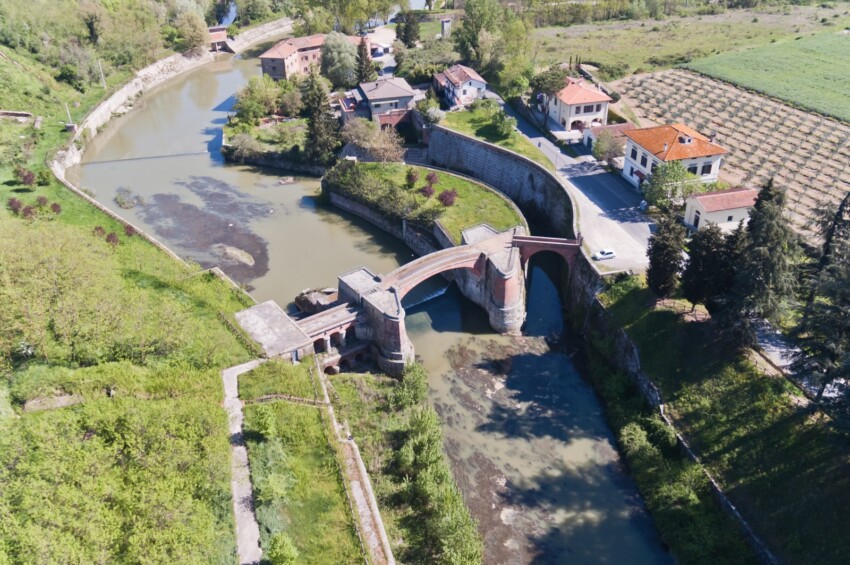
Travelling slowly along the Canale Maestro della Chiana through the lands of Siena and Arezzo reveals a different side of Tuscany—far removed from the rolling hills of Chianti or picturesque medieval villages. This is the flat, agricultural and peaceful Tuscany of the Valdichiana, a landscape reclaimed from water through centuries of human labour, still bearing the visible marks of that great transformation. The valley cradles the roots of Etruscan civilisation and is traversed by a canal that continues to serve as an active waterway today.
The Sentiero della Bonifica is a cycle and walking path of approximately 62 km that connects Arezzo to Chiusi, running alongside the Canale Maestro della Chiana through the provinces of Arezzo and Siena. Once the maintenance road for the canal and the Grand Duke’s locks, this route is now a completely traffic-free cycle and walking path—flat, well-signposted and integrated with the railway network. You can start by train from one city and arrive at the other by bike or on foot, with no need to retrace your steps. It forms part of the EV7 Ciclovia del Sole, the major European cycling route connecting northern Europe to Sicily.
The Sentiero della Bonifica runs entirely on unpaved gravel track, following the original maintenance road of the Grand Ducal locks. The path is completely flat, with a total elevation gain of just 20 metres across the entire route—a rarity in Tuscany that makes the trail accessible to cyclists of all abilities, including families with children, provided they have bikes suited to unpaved surfaces.
The route starts at San Leo, on the outskirts of Arezzo, where the Chiusa dei Monaci del Fossombroni divides the waters of the Chiana before they flow into the Arno at Ponte Buriano, and ends at Chiusi Scalo railway station, the natural starting point for those arriving by train. Many cyclists prefer to start from Chiusi and cycle towards Arezzo. Both stations are served by Trenitalia regional trains, allowing you to complete the route in one direction without needing to return to your starting point.
The path passes through no towns for most of its length—it’s an immersive experience in open countryside, with the hills of Valdichiana rising on either side, Cortona visible in the distance across the eastern hills, and the canal running parallel for all 62 kilometres. Along the way, escape routes are marked towards provincial roads, useful if needed or if you want to break the journey over several days.
Cortona doesn’t lie directly on the Sentiero della Bonifica, but is reachable via a detour of approximately 12 km thanks to the so-called Sentiero dei Principes Etruschi, which branches off the main route near Castiglion Fiorentino. If you have the time and inclination, this detour is absolutely worth the extra kilometres: Cortona is the valley’s most enchanting Etruscan town, and its medieval historic centre, with the MAEC museum and views across Lake Trasimeno, is one of the finest stops in the entire Valdichiana.
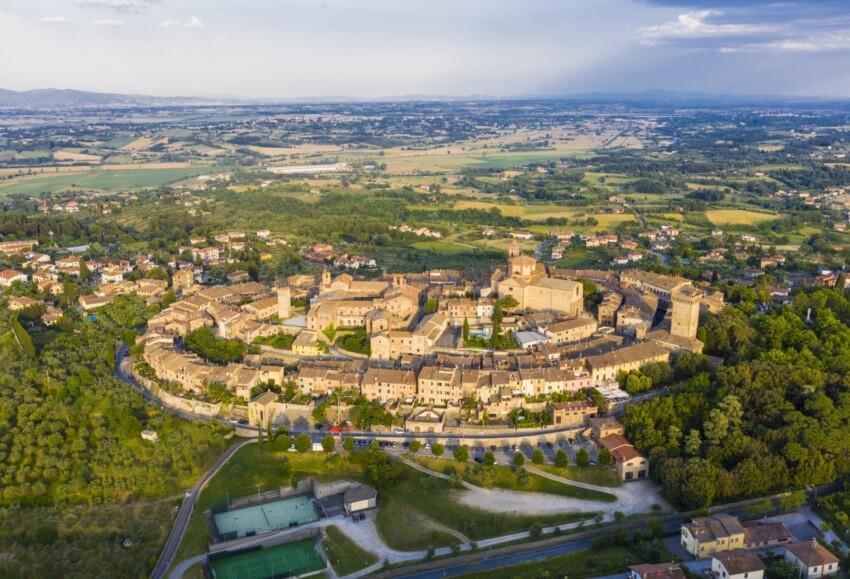
Although the path is largely through open countryside, there’s no shortage of historical, natural and scenic points of interest.
In the southern section of the route, near Chiusi, the path runs alongside Lake Chiusi and the Lago di Montepulciano Nature Reserve, two wetland sites recognised by the CNR as among the most ecologically important in inland Tuscany. These are water bodies rich in aquatic flora and wildlife, frequented by grey herons, little egrets, cormorants and numerous species of ducks. It’s the most evocative section for birdwatchers: dawn and dusk are times of particularly intense bird activity. Nutrias are commonly seen along the canal banks near the lake.
Not far from Chiusi stand two medieval towers with intriguing names: the Torre del Beccati Questo, built by the Sienese, and the Torre del Beccati Quello, erected by the Perugians. The two towers faced off across the disputed border between territories, and their dialect names aptly capture the rivalry between these competing cities. They are among the most photographed spots on the route.
Along the canal you’ll encounter hydraulic locks that regulated water flow during the Grand Ducal land reclamation, some of which still function today. The Leopoldine buildings—farmhouses built by the House of Lorena to populate the reclaimed valley, recognisable by their functional and orderly architecture—dot the agricultural landscape with almost rhythmic regularity, testifying to the systematic planning with which the Grand Duchy redesigned the territory.
Though not directly on the main route, the hilltop villages of Valdichiana are all reachable with short detours: Castiglion Fiorentino, Foiano della Chiana, Lucignano and Monte San Savino all lie within a few kilometres of the path and offer excellent opportunities for cultural or culinary breaks. Montepulciano and its renowned Vino Nobile DOCG production are accessible via a climb from the Siena section of the route.
The gravel surface of the Sentiero della Bonifica requires an appropriate bike: road bikes with narrow tyres are not recommended, while gravel bikes, mountain bikes and trekking bikes with wider wheels are ideal. Gravel e-bikes are an increasingly popular choice, especially for covering the entire route in a single day. Urban hybrid bikes with very narrow tyres are not suitable.
Official maps—downloadable from sentierodellabonifica.it—mark supply points, bike repair shops and affiliated bike hotels. Rest areas with drinking water and facilities are scarce along the open stretch: it’s essential to set off with full water bottles and enough food for several hours of cycling. Bars and shops are found only near settlements, away from the main route.
The path is also suitable for walking and horse riding, and is completely closed to motor vehicles (except for authorised maintenance vehicles).
Spring (April-May) and autumn (September-October) are the best times to cycle the Sentiero della Bonifica. Temperatures are pleasant and the agricultural landscape shows its finest colours. Summer is not recommended during the heat of the day: the route is almost completely exposed to sun and the Tuscan plains summer heat is intense. If cycling in summer, it’s best to start at dawn and finish by 10-11 in the morning.
One factor not to underestimate is wind: the flat, open nature of the Valdichiana makes it particularly exposed to wind currents, which on blustery days can significantly slow your pace, especially heading north. Check the forecast before you set off.
Train integration is one of the route’s greatest strengths: the Arezzo-Chiusi railway line is served by Trenitalia regional trains with stops at all intermediate stations in the Valdichiana, allowing you to break the journey into segments and return to your starting point by train. For those wanting additional services—bike rental, luggage transport, environmental guides—specialist operators work in partnership with the trail.
From Arezzo: the route’s access point is the Chiusa dei Monaci di San Leo, reachable from Arezzo railway station in about 20 minutes on foot or by bike via urban cycle paths. Arezzo station is connected to Florence (approximately 1 hour), Rome and major Tuscan cities.
From Chiusi: Chiusi Scalo station is the southern access point. It’s served by the Rome-Florence line with regional and intercity trains. The path begins just a few minutes’ walk from the station forecourt.
For those arriving by car, several access points with parking are located near the canal along the route, allowing you to cycle only a section without needing to cover the entire distance.
 Hotel
Hotel  Budget accommodations
  Apartments
  Family Hotel
  Luxury Hotel
  Resorts