Albergo Falterona
Stia - Piazza Bernardo Tanucci 85
Book now
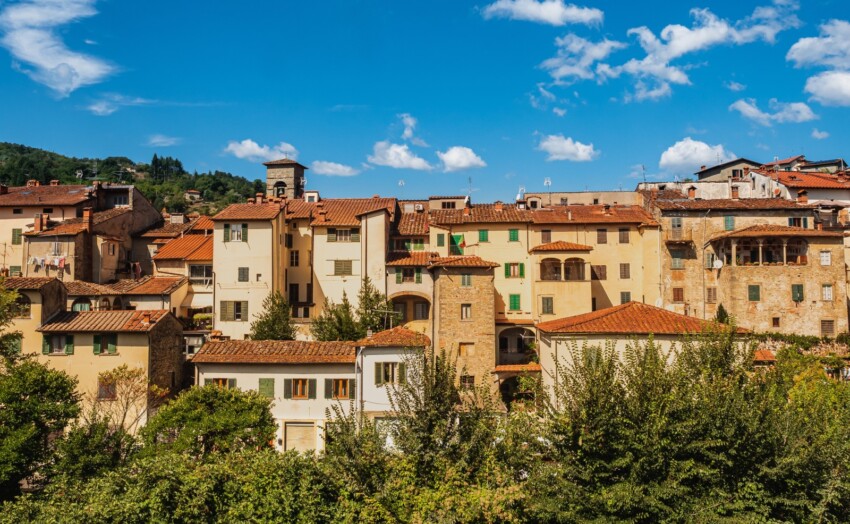
During the Middle Ages, Stia developed as a “market town” of the County of Porciano and as a residence of the Guidi Counts known as “di Palagio”, a name recalling the construction in 1230 of a grand residence on the banks of the Staggia stream, called the Palagio. A new settlement grew up around this imposing building, which was added to the existing village higher up the valley, known as Stia Vecchia. The Guidi Counts “di Palagio” maintained possession of Stia until the siege of the town by the Florentine Republic in 1402.
Thereafter, Stia’s history remained closely linked to that of Florence, first under Medici rule and later under the House of Lorraine-Hapsburg. The town, which in 1840 had a population of 2,901, experienced significant growth thanks to the wool industry, which made Stia an important production centre. The celebrated “Casentino” cloth was born here. In the early 1900s, the Stia Mills employed almost 500 workers. The town, which grew to the sound of the factory whistle, experienced various periods of development and certainly suffered from the closure of the great woollen mill.
Today, Stia, which has identified tourism as its new driver of growth, is a town where past and present, economic progress and environmental protection, and traditions and history are thoughtfully interwoven.
Historical records concerning Porciano date back to around 1000, as it is mentioned in a document from 1017 as the residence of Count Guido of Teudegrimo, founder of the line of Guidi Counts from Porciano. We can therefore consider the castle as one of the earliest seats of this powerful Casentino family.
More than two centuries later, from 1288, it belonged to the notorious Count Tegrimo, who, having retreated here after the Battle of Campaldino, would attack and rob unfortunate travellers and merchants passing near the castle. There is evidence of this ‘noble profession’ in a 1291 conviction to pay 10,000 gold florins to the Podestà of Florence for having robbed a merchant from Ancona.
Tegrimo’s successor was Count Guido Alberto of Porciano, who was also condemned by the Florentine Signoria for plotting a conspiracy to overthrow it. On 20 March 1349, the castle came under the dominion of the Commune of Florence when the last Count of Porciano, Ludovico, took monastic vows and renounced all his earthly possessions.
Like many other places in the Casentino, Porciano is associated with numerous memories, though not historically proven, connected to Dante Alighieri. It is said that in 1311 the poet first came to Porciano to persuade the Guidi Counts, who had always opposed the Guelph Florentines, to support the newly crowned Emperor Henry VII and convince him to openly side with the Ghibellines.
From Porciano came two famous letters by Dante. The first, dated 31 March 1311, addressed to the Florentines, was full of bitterness and resentment following his exile, urging them to submit to the Emperor. The second, sent on 16 April of the same year, to the Emperor, to encourage him to crush Florence itself by force of arms. Things did not go as planned; the Guidi Counts failed to keep their promises of loyalty to the Emperor, and the poet immortalised his contempt for the traitors in the fourteenth canto of Purgatorio in the Divine Comedy. This provoked the Guidi’s revenge, and they imprisoned Alighieri in one of Porciano’s rooms.
Another legend surrounding the castle concerns the presence within its walls of a treasure—a golden bell worth as much as all of the Casentino.
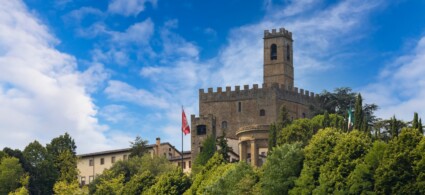
The imposing Torre Palazzo of Porciano, still fitted with Guelph crenellations and the tallest in the Casentino at 35 metres and six storeys high, rises among the remains of the walls, two towers—the western one converted into the bell tower of the parish church—and two gates, one to the north and one to the south.
The castle’s decline began in the sixteenth century, coinciding with the growth of the town of Stia down in the valley, which proved far more convenient for commerce. The ruins of the fortification were even put to agricultural use. Like the nearby castle of Romena, Porciano also became the property of the counts Goretti dè Flamini in the 1800s, who oversaw its restoration. Archaeological research was also carried out on the site, which enabled the recovery of artefacts that helped reconstruct the castle’s developmental phases.
It was also possible to reconstruct the complex water drainage system that channelled water from the tower’s roof both to the main cistern in the castle’s courtyard and to a smaller one inside the tower itself for drinking water. Following the final restoration work completed in 1978, the ruins are now well maintained and open to the public. The tower also houses a private residence for the owners and a small museum displaying artefacts found in the area.
Looking at this relatively modest fortification today, it may seem impossible that in the Middle Ages it held considerable importance. Yet Porciano’s ‘court’ was frequented by knights, nobles and ambassadors, merchants from the east had to pass under its walls to reach Florence, and an Emperor was counting on its alliance to subdue the powerful Florentine Signoria.
To see all the facilities and book accommodation in Stia use the form below, entering the dates of your stay.
 Hotel
Hotel  Budget accommodations
  Apartments
  Family Hotel
 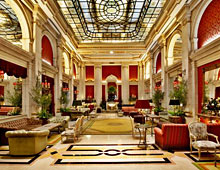 Luxury Hotel
  Resorts