Moody smart & comfy Hotel
Terranuova Bracciolini - Vi Strada Poggilupi, 305
Book now
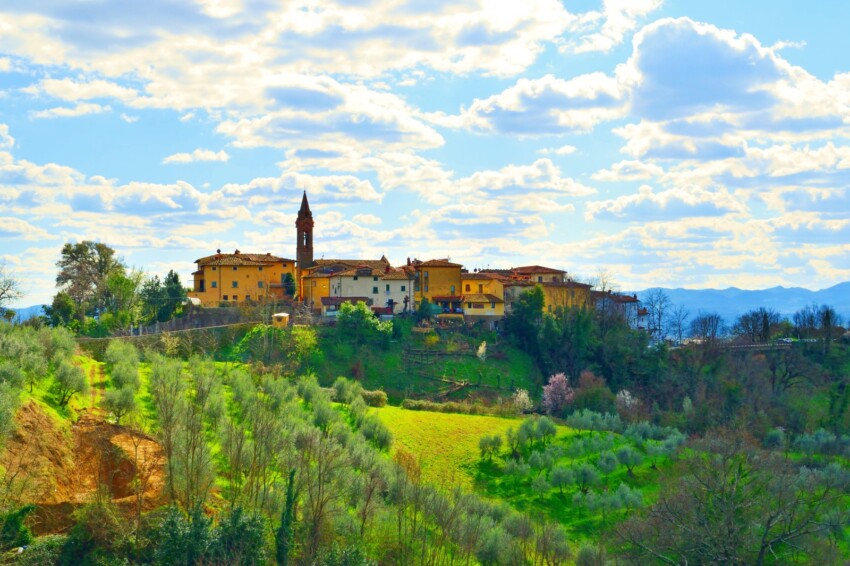
Terranuova Bracciolini is the last walled town built by Florence and still retains the ancient walls and towers from its foundation. Originally called Castel Santa Maria, it takes its new name from the great 15th-century humanist Poggio Bracciolini, who was born here in 1380. Frescoes from the 14th and 15th centuries are preserved in the Church of San Biagio ai Mori. Terranuova was also the birthplace of Fra’ Diamante, also known as Feo, who was born here around 1430 and was a collaborator of Filippo Lippi. The panorama of the Balze, visible when climbing above the small village of Persignano, is particularly striking. True to tradition, Terranuova, like many Tuscan towns, hosts an Antiques Fair on the second Sunday of each month (except August) in the historic town centre’s squares.
The countryside surrounding Terranuova offers an incredible array of itineraries with natural, historical and artistic interest.
Beyond the destinations better known to international tourists (Chianti, Vallombrosa, Casentino, etc.), visitors will find plenty of options for trips and excursions through a quieter, lesser-known “Tuscany” that is nonetheless deeply evocative, and rewarding in every season of the year.
Your journey can begin at the far reaches of the Valdarno, near the city of Arezzo, where you’ll find Ponte Buriano: this Romanesque bridge over the Arno is almost certainly the one Leonardo da Vinci reproduced in the background of the Mona Lisa.
From Ponte Buriano, the Setteponti road runs north between vineyards and olive groves, with the first terraced slopes of Pratomagno on one side. After the farmhouses of Castiglion Fibocchi and Laterina, the ancient Cassia Vetus road arrives near Borro, an attractive medieval village and today an important tourist destination.
It then passes through Loro Ciuffenna, an ancient settlement built on high rock cut through by the waters of the stream. You can still admire almost all the medieval buildings in the characteristic district known as “Fondaccio”, clustered at the end of a Romanesque bridge with a remarkably elegant span. Near the Town Hall, you should visit the Venturino Venturi Museum (which houses paintings and sculptures by the local artist), the ancient water mill and the recently renovated “La Filanda” centre.
Loro Ciuffenna is the gateway to the mountain, initially covered with vineyards and olive groves, then with oak and chestnut trees and finally with beech. There are many small villages on the Valdarno slopes of Pratomagno, and their names recall ancient origins: Rocca Ricciarda, Modine, Gorgiti, Poggio di Loro, Chiassaia, Anciolina.
Continuing along the Cassia Vetus road and right in the heart of the Balze region, you’ll come across the villa-farm of Poggitazzi and then Castelfranco (another of Florence’s “new towns”); just outside the walls stands the abbey of Soffena, built in the 11th century.
The final stop in the Arezzo Valdarno is Piandiscò, with its Romanesque church of Santa Maria a Scò; a few kilometres further on, you enter the Vallombrosa forest, which boasts an ancient and prestigious history and has long been a tourist destination. The thousand-year-old Abbey is worth visiting, as is the “collection” of tree species, now a protected biogenetic nature reserve.
The valley floor is the most vital area of Arezzo province, shaped over time by strong economic and demographic development, where modern infrastructure coexists with historic roads, traces of industrial archaeology and farmhouses now renovated for tourism.
San Giovanni Valdarno is a small town of artistic merit: it is the birthplace of Masaccio, and its Podestà Palace is attributed to Arnolfo di Cambio. The Basilica of Santa Maria delle Grazie houses an Annunciation in its adjoining Museum, a masterpiece by Beato Angelico.
Also on the left bank of the Arno is Montevarchi, with its curious elliptical layout. Always characterised by intense business activity, Montevarchi was once important for its agricultural market, then for wool and leather manufacturing, and today for plant nurseries and the fashion industry. The Collegiate Church contains the monumental Tempietto by Andrea della Robbia. A few dozen metres away are the Palaeontological Museum and the impressive library of the Accademia del Poggio.
Beyond Levane (where Montaigne praised the inn in the 16th century as “…the best in all Tuscany”) and heading towards Siena, the Ambra Valley opens up, with one of the most beautiful rural landscapes. Short excursions lead to small villages such as Cennina, Montebenichi, San Leolino, Badia a Ruoti, Duddova: it’s a genuine journey through time, among churches, castles and artistic and historical treasures. Here begins the Chianti region, and you can already sense Siena’s influence.
To see all the facilities and book accommodation in Terranuova Bracciolini use the form below, entering the dates of your stay.
 Hotel
Hotel 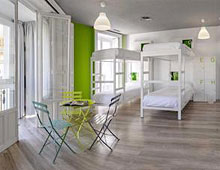 Budget accommodations
  Apartments
  Family Hotel
 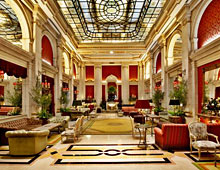 Luxury Hotel
 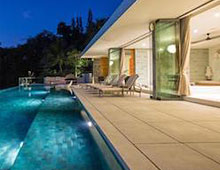 Resorts