Cortona Resort & Spa
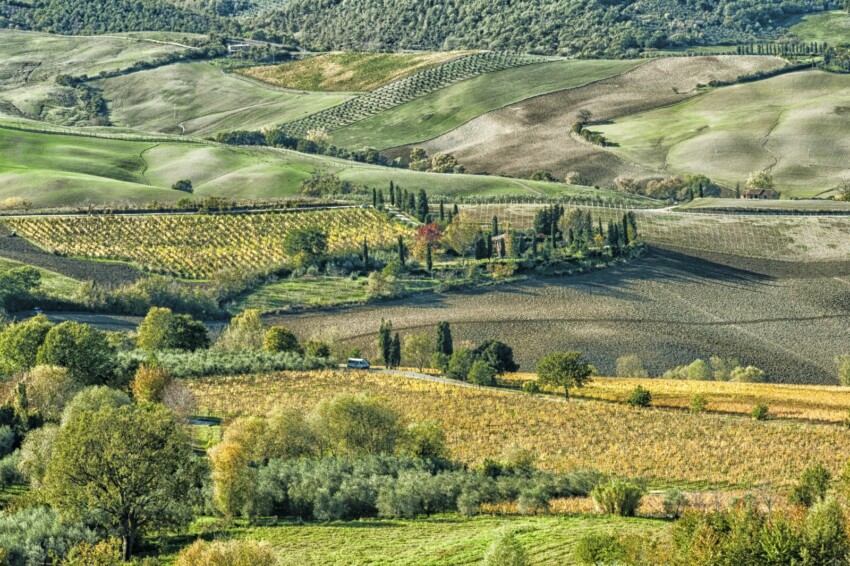
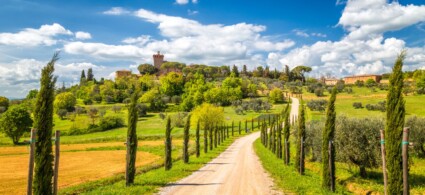
The Val di Chiana, or Valdichiana, is one of the largest valleys in the central Apennines: over 500 square kilometres of fertile countryside stretching across the provinces of Arezzo and Siena in Tuscany, continuing southwards into the Umbrian provinces of Perugia and Terni. Viewed from above — particularly from the terraces of Cortona, which dominates it from its 600-metre altitude — it appears like a vast, orderly garden, with vineyards, olive groves and cultivated fields alternating in a landscape of rare harmony.
Its history is as ancient as that of Etruria itself: the Etruscans populated and farmed this plain, battling the marshes that periodically submerged it, and traces of that civilisation are still visible in numerous museums and archaeological sites scattered across the territory. Centuries later, it was Leonardo da Vinci who studied a hydraulic drainage system for the valley, and it was finally the Grand Duke of Tuscany who completed it between the seventeenth and eighteenth centuries, transforming the marshes into the fertile expanse we see today.
Beyond its history, Valdichiana is renowned for the Chianina, an indigenous cattle breed among the most prized in the world and the undisputed star of local gastronomic tradition. A territory best explored slowly, village by village, preferably by car.
Valdichiana is traditionally divided into Valdichiana Aretina and Valdichiana Senese, two areas with distinct characteristics but equally rich in attractions. Hilltop villages, medieval historic centres and Etruscan sites form the backbone of tourism in this valley, alongside food and wine that alone justify the journey.
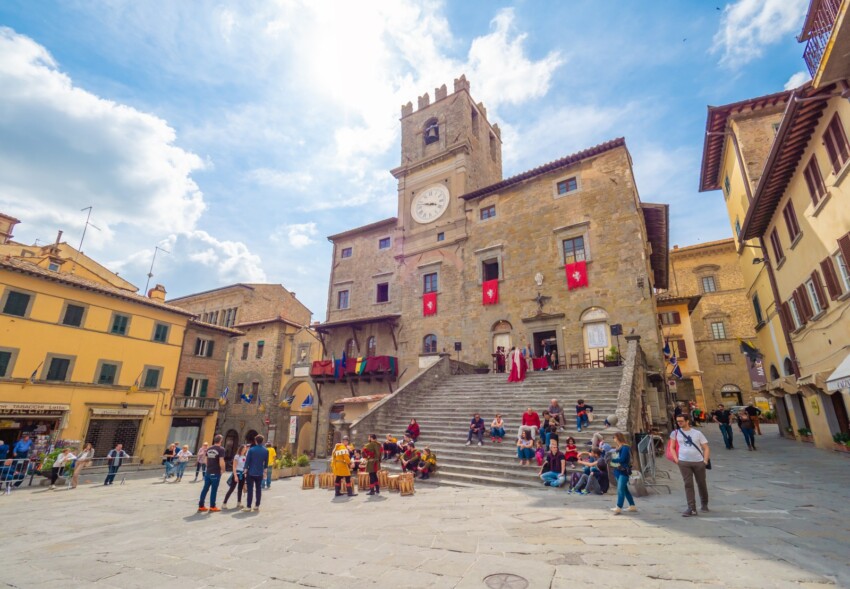
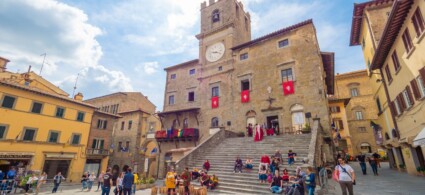
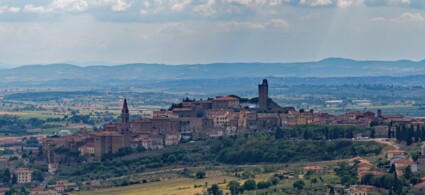
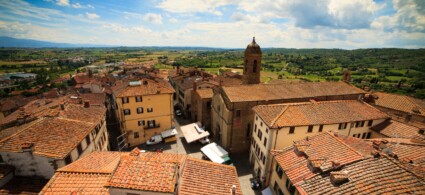
Cortona is the undisputed queen of Valdichiana and one of Tuscany’s most enchanting medieval towns. Perched on a hilltop at 600 metres, it commands sweeping views across the entire valley to Lake Trasimeno. Its historic centre, with stone-paved alleyways, irregular piazzas and Renaissance palaces, has remained substantially unchanged over the centuries.
The main cultural attraction is the MAEC — Museo dell’Accademia Etrusca e della Città di Cortona (Museum of the Etruscan Academy and the City of Cortona), which houses one of Italy’s most important Etruscan collections, including the celebrated fifth-century BC Etruscan chandelier. Don’t miss the Santuario di Santa Maria delle Grazie al Calcinaio, a Renaissance masterpiece by Francesco di Giorgio Martini, and the ancient Etruscan walls that still partly encircle the city. Cortona is also well known to the general public thanks to the book and film “Under the Tuscan Sun”, which has helped establish it as an international destination.
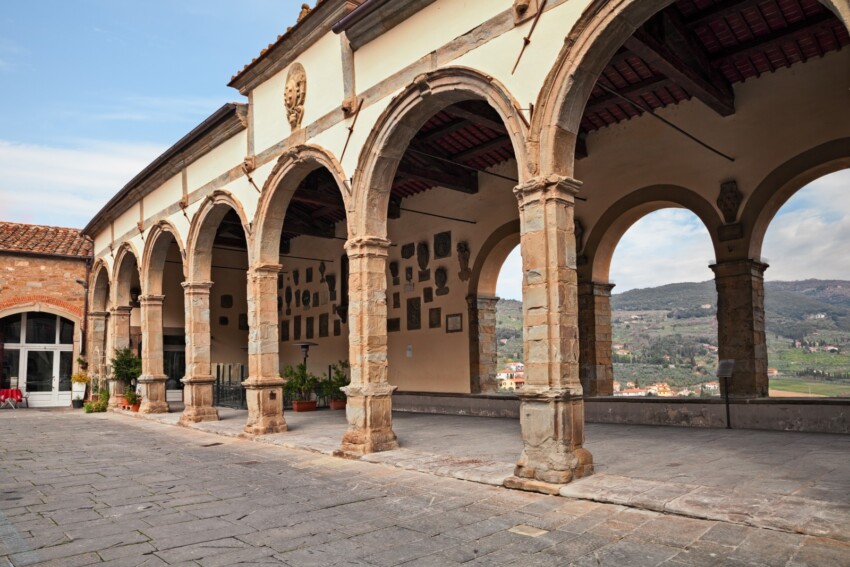
Castiglion Fiorentino rises on the eastern flank of the valley, on a hilltop commanding exceptional views across the plain below. The heart of the village is Piazza del Municipio, dominated by the elegant Logge del Vasari — attributed to Giorgio Vasari, the Aretine architect and art historian — beneath which opens a breathtaking prospect over the surrounding countryside.
Worth visiting is the Cassero complex, the ancient defensive structure that now houses a civic and archaeological museum featuring Etruscan, Roman and medieval artefacts. The village also preserves several churches of considerable interest, including the Collegiata di San Giuliano with works by Bartolomeo della Gatta. If you’re in the area in August, don’t miss the village’s own version of the Joust of the Saracen, which brings the historic centre to life with medieval costumed performers.
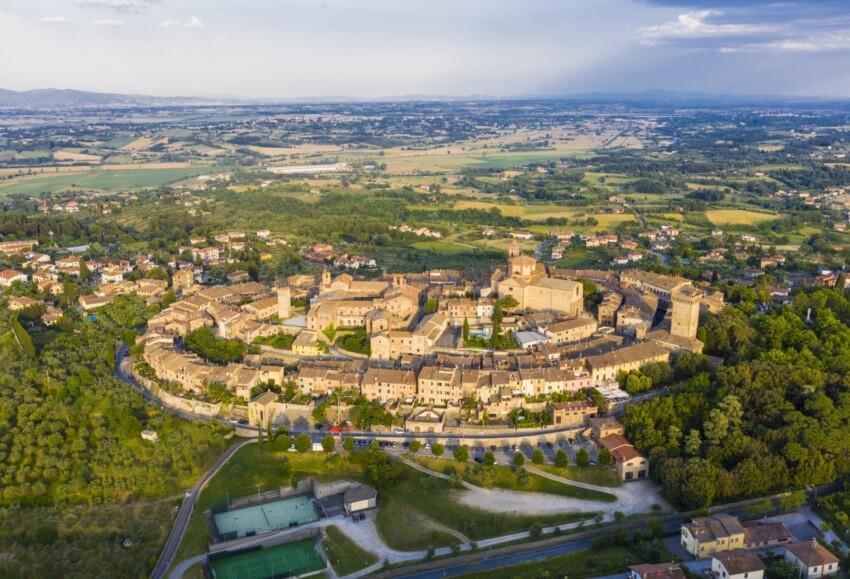
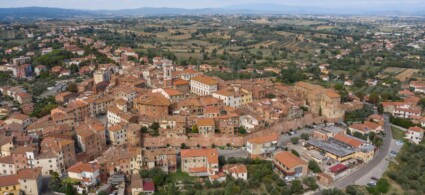
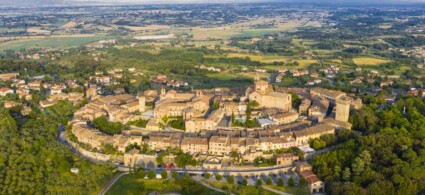
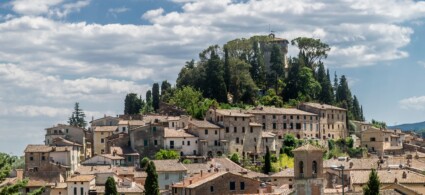
Lucignano is one of Tuscany’s most distinctive and photographed villages, celebrated for its elliptical urban layout: four concentric rings of alleyways, towers and palaces spiralling around the hilltop summit like the rings of a snail shell. A unique urban design in Italy, fully appreciated only from above or in a satellite image.
Within the Civic Museum is housed the Golden Tree, a fourteenth-to-fifteenth-century Gothic reliquary in gilded silver of extraordinary craftsmanship, considered one of Tuscany’s finest medieval goldsmith masterpieces. The village is also surrounded by well-preserved walls with corner towers, and a stroll around the outer perimeter rewards you with stunning views across Valdichiana countryside.
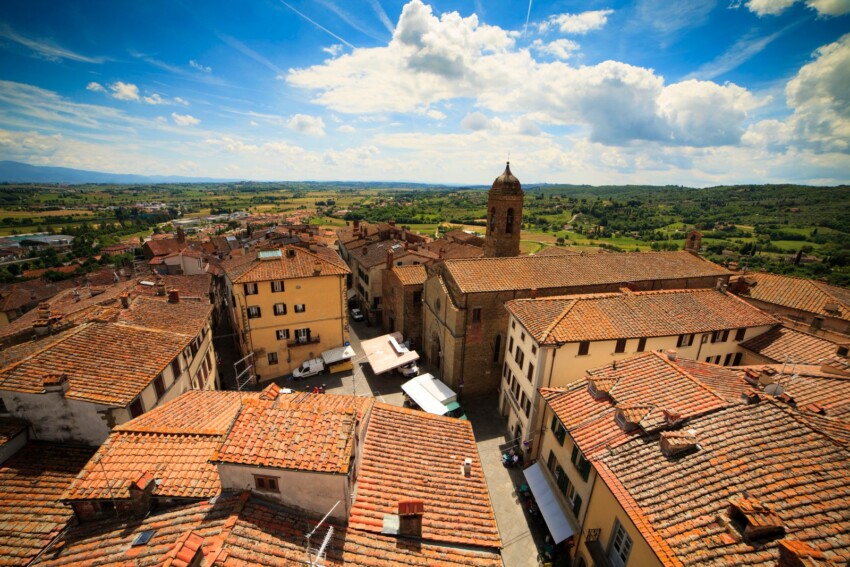
Monte San Savino is the birthplace of Andrea Contucci, called Sansovino, the Renaissance sculptor and architect who left some of his most significant works here before departing for Rome and Portugal. The Loggiato dei Mercanti, attributed to Antonio da Sangallo the Elder, and the Church of Santa Chiara featuring Sansovino’s terracottas are the main attractions of the historic centre.
The village is also one of Tuscany’s most important centres for artistic ceramics production, with craft workshops keeping centuries-old traditions alive. Its hilltop position offers fine views over the plain, and the surrounding area features Medici villas and historic farmsteads testifying to the region’s agricultural heritage.
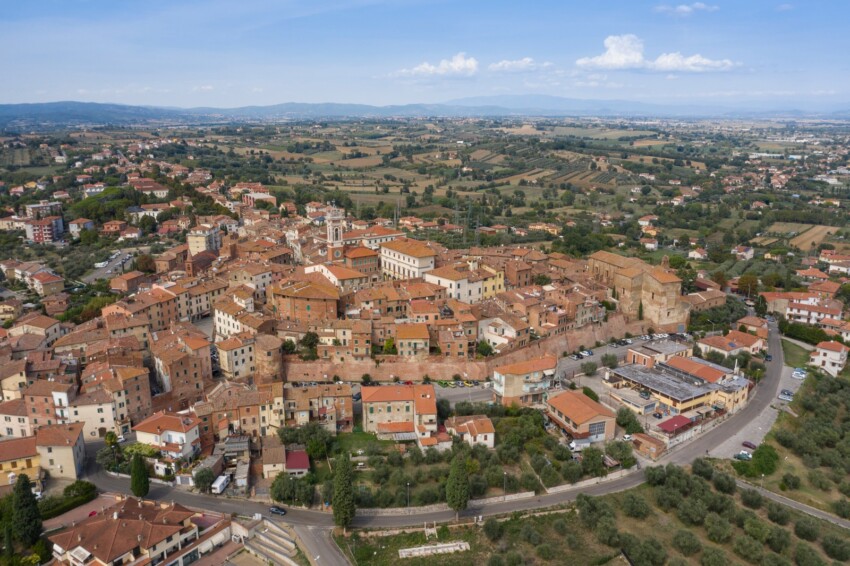
Foiano della Chiana boasts the distinction of hosting Italy’s oldest carnival, with documented tradition dating back to 1539. Each year, between January and February, four districts compete in constructing satirical allegorical floats that are then ritually burned on the final Sunday of Carnival: a spectacular and colourful event attracting visitors from across the region.
Beyond Carnival, Foiano deserves a visit for the Collegiata di San Martino, which preserves a precious altarpiece by Luca Signorelli, and for its characteristic red-brick historic centre, an unusual choice compared to the pietra serena stone predominant in nearby villages.
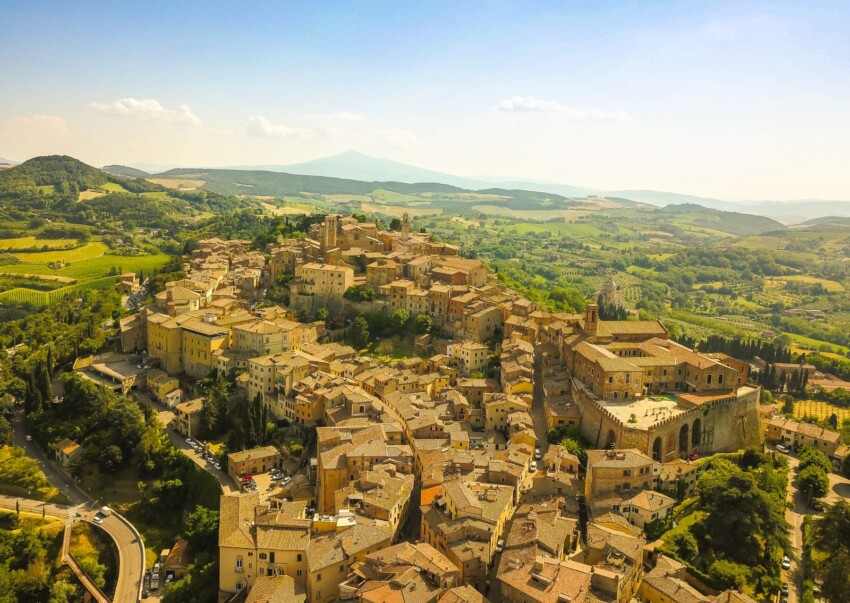
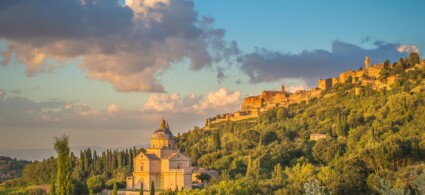
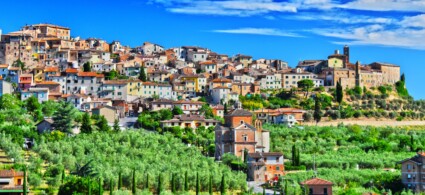
Technically in Valdichiana Senese, Montepulciano is one of the valley’s most celebrated destinations. The city dominates the plain from atop a long hill ridge and its Renaissance historic centre, with Piazza Grande framed by the Cathedral and Town Hall, ranks among Tuscany’s finest. But Montepulciano is renowned worldwide above all for its wine: Vino Nobile di Montepulciano DOCG, produced mainly from Sangiovese grapes, is one of Tuscany’s most prestigious reds. Wine bars and cellars carved into the tufa beneath the historic centre are an essential stop for wine lovers.
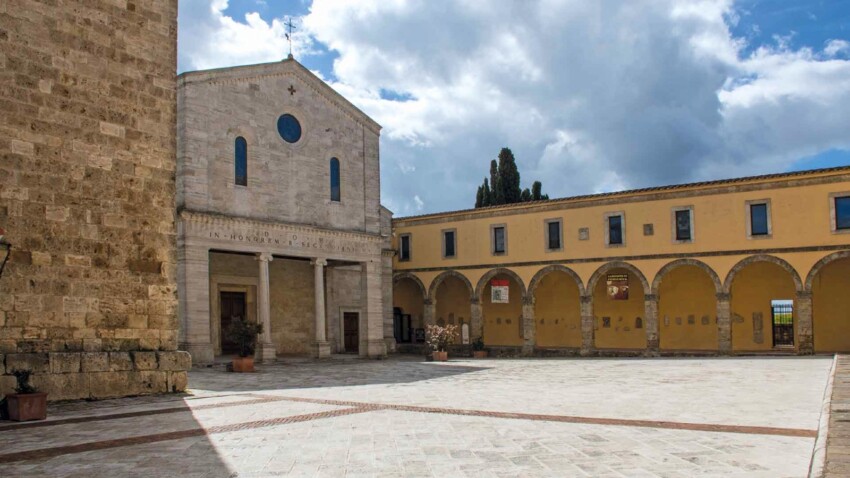
Chiusi was one of the most powerful Etruscan city-states, the city of King Porsenna who legend says challenged Rome. Its National Etruscan Museum is among Italy’s most important, with a collection of vases, funerary urns, sarcophagi and everyday objects documenting millennia of civilisation. In the surrounding area it’s possible to visit some Etruscan tombs still in situ, guided by specialist guides: the Tombs of the Monkey and the Lion are among the most fascinating.
The medieval historic centre, with its Cathedral incorporating Roman columns and preserving cosmatesque mosaics, is worth exploring, as is the view of Lake Chiusi opening just beyond the walls.
Valdichiana offers a variety of accommodation to suit the most diverse tastes and needs. Cortona is the centre with the greatest range of hotels in the area: hotels in the historic centre, bed and breakfasts in historic palaces and farmhouse stays on the surrounding hills allow you to choose between immersion in the medieval village and countryside tranquillity, with views across the valley at breakfast.
Those seeking maximum privacy and authentic Tuscan charm will find in the countryside between Castiglion Fiorentino, Lucignano and Monte San Savino a concentration of quality farmhouse stays and holiday homes, often converted from ancient farms and estates with swimming pools and private vineyards. This is the ideal solution for those wishing to use Valdichiana as a base for daily excursions to both Arezzo and Siena and Montepulciano.
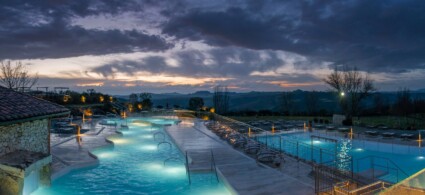
In the Siena area, Montepulciano and its surroundings offer some of the zone’s most refined properties, with wineries that also offer rooms and suites for a complete wine-and-landscape experience. Chianciano Terme remains the reference thermal spa destination, with hotels equipped for wellness stays and spa treatments.
Valdichiana is easily accessible thanks to its position along central Italy’s main transport corridor. The Autostrada del Sole A1 motorway crosses it north to south with several exits — Arezzo, Val di Chiana, Chiusi-Chianciano — making the valley reachable in roughly two hours from Florence and slightly more from Rome. Those arriving by train can use the Florence-Rome line with stops at Arezzo and Chiusi, both well connected to valley locations via bus or taxi.
The nearest airport is Florence Amerigo Vespucci, roughly an hour’s drive from the heart of Valdichiana Aretina. Pisa airport is about an hour and a half away. In either case, car hire is the best option for moving freely around the valley: the hilltop villages are often accessible only by road and the distance between one centre and another makes having your own transport essential.
Val di Chiana stretches across central Tuscany between the provinces of Arezzo (to the north) and Siena (to the south-west), continuing beyond the regional border into Umbria. Cortona is 28 km from Arezzo, 80 km from Siena and 120 km from Florence. Montepulciano is roughly 70 km from Siena and 130 km from Florence.
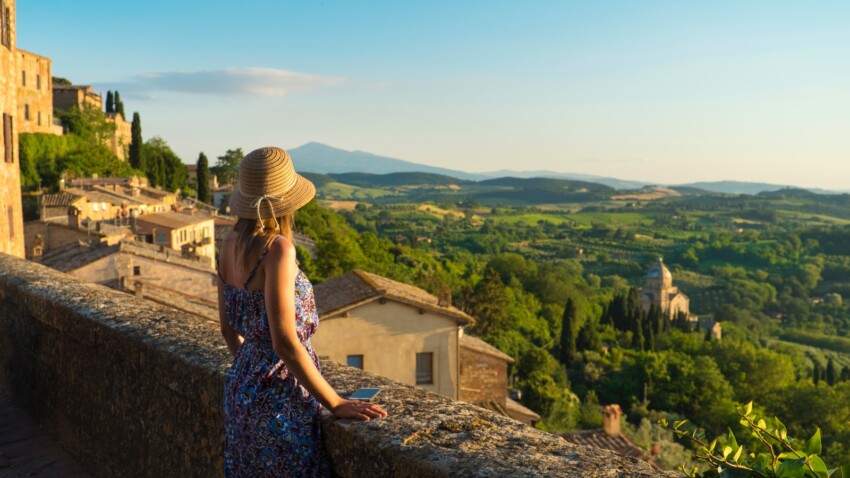
The Chiana is the largest of the Apennine valleys: over 500 square kilometres of meticulously cultivated land. A garden, to see it from Cortona, that ancient city dominating it all from its 600-metre height. Already twenty-two centuries ago it must have been regarded as Etruria’s granary if Hannibal, before crossing it to draw Roman legions into the Trasimeno ambush, was able to supply his army by plundering it.
But more than historical accounts, archaeological evidence and cultural traditions support the idea of Val di Chiana as a land of ancient civilisation. The underground tombs of Camucia and del Sodo, finds from Farneta, Foiano, Cignano and Castiglion Fiorentino, and the Cortona museum confirm that the Etruscans populated and farmed this valley, battling the waters that had paludified it for millennia.
When Leonardo, over fifteen centuries later, sketched the Codex Atlanticus, Val di Chiana appeared once again as a lake. This was because, following the fall of the Western Roman Empire, barbarian invasions and especially the Gothic wars that bloodied Italy for almost the entire sixth century AD led to rural depopulation: no longer carefully tended, Val di Chiana succumbed once more to waters that returned to inundate it.
The Lorraine land reclamation, designed and directed by the Aretine Vittorio Fossombroni between the late eighteenth and early nineteenth centuries, restored Val di Chiana to its ancient fertility, scattering it with new villages and farmhouses of magnificent architecture and, for the time, impeccable functionality.
It was not always a fortunate island. After Hannibal’s passage, other epic moments in history occurred in Val di Chiana during the process leading to the constitution of the Tuscan state: the battle of Pieve al Toppo (1288), in which the Aretines inflicted a heavy defeat on the Sienese, then allied with the Florentine Guelphs, and the battle of Scannagallo (1554) — so named for the great number of French mercenaries killed — fought near Foiano, which determined the subjugation of the Siena Republic to Cosimo de’ Medici, First Grand Duke of Tuscany. Numerous gifted artists were born here, among whom stood out Luca Signorelli, Pietro da Cortona, Andrea Sansovino and Gino Severini.
The Val di Chiana was once the breadbasket of Etruria and remains one of the prime regions for the Chianina, an indigenous cattle breed considered among the world’s finest for meat production. Tall, white and muscular, the Chianina is one of Europe’s oldest cattle breeds: its origins trace back to prehistoric times in the valley, evidenced by depictions on Roman coins and bas-reliefs showing white oxen in triumphal processions. Today, its breeding is governed by strict regulations under the Vitellone Bianco dell’Appennino Centrale IGP consortium, which safeguards the quality and traceability of the meat.
 Hotel
Hotel 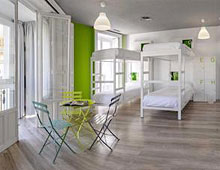 Budget accommodations
  Apartments
  Family Hotel
 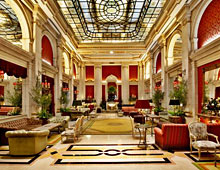 Luxury Hotel
 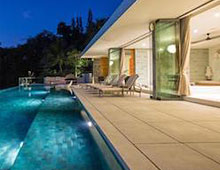 Resorts