Florence: Uffizi Timed Ticket & Masterpieces Audio App
7.148 reviews
Buy now
From 27,20€ per person
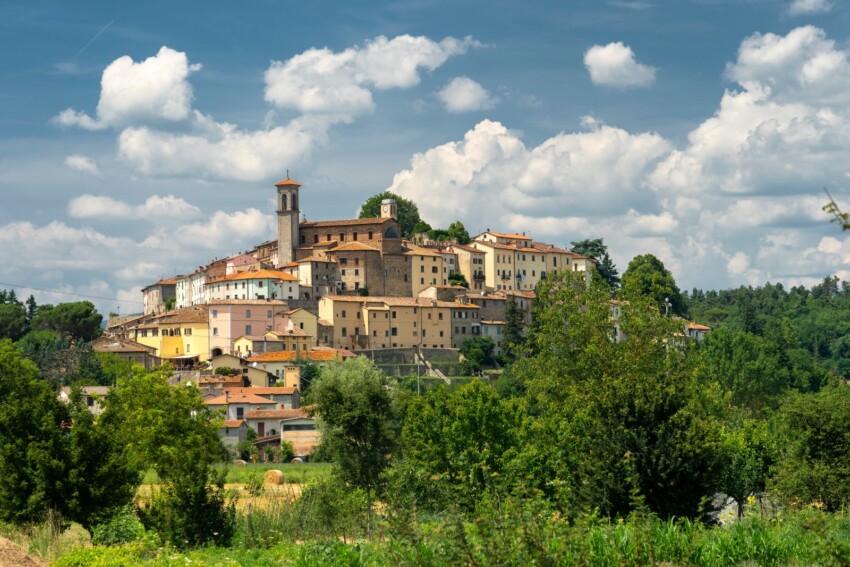
The Valtiberina is the valley of the Tiber, with the river defining its contours and making it a fertile land where authentic countryside flavours and aromas meet. It’s a place where the distinction between organic and natural is almost imperceptible—where farms still produce everything in the traditional way, just as peasant farmers once knew how to work the land.
The Valtiberina served as both a border and meeting point between different civilisations: Umbrian and Etruscan, Byzantine and Lombard. For centuries, the Bishops of Arezzo, the Lords of Rimini and Montefeltro, the Popes of Rome and finally the Florentines fought over these mountains and valleys. Roman nobles in the time of Augustus discovered its beauty and built villas here.
Then came the age of feudal lords and abbots, who erected solid fortresses and monasteries, and of saints who found places here to satisfy their mystical yearnings. Michelangelo, born among these mountains, perceived life within the heart of stone, whilst Piero della Francesca, a native of Borgo San Sepolcro, grasped the secrets of space and light and translated them into paint. In its variety of architectural styles, customs and traditions, artisanal products and even language, the Valtiberina reveals multiple influences from Romagna, the Marche and Umbria—influences that give the valley its distinctive character within the broader Tuscan context.
The traditional difficulty of crossing between the two sides of the central Apennines contributed to the relative isolation of this valley, in which Sansepolcro established itself as a town with its own distinct identity and cultural independence. Perfectly preserved walled towns like Anghiari and river settlements such as Pieve Santo Stefano, Camaldolese abbeys and Franciscan convents, ancient parish churches and medieval castles all tell the story of this enchanting world and point travellers towards the most evocative and varied routes.
The Upper Tiber Valley is traversed along its entire length by the SS3 Tiberina road and the E45 superstrada, which connects Rome to northern Italy whilst crossing the Apennines near the Tiber’s source. Other roads link it to Arezzo, the Val di Chiana, Casentino to the west, Romagna to the north, and Montefeltro and the Adriatic to the east.
Sheep, Chianina cattle, pigs of every breed, small livestock farms and the fruit and vegetables of the fertile plains, Kentucky tobacco, grain, spelt, chestnuts and aromatic herbs are found at every turn, on every mountainside. It’s difficult to say which product is most significant to the valley, and hard to recommend where to start: with chestnuts, with pasta (which has a rather intriguing history here), with delicious authentic cheeses, or perhaps it’s the perfect opportunity to try genuine Chianina beef—and you really can here, because you’ll see Chianina cattle everywhere, with breeders who know their white cows and enormous bulls by name!
It doesn’t matter where you decide to start—what matters is deciding to take a route through these farms scattered across this paradise, where nature is truly unspoilt, captivating and genuinely “delicious”!
The Valtiberina is a land to be seen and savoured with your eyes and palate, to be crossed with care and unhurried pace, and where you should linger to discover and appreciate the natural beauty, places of historical and artistic interest and the precious gastronomic heritage. The basket of products brings together the “typical” Valtiberina specialities in one collection—products that are “typical” because they’re connected to our historical traditions, characterised by the use of strictly local raw materials and sourced from businesses within the area.
You could start in Anghiari, a characteristic medieval village and site of the historic 1440 battle between the Florentines and Milanese, celebrated by Leonardo in a fresco of which only a few cartoons remain. The countryside around Anghiari is surrounded by olive groves producing excellent oil with an herbaceous flavour.
The next stop is Monterchi, the birthplace of Monna Romana, mother of Piero della Francesca, where you can admire the famous fresco Madonna del Parto, which inspired the logo of the Flavour Route. Sunflower fields and maize crops characterise the agricultural activity, and polenta is indeed the typical dish here, as witnessed by the popular Polenta Festival held in autumn.
Continuing towards Sansepolcro, the route passes through fields of tobacco cultivation. This is Kentucky Tobacco, a prized variety produced through long tradition and renowned expertise, used to make Tuscan cigars. Excellent vegetable, fruit and produce cultivation, along with fine cheeses, characterise the countryside around Sansepolcro and throughout the valley you can enjoy high-quality meats and cured products. The town is known worldwide for its pasta—it was here in the early 1800s that the first Buitoni factory was established. Moreover, considerable care and attention has always been given to bread-making and bakery products.
Heading towards Badia Tedalda, with the Alpe della Luna Nature Reserve behind you, the landscape is dominated by vast pastures where semi-wild white beef cattle of the Central Apennines (the renowned Chianina breed) are raised. The national cattle show and market for Chianina-breed livestock is an important event for all sector operators, held at Ponte Presale at the end of September.
Badia Tedalda is a small village that preserves ancient memories: pilgrims heading along the Via Romea towards the Holy City passed through here. Through dense forests, renowned for truffle gathering and mushroom and aromatic herb collection, you reach Sestino, the last town in Arezzo province. Inhabited since Neolithic times and formerly a Roman municipality, the numerous archaeological finds preserved in the National Antiquarium testify to its thousand-year history.
Pieve Santo Stefano, a town of Roman origin, is now known for its collection of unpublished writings preserved in the National Diary Archive. Here the Institute for Agriculture carries out important work rediscovering indigenous fruit crops such as apples, pears and other typical varieties.
The “prugnolo” (Caesar’s mushroom), the most prized of all mushrooms, takes centre stage at the Prugnolo Festival in spring.
Caprese Michelangelo, birthplace of Michelangelo Buonarroti, is a village surrounded by chestnut woods where the famous and prized Caprese chestnuts are gathered, along with mushrooms and other rich woodland produce. Many chestnut-based dishes or chestnut flour dishes are revived each year in October at the traditional festival.
The Flavour Route, with its maps and directions, guides travellers through the ancient villages of the Valtiberina, its protected areas, green valleys and woodlands, on a journey dedicated to tranquillity and the pleasure of living in close contact with the rural and artisanal traditions of this land.
The businesses and accommodation along the route are stopping points where you can taste and savour the rich array of local specialities: Chianina beef, traditional cured meats, delicious woodland products, varieties of mushrooms, truffles, chestnuts, honey, cheeses, bread, oil, wine and medicinal herbs—products that represent the culture of this land.
The Sasso di Simone Nature Reserve presents itself to visitors as one of the most distinctive in the Arezzo Province. It’s designed as a destination for those passionate about nature and history who wish to immerse themselves in an almost untouched environment, discovering fascinating panoramic vistas, extraordinary geological formations and intriguing historical events centred on this enormous limestone raft.
In continuous motion on a geological timescale, the Sasso “migrated” in ancient times from the Tyrrhenian Sea where it emerged 15 million years ago, floating above a thick layer of clay. Nature expresses its pristine beauty in the natural cerreta woodland, a treasure chest of rare plant and tree species, in the immense meadows that in spring burst with colours from countless floral species, and in the badlands formations with their multicoloured earth offering glimpses of a lunar “gorge” in their spectacularly dramatic shapes and hues. The history of the Sasso features the Medici Family, who with Cosimo commissioned the construction of a fortress city on the summit itself, called the “City of the Sun”, whose traces are still visible today.
 Hotel
Hotel  Budget accommodations
  Apartments
  Family Hotel
  Luxury Hotel
  Resorts