Poggio Baronti B&B
Bagno a Ripoli - Via Dell'Eremo 3
Book now
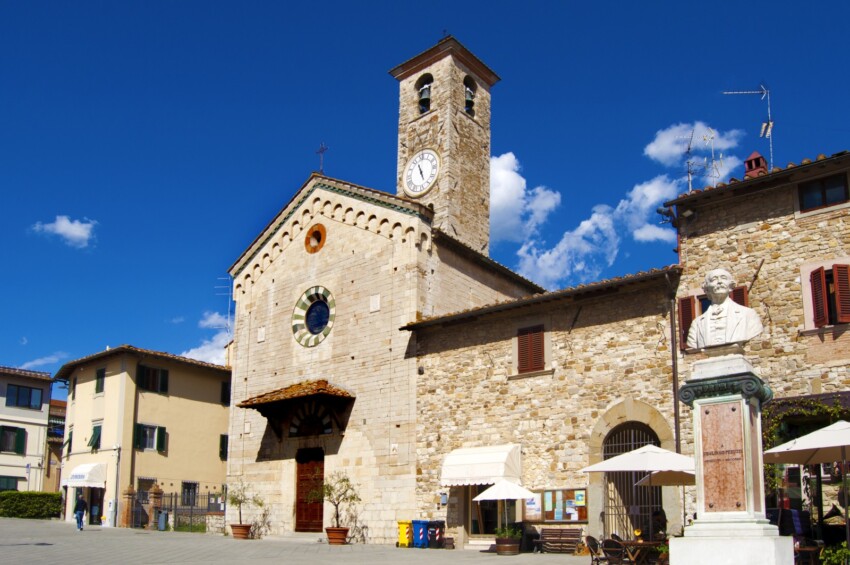
The history of the community of Bagno a Ripoli stretches back through the centuries, even predating the legendary foundation of Florence in 59 AD, reaching back to the Etruscan and Roman periods – as evidenced by numerous archaeological finds. These include the famous Sasso Scritto, a sandstone boundary marker discovered in the 1970s on the banks of the Borro di Calcinaia near Gavignano, bearing an Etruscan inscription with the legible words Tular spular, meaning “boundary of the community” (the stone likely marked the boundaries of the Etruscan community of Fiesole, along an ancient trade route connecting southern and northern Etruria), through to Roman-era excavations. It was under Roman rule that our territory truly acquired greater significance as a crossroads for commercial exchange.
The ancient Ripulae, whose name derives from the embankments built to prevent the Arno from flooding the cultivated plains with its recurring floods, became a thriving settlement between Florence, Fiesole and Arezzo. Clear evidence of this prosperity can be found in the excavations on via della Nave and those – not open to the public – of the Roman Villa at Antella, on the left side of the road leading to Ponte a Niccheri hospital. The complex discovered there likely formed part of a rural villa from the imperial age, owned by timber merchant Publius Alfius Heracles, whose funeral inscription, dedicated to him by his wife Versinia, has been uncovered.
Agriculture and the beauty of the landscape represent the oldest and truest wealth of this territory, particularly from the Middle Ages onwards when the fertile countryside of Bagno a Ripoli began to be “colonised” by noble Florentine families.
The healthy climate, the availability of renewable energy from the waters of the Arno, and the fertility of the Ripoli soil – which earned our municipality the description of the “most delightful garden” in the Florentine countryside – have exercised a continuous appeal throughout the Renaissance as well. As the centuries have passed, this has left a tangible and unique mark: churches, convents, castles and villas still dot our hills today.
Among the most important buildings we should mention Castello di Quarate, an ancient fortress of Lombard origin (9th century AD) whose tower is today crowned with olive trees.
Linked to pilgrimage traditions is the Spedale del Bigallo, built in the early 1200s to provide shelter for the poor and pilgrims, and today an international youth hostel as well as the venue for prestigious events (dinners, tastings, exhibitions) held in its monumental halls and charming enclosed garden.
Another jewel of the Bagno a Ripoli territory is the Oratory of Santa Caterina, a treasure of Gothic art commissioned in the 14th century by the Alberti family and beautifully frescoed by three great masters of Italian painting – the Master of Barberino, Pietro Nelli and Spinello Aretino – with a pictorial cycle devoted to the life and miracles of Saint Catherine of Alexandria. Today the Oratory serves as an evocative venue for important contemporary art exhibitions.
The close relationship between art, faith and history is underlined by numerous other sacred buildings rich in artistic treasures: the Parish Church of Villamagna (11th century), with its characteristic three-nave basilica layout and an abundance of frescoes by Buggiano, Mariotto di Nardo, the Master of Signa and Francesco Granacci, a friend of Michelangelo.
Also of considerable interest is the Parish Church of Santa Maria a Quarto (13th century), which houses a Madonna in Majesty by Bicci di Lorenzo, the Parish Church of Santa Maria all’Antella, and that of San Piero a Ripoli. Equally evocative are the Oratory of San Tommaso a Baroncelli (12th century), the jealous custodian of the famous Miraculous Crucifix that, in the time of Grand Duke Cosimo, saved many residents from the plague, and the quiet hermitage of the Convent of the Incontro, an ancient Lombard fortress converted into a hermitage for monks from the 8th century onwards and subsequently expanded into a convent from 1716 thanks to the work of San Leonardo da Porto Maurizio, founder of the Via Crucis.
The history of Bagno a Ripoli is also closely linked to the development and establishment of new techniques in both craft and agricultural production.
On the banks of the Arno, living evidence of the relationship between man and Florence’s premier river, stands the 14th-century complex of the Gualchiere di Remole, formerly a castle and then, in the 14th century, converted by the powerful Alessandri and Albizi families into a wool-processing mill, whose output represented a major source of wealth for many noble Florentine families. The Gualchiere di Remole constitute one of only a few surviving intact examples of European industrial archaeology, demonstrating the use of the water wheel and a production system entirely powered by water. Also scattered across the gentle hills of Bagno a Ripoli are numerous rural complexes alongside splendid Medici villas, set within the typical Tuscan countryside: Villa La Tana, home of Bianca Cappello, mistress of Francesco I de’ Medici; Villa Mondeggi, with its frescoed rooms and lush park complete with fountains and water features; the nearby Villa Lappeggi, transformed into a palace by architect Alessandro Ferri at the behest of the pleasure-loving Cardinal Francesco Maria de’ Medici, who made it a refuge for poets, artists and master chefs; and not least, Villa Il Riposo.
Within the park of this residence stands the Fata Morgana Fountain, an example of garden architecture created by the Flemish artist Giambologna (late 16th century), unique in its kind as it sits somewhere between traditional nymphaeums and grottos.
To see all the facilities and book accommodation in Bagno a Ripoli use the form below, entering the dates of your stay.

 Hotel
Hotel  Budget accommodations
  Apartments
  Family Hotel
  Luxury Hotel
  Resorts