Villa San Filippo
Barberino di Val dʼElsa - Strada delle Ginestre nr 06
Book now
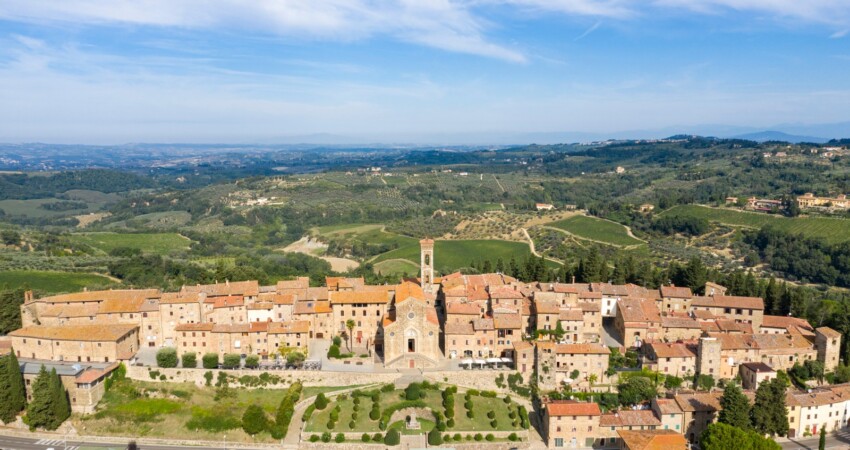
The land of Barberino, brimming with history and legend, lies in the heart of Tuscany, between Florence and Siena. Numerous architectural treasures scattered across the territory make its history still legible today. The medieval historic centre continues to characterise the town, which has an oblong or “spindle” shape and is traversed along its entire length by the main street connecting the two access gates—the Roman Senese gate and the Florentine gate—whilst two other parallel streets converge near the gate. This urban layout is fairly typical of the walled centres of Valdelsa and has remained substantially intact, though the defensive walls have suffered some damage. Both gates still exist today, although the Florentine gate is a modern reconstruction, as are the defensive towers overlooking the Drove valley.
The Senese gate is built in stone and features an elegant Gothic arch, with a small brick bell tower from the 18th century above the masonry. As a fortress or borough within the parish of San Pietro in Bossolo, Barberino is mentioned in a document discovered among the papers of Passignano Abbey in 1054. The development of the borough, however, dates to the early decades of the 13th century, following the destruction of Semifonte by the Florentines in 1202. “Florence, step aside, for Semifonte becomes a city” was the refrain that echoed even beneath the walls of Florence, which, in fury and violence, after conquering it wished to destroy it completely, forbidding any rebuilding on the hill for centuries. Today, in perpetual memory of that tragic event, there stands on the summit of what was once the hill of Semifonte, a dome identical to Brunelleschi’s, though five times smaller.
By the following century, the centre was already under Florence’s control, which surrounded it with walls and provided it with a military garrison. It subsequently became part of the Florentine Republic and served as the seat of a Podestà. The road that now skirts the town to the east originally ran through it, meaning merchants and pilgrims necessarily had to pass through and stop within its walls. This explains the presence, just inside the Florentine gate, of the Pilgrims’ Hospital, built in 1365 by Taddeo di Cecco, son of the notary and poet Francesco da Barberino. Its ridge-top position, on the watershed between Valdelsa and Val di Pesa, favoured the Florentines’ strategic interests, as they fortified the castle against feudal lords allied with the Empire.
Once you enter the town from the Senese Gate, on your left you’ll find a noble palazzo: this is the so-called Cardinal’s Palace, which bears the coat of arms with bees on its main entrance—that of the Barberini, the powerful family of Pope Urban VIII. Inside is a picturesque courtyard with a circular well and a grand reception hall. To the right of the gate stands another 14th-century palazzo built on the eastern walls, now converted into a farm. Continuing along the main street, on the right you’ll encounter the handsome Palazzo Pretorio, now the propositura of S. Bartolomeo, with a Renaissance façade adorned with heraldic shields belonging to the Podestà until the 15th century.
The thirty-five shields on the façade belong to the most important families of Florence and are mostly carved in pietra serena. Across the piazza, a building with a loggia opens up, which served the typical function of civic loggias as spaces for public representation, assembly and covered market.
The propositura of Barberino underwent considerable changes over the centuries until it was radically transformed in 1910 by Florentine architect Castellucci, who also changed the orientation of the façade from the main piazza towards the valley. An interesting remnant of the old church is the cross sculpted and enclosed in a tondo of the external architrave of the main door. Inside you can admire some 14th-15th-century fresco fragments, a bronze bust of Blessed Davanzato and his remains.
Near the Florentine gate stands the Pilgrims’ Hospital, of which some frescoes and a stone plaque are preserved. Recently restored, the building now houses the Municipal Library. Recently, a statue was placed in the piazza in front of the Town Hall to commemorate the 14th-century writer Francesco da Barberino, who was born in our town—a work by German sculptor Quirin Roth.
This is a small archaeological museum, located in spaces adjoining the pieve (parish church) of Sant’Appiano (just a few kilometres from Barberino Val d’Elsa), which houses some of the numerous excavation materials found in the surrounding area.
In the first of the two small rooms making up the Antiquarium you’ll find some alabaster funerary urns from the Hellenistic period, with effigies of the deceased carved on the lid and bas-reliefs depicting scenes of Greek mythology. Two smaller caskets, one of which bears the figure of a knight wrapped in a shroud about to enter Hades, are displayed in a case alongside Attic red-figure ceramics dating to between the 6th and 5th centuries BC.
The glass cases in the second room contain a substantial collection of low medieval and Renaissance ceramics typical of the Florence area, some Etruscan funerary cippi and a small pagan arenaria idol depicting the god Eros riding an animal, discovered during the demolition of the baptistry.
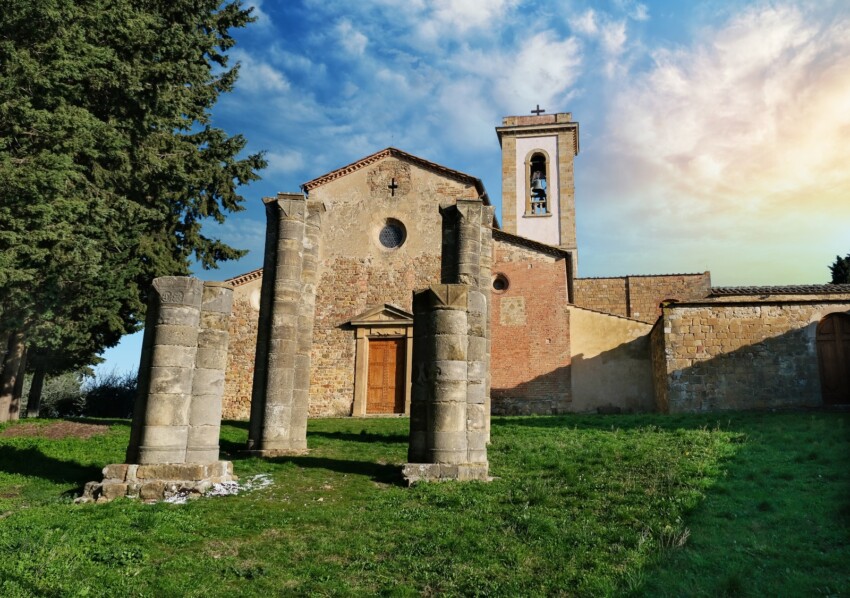
The interior of the pieve displays two different versions of Romanesque style: the proto-Romanesque, dating back to the original foundation, and a later version of the same style, recognisable in the right lateral nave, which was destroyed and rebuilt between the 12th and 13th centuries. The church walls retain a series of frescoes in the Florentine school style from the late 15th century (in the left nave), and 16th-century frescoes on the vault at the base of the bell tower and in the Chapel of the Blessed Sacrament.
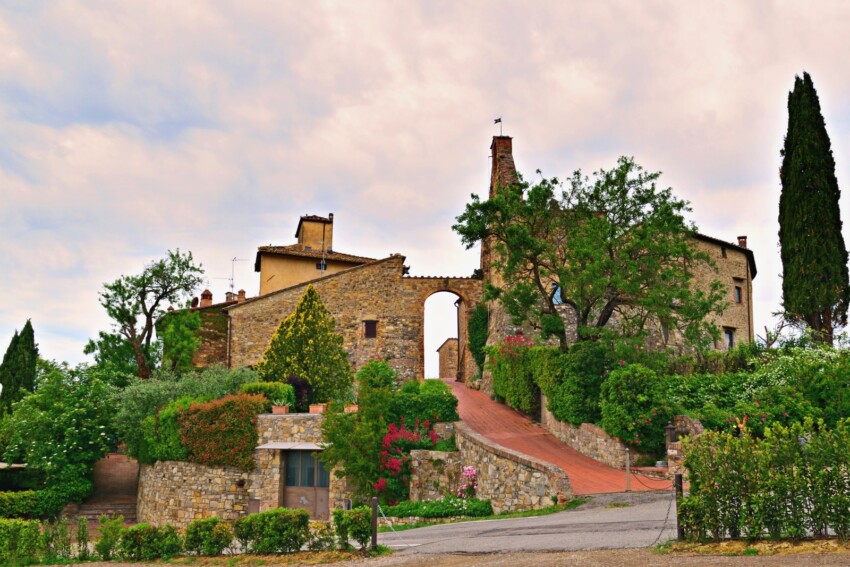
Perched on a small hillock (334 m) facing Barberino, with sweeping views across the Elsa Valley and the narrow Drove valley, lies the picturesque castle of Tignano. It is perhaps the finest example of a walled settlement in the Elsa Valley. Its original circular castellated structure with a central piazza is distinctive. Access to the castle is via a steep ramp leading to the Florentine Gate, defended by a squat square tower, the Cassero.
Excellently positioned on an elongated hilltop that acts as a watershed between the Elsa and Pesa valleys. Rounded arches and stone palaces with imposing openings are striking features. The pentagonal piazza is particularly noteworthy. Renowned for its climate thanks to its ridge-top location and altitude of around 400 m above sea level, Marcialla offers stunning views in all directions.
The village of Petrognano spreads across verdant vineyard-covered hills along the road from Barberino to Certaldo. It is a cluster of old houses scattered haphazardly around Villa Capponi—urban dwellings with medieval towers, seemingly lost in the countryside. This is because Petrognano is nothing more than a settlement of a vanished city: Semifonte.
Semifonte no longer exists today—it was razed to the ground by Dante’s fellow citizens, the Florentines, in 1202. It had four gates and a central keep with an octagonal tower. The dome of San Donnino, the sole structure now present in that location, was built four centuries later in memory of those tragic events.
A medieval urban centre strategically positioned on a hillock touched by the Via Francigena and near the bridge of San Galgano, which connects the Volterra road to Florence via Semifonte. It retains the urban structure of a spindle-shaped walled castle with two central spaces and two parallel streets converging near the two gates, now disappeared.
On a small hill crossed by the road that branches off from the valley-floor Via Francigena towards Barberino Val d’Elsa, lies the modest rural village of Poneta. The Church of Santa Maria a Poneta is very ancient and significant. San Martino a Pastine is a small and charming church dating to the twelfth century; its structure is substantially intact in its original Romanesque design. Poppiano Castle stands on a hill facing the medieval towers of San Gimignano, of ancient origin but completely rebuilt with crenellated neo-medieval towers.
A delightful fortified village of very ancient origin and great charm due to its location among the verdant hills of the Elsa Valley, on a branch of the Via Francigena leading towards Barberino. In the upper section, where the ancient fortress stands, sits a small Romanesque church of Santa Maria with a fine eighteenth-century bell tower. The castle is organised around a central paved street running from gate to gate.
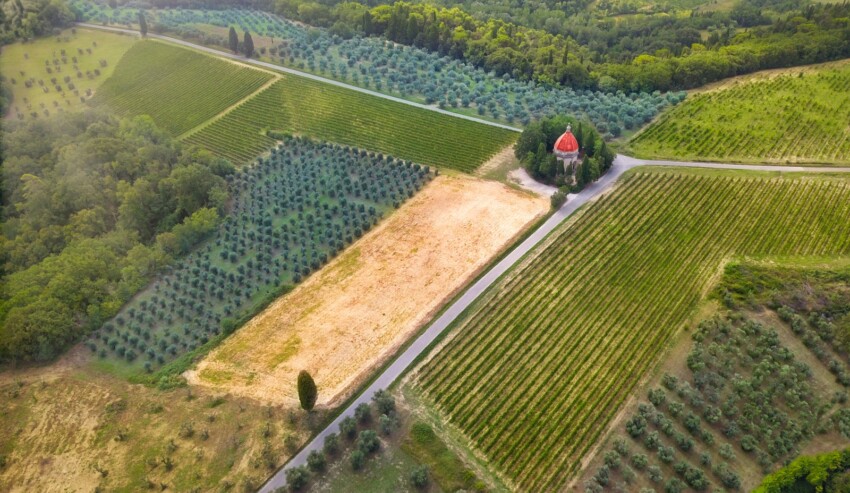
The monumental complex of Sant’Appiano is situated on a pleasant hillock, surrounded by austere cypresses, and comprises the Romanesque Pieve, the ruins of a crumbling octagonal building, the cloister, the rectory and a cluster of houses set slightly apart, forming the village. The beauty of the landscape is matched by the sanctity of the place, where the remains of the saint who gave his name to the locality are preserved.
San Martino ai Colli is a group of ancient houses arranged along the Cassia state road; they are farmsteads but also buildings that served the road, travellers and pilgrims heading to Rome. Today only the cemetery chapel remains, serving as a place of worship.
The rural centre of San Filippo extends across a hill with successive clusters of great landscape appeal. The central settlement, which most closely resembles an urban centre, is traversed by a paved street ending at the Church of San Filippo a Ponzano. This is a Romanesque church of the twelfth to thirteenth centuries, with a rectangular plan and apse.
Monsanto sits on the ridge between the Drove stream and the Cepperello watercourse, in a panoramic location. As a frontier territory between Siena and Florence, it is surrounded by woods, among which the cypress forest is particularly renowned.
Surrounded by countryside that still features examples of traditional cultivation, this tiny centre consists of a cluster of stone houses, a church and a palace. In a strategic position defending the road along the contested border between Florence and Siena stands the splendid tower house of Chito, a superb example of medieval defensive architecture.
The small centre of Olena sits on the margins of the great Chianti forests, a sparse cluster of houses with a church at its heart in a rural setting, evoking an ancient atmosphere but of great landscape charm. The surrounding countryside is particularly beautiful thanks to the forests and hillsides cultivated with specialised vineyards. San Giorgio, by contrast, is an ancient isolated building, built to provide assistance to pilgrims and poor travellers.
To see all the facilities and book accommodation in Barberino Val d’Elsa use the form below, entering the dates of your stay.
 Hotel
Hotel  Budget accommodations
  Apartments
  Family Hotel
  Luxury Hotel
  Resorts