Casa Margherita
Capraia e Limite - Via Vicinale Pulignano, 3a
Book now
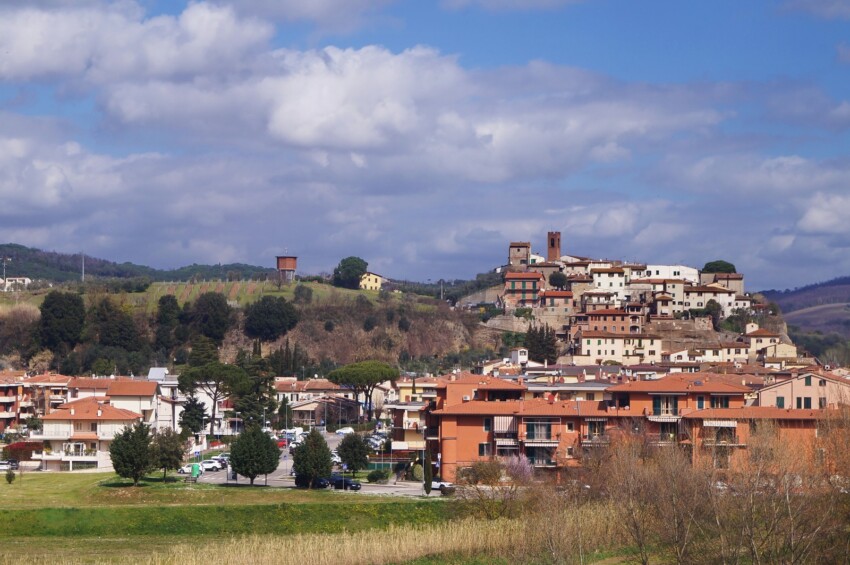
The municipality of Capraia e Limite sits on the right bank of the Arno in the Lower Valdarno, at the foot of Montalbano, and boasts considerable archaeological, historical and artistic riches. Scholars from the De Agostini Institute in Novara have theorised the existence of an ancient Etruscan port settlement within the territory of Capraia e Limite. The northern part of the area is predominantly covered in dense woodland of cerro oak, pine and holm oak, whilst on the hillsides olives and vines are cultivated, and in the flat zones alongside the Arno river, cereals and legumes are grown alongside grapes. Today the municipality comprises two towns (Capraia Fiorentina and Limite sull’Arno) and several small hamlets where ancient settlements first emerged: Bibbiani, Pulignano, Castellina, Castra, Conio and Colle. Today, Capraia e Limite has a population of around 5,800 inhabitants and extends across 25 square kilometres from the right bank of the Arno to the slopes of Montalbano.
The settlement of Capraia sits on a spur that plunges sharply to the Arno and retains the structural characteristics of a fortified medieval village, emphasised by its position on a steep hillock, its narrow lanes designed to repel attacks, and its castle dominating the entire settlement. The origins of Capraia are undoubtedly ancient. It was a fief of the Pistoiese, who from the “Grotta” and the summit of the spur could control traffic—both river and overland—between Florence and Pisa. They were rivals of the Florentines, who, from the castle of Montelupo built directly opposite Capraia‘s castle, countered armed incursions by the Pistoiese themselves.
Limite probably owes its name to its position on the boundary of a political and ecclesiastical jurisdiction. The Diocese of Pistoia ended precisely at Limite, and the Church of San Lorenzo is recorded in 1100 among the thirty-five ancient parish churches of that diocese. Limite developed as a river port thanks to the particular characteristics of the Arno in the stretch where it passes through the town.
From primary activities in farming, pastoralism and forestry, over the course of time other trades emerged, giving rise to small groups of artisans, straw-makers, builders, fishermen and, above all, barge operators who, with their vessels, travelled up and down the river transporting salt, herrings, timber, hides and so on. From ancient times, the people of Limite were drawn to and captivated by their river.
The small port and village of barge operators was destined to develop rapidly, drawing new labour from neighbouring settlements established before Limite, whose inhabitants moved here to pursue the expanding new trades. Gradually, over the years, Limite gained greater importance than Capraia. The Arno river and the development it enabled in the growth of productive, creative and labour activities undoubtedly contributed to Limite‘s expansion: the barge operators grew rapidly in importance due to the skill required to navigate the river at Limite, and they soon became the most accomplished navigators of the Arno from Florence to its mouth and back, sought after for the most important and difficult transport operations. The transition from this category to boat-builders was swift, and when the construction of the Florence-Pisa railway and bridges over the Arno diminished the importance of barge operators, this only served to enhance and strengthen the new specialisation of Limite’s inhabitants as “master carpenters” and the birth of Shipyards, made famous by the distinctive vessels constructed there.
Built in the medieval period, the castle of Castra, whose Roman name indicates a fortified settlement, occupied—as did the nearby castle of Conio—a highly strategic position. Its location appears to be connected with the ancient road network of the area, specifically the Via Francigena or Francesca which, linking Rome with important centres in Germany, France and Spain, was one of the principal routes of medieval travel.
Today, little remains of the ancient nucleus except the tower. The only significant artistic structure is the Church of San Pietro a Castra, which, rebuilt on the ruins of the seventeenth-century building that collapsed following bombing in the last war, preserves inside, in a single nave, a polychrome wooden statue of Saint Peter, datable between the end of the 16th century and the beginning of the 15th century.
To see all the facilities and book accommodation in Capraia e Limite use the form below, entering the dates of your stay.
 Hotel
Hotel 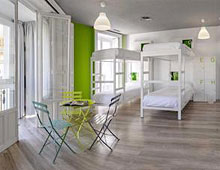 Budget accommodations
  Apartments
  Family Hotel
 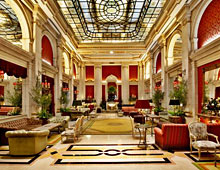 Luxury Hotel
 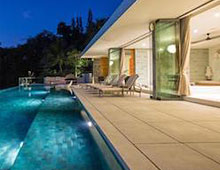 Resorts