Delano rooms
Castelfiorentino - 28 Viale F. D. Roosevelt
Book now
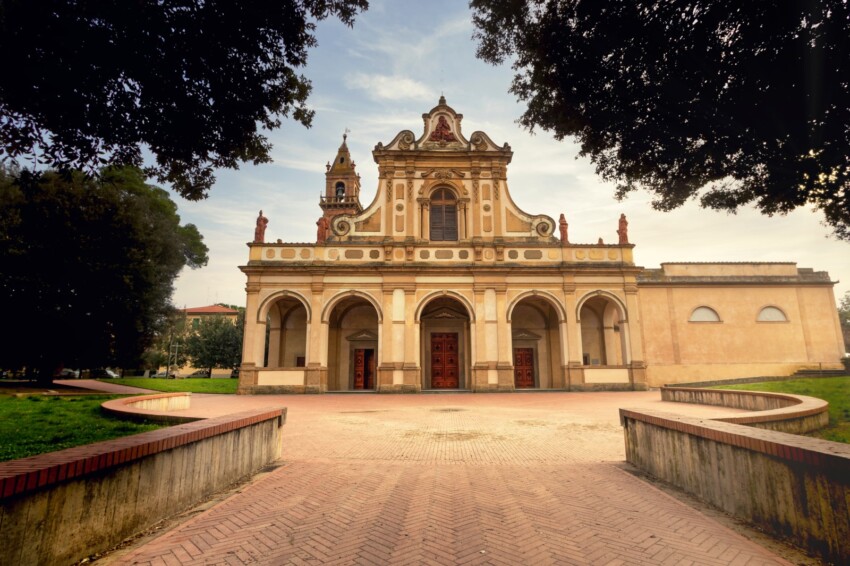
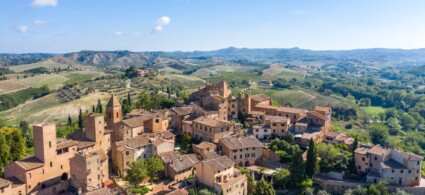
Nestled among Tuscany’s rolling green hills, Castelfiorentino is a charming town in the province of Florence. Situated on territory rich in natural and historical trails, it has become a delightful discovery from a tourist perspective. Ideally positioned, it offers visitors the opportunity to stay in an artistically interesting locality, with its numerous churches, stately villas, and impressive frescoes by Benozzo Gozzoli and those in the Sanctuary of Santa Verdiana, allowing them to reach the major art cities with relative ease.
Thanks to its network of inter-municipal services, it provides quick connections to Tuscany’s principal art cities such as Florence, Pisa and Siena, and to places of historical and artistic interest including Vinci, San Gimignano and Volterra.
An abundant range of accommodation facilities, especially agriturismos, offers opportunities for nature-focused tourism to discover the wonders in the surrounding area of Castelfiorentino. The presence of two hostels (one part of the international Hostelling International chain) demonstrates that tourism aimed at young people is also a fundamental objective of this municipality.
A varied and flourishing programme of artistic and cultural events, fairs and festivals makes the town interesting to visit throughout the year.
The focal point is the large tree-lined Piazza Gramsci, where the Teatro del Popolo overlooks, built in the 19th century.
Walking through the streets of the centre leads to Piazza Cavour, from which Via Palestro begins, where the Palazzo dell’Arciconfraternita della Misericordia stands, built in the 1930s.
Continuing along the street, the massive bulk of the Church of San Francesco (13th century) rises on the right. Behind San Francesco, at the far end of a vast tree-lined meadow, stands the Sanctuary of Santa Verdiana, restructured in the early 1700s.
Returning to the town centre streets and walking along Via Garibaldi and the steep climb (Via Ferruccio), you can see the only remaining gate of the old walls. On the right, in Via Lungo le Mura, remains of medieval dwellings are visible. Continuing up the slope leads to Piazza del Popolo, where on the left you can observe the Palazzo del Comune, rebuilt after a fire in 1544 and restored in 1867. Opposite the Town Hall stands the Church of Santi Lorenzo and Leonardo, dating from the 13th-14th centuries.
Walking along the street to the left of the church (Via Sant’Ippolito) and climbing the steps opposite, you reach the top of a hillock, where stands the Pieve dei Santi Ippolito and Biagio, built in 1195 in terracotta with ceramic motifs on the façade; nearby are also the remains of the original circle of walls with two towers.
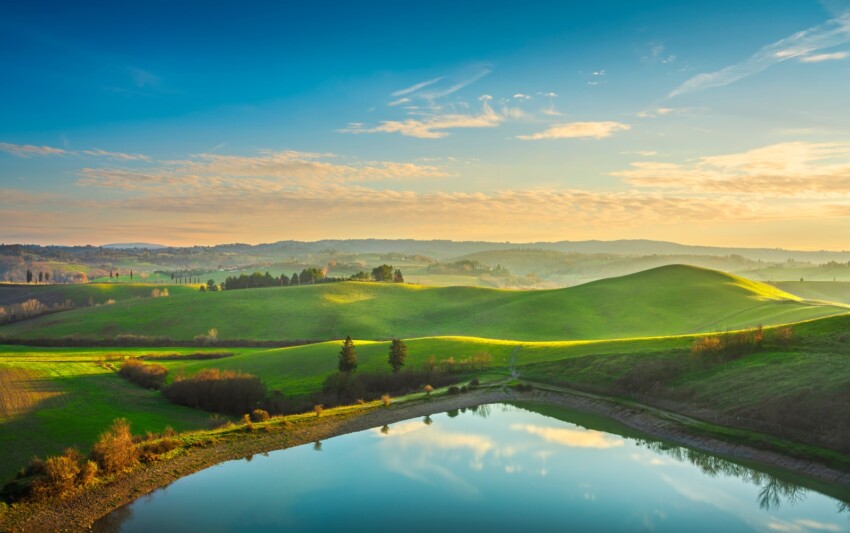
A nature and environmental trail that allows you to immerse yourself in the typical hilly landscape characteristic of the Valdelsa. Along the route you encounter ancient farmhouses, the ruins of the Castello dei Signori di Quercecchio and natural curiosities such as the centuries-old holm oak of Monte Ravoli. The alternation between cultivated land, groves of oak saplings, olives and vineyards are the defining elements of the countryside along this route.
A historical and natural trail allowing you to admire fine features such as the ancient Pieve di Sant’Ippolito a Elsa, known as Pieve Vecchia, the Castello di Cabbiavoli, where tradition holds that Frederick Barbarossa was once hosted, and the Villa di Montorsoli, which was also the convent of Bartolomeo Arrighi.
The route also allows you to reach the Castello di Oliveto, a crenellated and turreted fortification built by Puccio Pucci in 1424.
The Via Francigena, which ran from Canterbury to Rome, is one of the great medieval pilgrimage routes, a main road travelled in the past by thousands of pilgrims journeying to Rome. It played a fundamental role in shaping European identity, connecting religions, cultures, customs, languages and local economies, thereby contributing to the integration of peoples across the old continent.
It was especially in the early second millennium that Europe was traversed by a multitude of pilgrims seeking spiritual purification. This route indeed attests to the importance of pilgrimage in the medieval period: it had to be undertaken predominantly on foot (for penitential reasons) at a pace of 20-25 km per day and carried within it a fundamental devotional aspect: pilgrimage to the Holy Places of the Christian faith. Moreover, the pilgrim did not travel alone but in groups and bore the insignia of pilgrimage.
It should be noted that these pilgrimage routes were simultaneously routes of intensive trade and commerce, and were travelled by armies in their movements. The Via Francigena passed through our territory and led to the creation and development of many towns in the Valdelsa.
Castelfiorentino is located in the territory of the Empolese-Valdelsa district, situated between the middle Arno valley and the northern part of the Elsa valley.
In the Middle Ages this area was a “crossroads territory”, within which the town arose near the intersection of the Via Francigena with the Via Volterrana, becoming a transit point for pilgrims and travellers from Northern Europe heading to Rome.
The original nucleus, the Castelvecchio, was built on the foundations of an ancient settlement of Roman origin, called Timignano.
A fief of the Cadolingi and later of the Conti Alberti, in the 12th century it was acquired by the Bishop of Florence and experienced the vicissitudes of conflicts between Church and Empire and between Siena and Florence, of which it was an important outpost. It was precisely for this reason that it obtained the seat of the Podestà, the privilege of the red Lily on the white banner and the integration of its name, which from 1149 became Castelfiorentino.
In 1260, following the battle of Monteaperti, the peace between Siena and Florence was signed in Castelfiorentino.
The town has had, from the 12th century onwards, great political, economic and artistic significance, by virtue of its position on the border between Florence, Pisa and Siena, cities that dominated the arts in all their forms of expression for centuries. This factor strongly influenced local tastes and patronage and contributed to the creation of an artistic heritage that stands as a true cultural “uniqueness”.
To see all the facilities and book accommodation in Castelfiorentino use the form below, entering the dates of your stay.
 Hotel
Hotel  Budget accommodations
  Apartments
  Family Hotel
  Luxury Hotel
  Resorts