Villa Petriolo
Cerreto Guidi - 7 Via di Petriolo
Book now
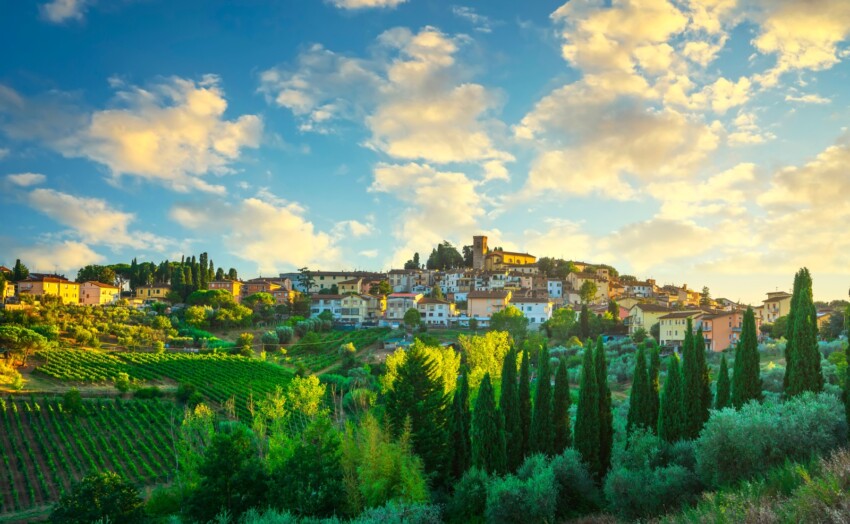
Cerreto Guidi, a territory of gently rolling hills between Montalbano and the Arno, takes its name from the Guidi counts, ancient feudal lords who built a castle here, not far from the route of the Via Francigena, the pilgrim and merchant trail.
In a celebrated drawing by Leonardo da Vinci (1503), the Castle of Cerreto Guidi is depicted; the sketch captures, in a concise yet convincing manner, the urban layout of the village, which appears encircled by fourteenth-century walls, characterised by an almost circular course and the presence of eight towers.
The tradition of hospitality has always made stays among these hills, planted with vines and olive groves, particularly pleasant: they produce DOCG wines and Cerreto Guidi rightfully belongs to the “Città del Vino” association. Vineyards run across hills dotted with fine farmhouses, historic villas and extensive rural dwellings. In the countryside and around smaller settlements, churches and chapels bear witness to the ancient devotion to patron saints, foremost among them Santa Liberata, venerated as the patron saint of Cerreto Guidi. For nature lovers and birdwatching enthusiasts, there are opportunities for interesting excursions along the recommended routes in the Padule di Fucecchio, a vast wetland area inhabited by sizeable colonies of herons and other aquatic species that have found their ideal habitat here.
The ancient church of Santa Maria Assunta, now the seat of the parish church of Bassa, is documented as existing in the year 998 under the title of Santa Maria de’Conflenti or Gonfienti, a name almost certainly referring to its location opposite the confluence of the Elsa into the Arno. The same church is also mentioned in Bulls dispatched by Innocent III (1198) and Honorius III (1217) to the Vallombrosani abbots of Fucecchio, to whom it was granted as a benefice until 1257, when all rights and appurtenances were transferred to the Poor Clare nuns of Gattaiola near Lucca, whose Abbess exercised episcopal jurisdiction until 1622, the year of the creation of the new Diocese of San Miniato.
The parish church of Gavena, whose presence in the plain along the current Lucchese provincial road is depicted in the Maps of the Captains of the Guelph Party, appears in the catalogue of churches of the Diocese of Lucca dated 1260, and was located precisely on the boundary of a political and ecclesiastical jurisdiction.
The plague of 1631 struck Cerreto and the surrounding lands severely, as it did almost everywhere. Around a hundred victims were buried in a place that was then isolated and sparsely populated, to avoid dangers and also, by gathering many victims together, to enable subsequent visits of comfort and prayer. The Lazzeretto thus came into being as a burial place for plague victims, before it became a residential settlement, and today it is an active and populous centre with significant economic interests.
Documented from the early Middle Ages (tenth century) at one of the most important strategic points—the Arno crossing on the Via Romea—the pieve of Ripoli, together with the castle of Colle della Pietra (almost certainly situated on the summit of Poggio al Vento), constituted a site for territorial and road control. In 922 the pieve, dedicated to Saint John the Baptist and Saint Peter, was destroyed for reasons that are unknown.
The name Stabbia derives from the Latin “stabulum”, meaning “a place suitable for grazing”, owing to its proximity to the wetlands of the Padule di Fucecchio. Few documents mention it in the distant past, with the exception of a letter from April 1244 from the Emperor Frederick II. The establishment of the settlement of Stabbia is therefore relatively recent; but the importance of that area was not lost on the Medici, who saw in this fertile tract of land the prospect of advantageous crops, abundant hunting and profitable fishing. The consolidation of these interests manifested itself in the construction of a Palace, built on a pre-existing “cottage with tower” previously owned by the Soderini after 1548. Cosimo I established at Stabbia a farm comprising six holdings with workers’ houses, two kilns, a house at the Stabbia Port that served for fish collection and more besides. The church of Stabbia and the establishment of a parish independent from that of Cerreto date from 1781 and the immediately following years.
To see all the facilities and book accommodation in Cerreto Guidi use the form below, entering the dates of your stay.
 Hotel
Hotel  Budget accommodations
  Apartments
  Family Hotel
  Luxury Hotel
  Resorts