Camping Village Panoramico Fiesole
Fiesole - Via Peramonda 1
Book now
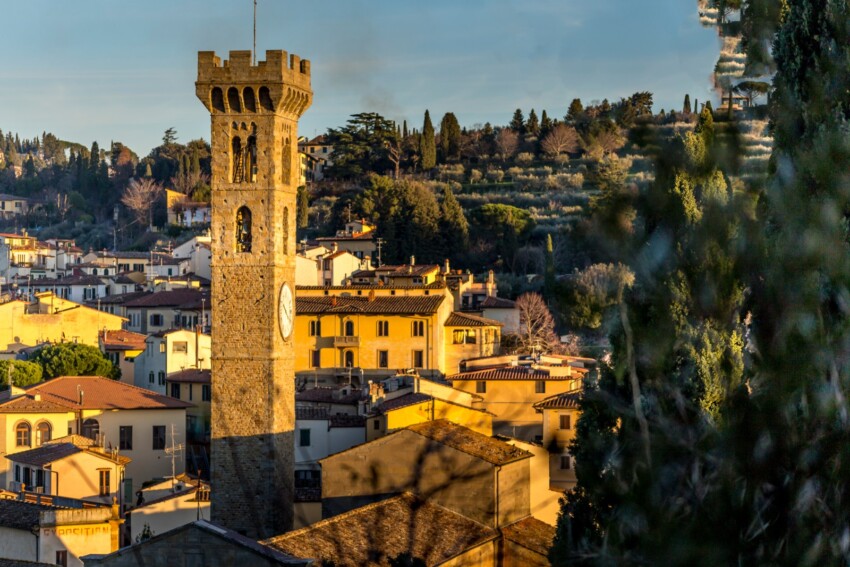
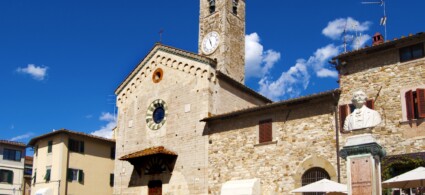
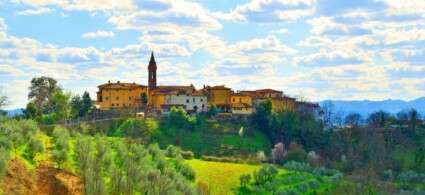
Fiesole, at an altitude of 300 metres, overlooks Florence’s city centre, which lies just 5 km away.
The area covers approximately 42 square kilometres, almost entirely hilly, with altitudes ranging from 58 metres on the banks of the Arno to 702 metres at Poggio Pratone, which stands as Florence’s highest peak.
The landscape is dotted with olive groves, cypress trees, patches of woodland and houses and villas seamlessly woven into this vista with centuries-old craftsmanship. Fiesole is quintessentially a residential and tourist area.
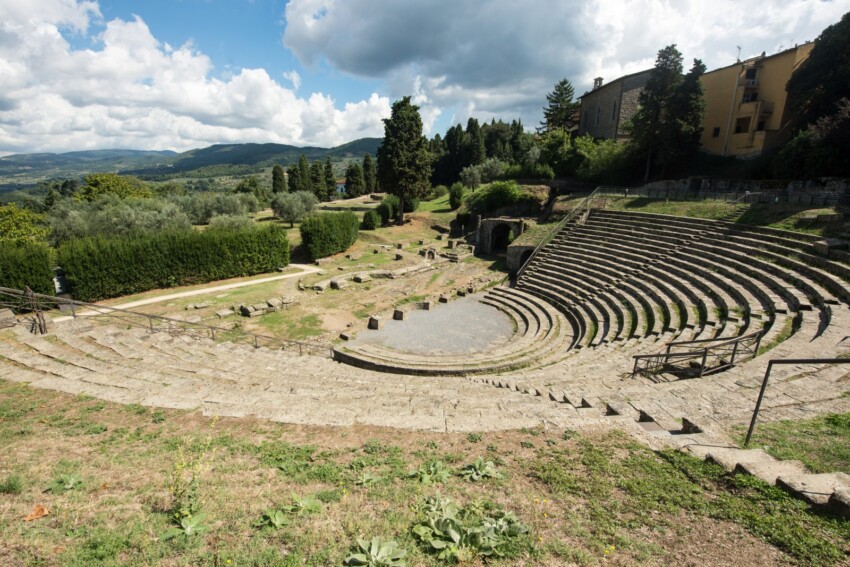
Fiesole’s archaeological area began to take shape from the late nineteenth century onwards, when the remains of the Roman theatre first emerged. Next came the discovery of the grand pools of the thermal complex and its interior section with baths and heated chambers. More recently uncovered was the Etruscan-Roman temple, whose initial excavations—following some chance finds—began in the early twentieth century and continue to this day, albeit in limited areas. This collection of remarkably well-preserved buildings, set within breathtakingly beautiful surroundings, constitutes Fiesole’s Archaeological Area, which also houses the Archaeological Museum.
Located within the archaeological zone, the museum is housed in a small Tuscan temple-style building. It contains the principal artefacts from the city and its territory, spanning a vast chronological arc: from prehistoric times through Etruscan, Roman, Lombard and Medieval civilisations. It boasts a rich antiquarian section comprising bronzes, marbles and sculptures. The Costantini Collection, featuring Greek, Magna Graecia and Etruscan ceramics, is of particular significance.
A veritable treasure trove of art: such is how the Bandini Museum might best be described, housing the collection of Canon Angelo Maria Bandini, a complex figure—historian, philologist and collector who lived between 1726 and 1803.
The museum stands out for its substantial holdings of Florentine and Tuscan artists from the thirteenth and fourteenth centuries, the so-called “Primitives”: the Master of the Stories of the Cross, Taddeo and Agnolo Gaddi, Nardo di Cione and Lorenzo Monaco are merely the most renowned among the creators of the gold-ground panels that make the Bandini Museum unique.
Equally significant are the works of fifteenth-century masters: from Neri di Bicci to Jacopo del Sellaio (his Triumphs are splendid) through to the delicate Madonna and Child from Botticelli’s workshop.
Newly opened are galleries dedicated to sculpture: among these are twenty polychrome terracottas by the Della Robbia family, the most important and celebrated manufactory of the Florentine Renaissance.
The ancient oratory of the Bishop’s Palace, dating from the first half of the eleventh century, has been reworked numerous times over the centuries. Today it is fully restored and open to the public.
Inside is a large fresco by Bicci di Lorenzo depicting the Coronation of the Virgin among angels and saints, along with a rich collection of sacred goldwork from the Florentine area spanning from the late Gothic through the Renaissance, Baroque and Neoclassical periods.
Built at the start of the year 1000 and consecrated by Jacob the Bavarian as Fiesole’s cathedral. From 1440 until 1778 it passed to the Lateran Canons, known as the Roccettini: the façade in white and green marble from Prato echoes Florence’s baptistry and San Miniato al Monte.
An early Christian basilica of the Constantinian type (possibly sixth century) with the central nave roughly twice the width of the side aisles. Its current appearance results from an eleventh-century renovation and restorations in the eighteenth, nineteenth and twentieth centuries, which revealed Etruscan remains beneath the apse. Earlier archaeological discoveries from the Etruscan, Roman and Lombard periods had also been made.
Fiesole’s cathedral was erected by Bishop Jacob the Bavarian in 1028 and enlarged in the thirteenth century. An inscription at the base of the bell tower (left side of the chancel) dates this work to 1206 (craftsman Michele). Dedicated to the martyr bishop Romolo, founder of the Fiesolane church. Major restoration works began in 1878 and were completed approximately four years later, affecting both the interior and exterior masonry: the neogothic appearance of the façade results from these renovations.
The crypt underwent archaeological excavation in 1990, revealing continuity of habitation from the Hellenistic period through to the fourteenth century. The interior nonetheless preserves a robust Romanesque structure reminiscent of San Miniato al Monte.
An area of approximately 44 hectares, famous for its sandstone quarries known as “pietra serena”, used since medieval times as a building material for architectural and ornamental elements, particularly in Florence. Referenced by Benvenuto Cellini and Giorgio Vasari, Fiesolane stone was ideally suited for architectural and monumental works, as well as for elements of civil, sacred and urban furnishings, prompting the Medici government to implement strict extraction control policies. Montececeri is also a “Leonardian” site: legend has it that Leonardo himself conducted his experiments in human flight here.
An ancient medieval fortress of the Alessandri family, it was purchased in 1855 by John Temple Leader and, enlarged and restored, became the focal point of a sort of neogothic revival in the outskirts of Florence, whilst also hosting important personages from courts across Europe. The restoration-reconstruction, carried out by local craftsmen, stands as an exemplary document of a taste and culture that wielded considerable influence in Florence’s late nineteenth and early twentieth-century circles. Within, Temple Leader accumulated paintings and sculptures to create a private museum oriented towards medieval revival. For some years now, Vincigliata s.r.l. has overseen the castle’s transformation from a private residence into a prestigious international centre hosting notable events such as art exhibitions, concerts, fashion shows, gala dinners, themed evenings, meetings and congresses.
Visits by request.
The original settlement, presumably from the thirteenth century, had been constructed by incorporating the hilltop, from which it derived its name, and upon it the Del Manzecca family’s country residence had been built, only to be demolished in 1348 by decree of the Florentine Republic. Niccolaio degli Alessandri, related by marriage to the Medici, in the second half of the fifteenth century had the entire complex rebuilt, characterised by crenellated walls, a tall and sturdy tower, the lordly residence and chapel. In the nineteenth century, the Castle underwent modifications including the expansion of the western zone and the renovation of the religious building. In 1921-22 the Zamberletti family, its final owners, entrusted architect Castellucci with the complex’s neogothic-style renewal, the creation of the “weapons room” and stone decorations of the interiors. These elements, together with the fine furnishings collected by the Zamberletti and recovered in their original locations, still characterise the monumental spaces today. Visits by telephone appointment.
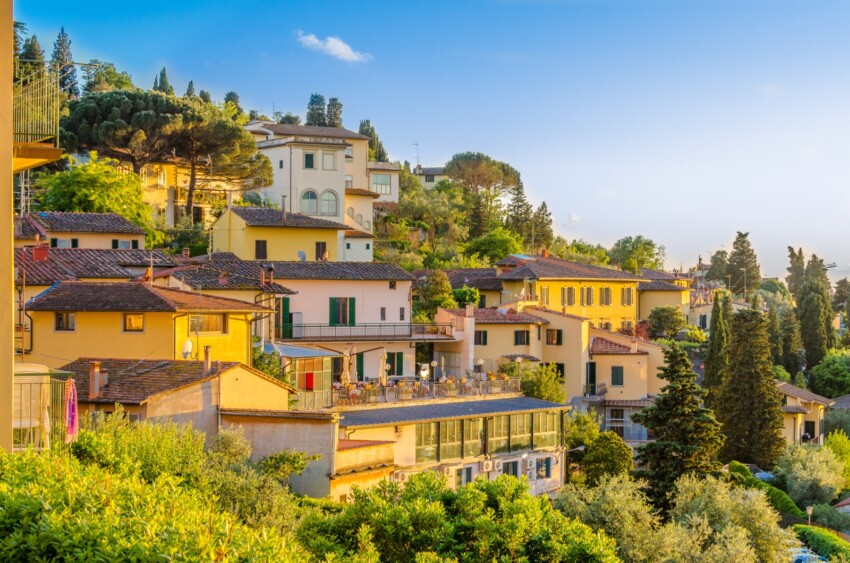
The villa was built upon Etruscan-era ruins. The Fonte Lucente garden, owned by the Bardini and Peyron Monumental Parks Foundation, was created solely for the pleasure of its owner Paolo Peyron and represents a rather rare and particular case. No practical purpose lay behind the woodland’s creation. Furthermore, Paolo Peyron did not enlist professional or expert help, but instead created the garden over time, in successive stages and without an overall design. Regarding the garden’s inception, Peyron recounts: “My first thought was to create an opening in the woodland, to open up the view towards the landscape.
As in all artificial places, there is an initial moment when the place begins to transform, and it is fascinating therefore to try to imagine how Fonte Lucente was before its transformation: in front of the villa we can see the dense woodland that obscured the view. The garden thus becomes an opening, a breach. Even today this vista is perhaps its dominant character, alongside the sensation of being a space carved out with effort from a dense and compact mass of vegetation.” A modest-sized garden, confined to the areas closest to the house, already existed when Peyron began his venture. The idea that dominated its realisation was thus that of the view obtained by opening a passage through the vegetation.
The villa, which belonged to the Pisan Biagini family, was purchased by Angelo Peyron in 1914, who commissioned architect Ugo Giovannozzi with transforming the building according to the historicist style of the period. The garden comprises a series of terraces on considerable slopes extending towards Florence. They follow an ideal central axis which thus becomes the park’s principal compositional element. Laterally, other spaces of some complexity have been designed: the chapel with its garden and the garden below it; then the staircases, which lead to the space dedicated to music and the small lake. The woodland also plays a very important role, both in forming the vegetative backdrop that encloses the composition and through a series of pathways, architectural features and decorations realised within it.
The villa was constructed between 1911 and 1913 by Cecil Pinsent (1884-1963) together with Geoffrey Scott, for Charles A. Strong, a wealthy American with a passion for philosophy. The construction sits on a long, narrow, steeply sloping plot of land known as le Balze di Macciò. Pinsent began laying out the garden in 1914 with Scott, continuing alone from 1917. Given the terrain’s form, Pinsent organised the space excellently, creating long perspective axes in a succession of “rooms”. From Via Vecchia Fiesolana one enters a first garden divided into eight grassed beds, then proceeds into the secret garden enclosed to the south by a high wall that conceals the view of Florence. The villa sits between the “formal garden” to the east and the “wild garden” to the west. This scheme allows the transition from architecturally defined garden space to the rolling landscape of meadows and olive groves. Le Balze is particularly rich in decorative details, such as mosaics, tufa work, stalactites and stuccos, all executed by Pinsent himself. In 1979, Le Balze was donated to Georgetown University.
It was the first Renaissance villa with a garden and the most celebrated among the Medici villas. Designed by Michelozzo in 1458 for Cosimo the Elder, it was Lorenzo the Magnificent’s preferred retreat.
Described by Giorgio Vasari, the villa was frequented by Poliziano—who sang of the beautiful roses that grew in the small “secret garden” and composed his Rusticus—and by other humanists: Pico della Mirandola and Cristoforo Landino. Sold by Cosimo III in 1671, the villa, restructured by Gaspare Maria Paoletti in 1780, passed through various owners, including painter William Spence. In 1911 the villa was acquired by Lady Sybil Cutting, an extremely wealthy American, who in 1915 entrusted Pinsent and G. Scott with the restoration of both villa and garden.
The terraced garden, situated on very steep slopes, commands views across the Florentine panorama. It represents the first perfectly successful attempt at integrating the building with the surrounding landscape. There are two principal terraces: the first, in front of the villa, constitutes the extension from the loggia of the main rooms, whilst the lower terrace, aligned with the first, features a parterre laid out in recent times, according to Cecil Pinsent’s interpretation of Renaissance canons. A fine pergola runs along the entire terrace wall.
On the rear face of the villa lies a small secret garden, accessible via an internal staircase. This simple space, adorned with a basin and fountain, is the least modified area compared to the original design.
Situated on the Fiesolane slopes facing towards Florence, the villa takes its name from the custom of Florentine bishops to find temporary rest here during their journeys to Fiesole.
The villa’s oldest parts date from the fifteenth century; a grand gate adorned with the episcopal symbol leads into the large villa which, protected by dark cypress trees and thick ancient walls, looks out over the romantic garden. In 1926 it became the property of Dutch artist W. O. J. Nieuwenkamp, who closely linked the place to his name and person. After lengthy travels in the Dutch Indies and some wanderings in Italy, attracted by the climate and landscape, W.O.I.N. (as he signs every drawing) chose Fiesole to realise what he defined as The Villa on the Hill.
The restoration and embellishment of both villa and garden were documented at every stage in splendid drawings by the Dutch artist. The garden is now a green scenario with its own decadent charm, in which one can perceive the original structure and ancient splendour. Extending over a descending slope, covering more than four hectares, the garden develops around a long central axis bounded by a fine fountain and a stone column. An orchard and iron pergola, which supports vines, bear witness to a time when fruit and grapevines were abundant here. Fountains, statues and marble furnishings are scattered throughout various corners of the garden just as the versatile artist had envisioned and executed them.
To see all the facilities and book accommodation in Fiesole use the form below, entering the dates of your stay.
 Hotel
Hotel  Budget accommodations
  Apartments
  Family Hotel
  Luxury Hotel
  Resorts