Toskana Relax
Fucecchio - via Sotto le vigne 9
Book now
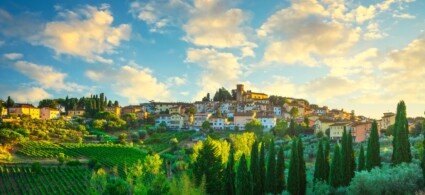
Fucecchio sits on the right bank of the River Arno, midway between two of Tuscany’s most important cities: Florence and Pisa.
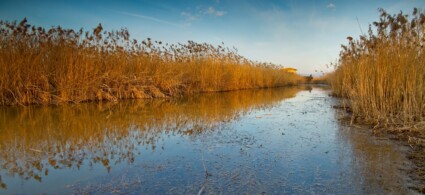
The surrounding area is characterised by a vast marshy expanse known as the Padule di Fucecchio and a hilly zone called the Cerbaie.
Fucecchio’s origins date back to the 10th century, and its development owes much to the Ponte di Bonfiglio, which allowed pilgrims travelling the Via Francigena to cross the River Arno – an important trade route – and to the presence of Castello di Salamarzana, owned by the Cadolingi counts, one of Tuscany’s most powerful families.
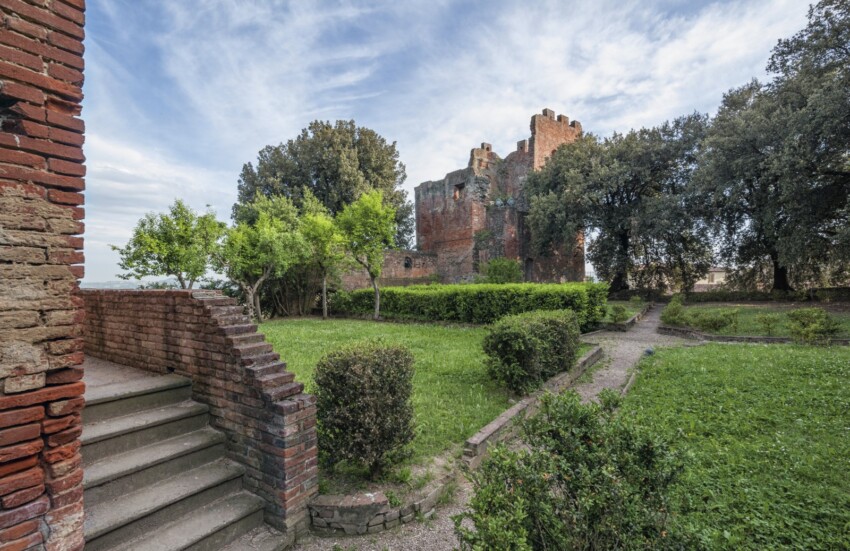
The Rocca Fiorentina, which rises on the site and remains of Castello di Salamarzana, dominates the historic centre from a hilltop where, in feudal times, the Cadolingi controlled the ford and bridge at the intersection of the Via Francigena and the Arno. The entire complex is now encompassed within the Parco Corsini, recently restored and made freely accessible to the public.
Access to the adjoining fortified area is gained from Palazzo Corsini itself, dominated by the towers of the Rocca, which was erected in 1322 by the Florentines during their war against Castruccio Castracani, Lord of Lucca, to ensure the loyalty of the former Lucchese Valdarno to the Guelph faction and the city of Florence.
The imposing structure consisted of two larger towers, the ‘torre grossa’ and the ‘torre di mezzo’, and a smaller one, surrounded by a double ring of walls dotted with smaller towers and fortifications at the access gates. Today the complex is largely in ruins, particularly due to damage sustained during the Second World War.
The ‘torre grossa’ stands on the site of the previous cassero (whose stone base differs from the terracotta bricks of the rest of the structure), dating back to the early medieval commune period (12th–13th centuries), itself probably built on the remains of the oldest tower of the Cadolingi Castello di Salamarzana (11th century). The fortification has always played an important role in controlling the Fucecchio crossroads and the bridge across the Arno.
The palace, accessed from Piazza Vittorio Veneto, is arranged over three storeys and concludes with an elegant lateral loggia supported by terracotta columns.
Built upon the older castle walls, the building originally included a gate opening onto the “little square” (now Piazza Niccolini) that connected directly to the main villages. Traces of earlier medieval structures are still visible inside the building, as it comprises at least two sections joined together during 15th-century renovations. Particularly evident on the first floor are a decorative terracotta arch, a fresco fragment from the 14th–15th centuries, and pictorial decorations (landscapes and friezes) created by Stefano Fabbrini in the second half of the 18th century.
Two wings are connected to the main building, formed by spaces once used for the estate’s services and now housing the Library, Historical Archive, and part of the museum route.
From the palace, you access the park where the Rocca’s towers dominate a wood of oaks, holm oaks and cypress trees. The fortification, commissioned by the Florentines in 1322, served to control the important Fucecchio crossroads and the Arno bridge, whilst also keeping in check the restless local population by suppressing their frequent uprisings.
Destined for military use throughout the 14th century, the fortification lost its original strategic importance in the early 15th century, after Florence, having conquered Pisa, consolidated its western frontier.
Dominated by the majesty of the “Torre grossa”, all that remains of the oldest Cadolingi Castello di Salamarzana, the park also contains the tall “Torre di mezzo”, which offers a spectacular panorama, and the smaller “Pagliaiola”, which stands on the eastern side.
Records of a bridge near Cappiano date back to the early Middle Ages, when the Via Francigena crossed the River Gusciana here, the outlet of the Padule di Fucecchio. It was a fortified bridge with an adjoining weir and mill, used in the early 1400s by the Florentine Republic as a lock to regulate the drainage of water from the Padule.
In 1550, Cosimo I had the Bridge and its ancillary structures rebuilt by a prestigious team that included David Fortini and Nicolò Pericoli, known as il Tribolo. The result was a multifunctional monument of considerable complexity: besides being a fortified bridge with two towers, it also served as a ‘calle’ (passage for small boats) and for lowering fishing nets, a weir to regulate water levels, a mechanism for harnessing hydraulic power, and finally as the administrative centre of a farm estate that was established during the 1500s.
Due to the considerable damage it sustained during the war, the bridge remained hidden by scaffolding for a long time to ensure its stability.
For the Jubilee, thanks to funding obtained by the local authority, the Bridge was restored to its former glory in just 16 months of work. The structure now serves as a hostel and hosts important cultural events and initiatives.
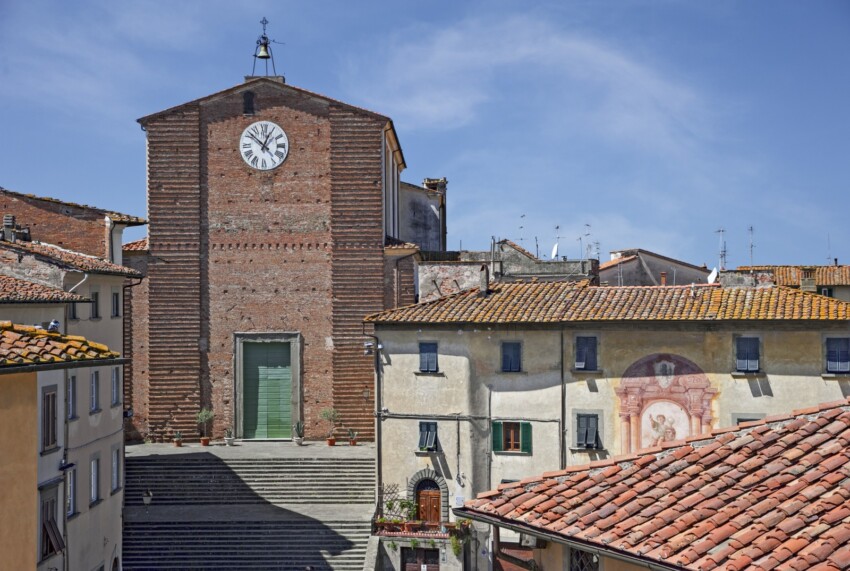
Founded by Count Cadolo near the bridge across the Arno, the Church of San Salvatore is first recorded in a document from 986. A Benedictine monastery was established alongside it around the year 1000; both buildings were rebuilt on a hilltop near Castello di Salamarzana following the devastating river flood of 1106. A period of considerable prosperity was followed, at the end of the 13th century after the extinction of the Cadolingi line, by decline: entrusted to the Franciscans, it later passed to the Poor Clares, who continue to reside there.
Nearly two-thirds of the municipal territory lies within the Cerbaie, low hills with gentle profiles that extend between the basin of the former Bientina marsh and that of Fucecchio. The area constitutes an important ecological resource, as it is still largely covered by rich vegetation.
The high forest is predominantly made up of maritime pines and, to a lesser extent, oak woodlands. The more humid “small valleys” are characterised by a particular microclimate that favours the survival of plant species now extinct elsewhere. Alongside alders and hornbeams, rare specimens of silver firs are found, along with a varied understory of hollies, viburnums, strawberry trees, heaths and brooms, plus now extremely rare species such as the Drosera rotundifolia, a carnivorous plant and a glacial-era tundra relic, or the Osmunda regalis (Royal Fern), typical instead of tropical climates. The fauna is typical of Tuscan woodlands and scrubland: you may encounter badgers, porcupines, squirrels, and among birds, magpies, green woodpeckers, great spotted woodpeckers and jackdaws.
Despite these precious natural features, the Cerbaie landscape is to a large extent also the product of interventions and practices carried out by man over the centuries.
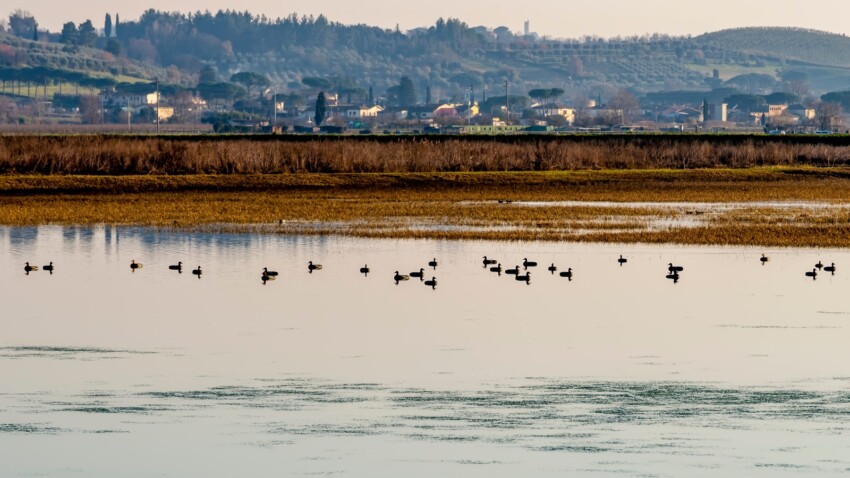
Covering approximately 1,800 hectares divided between the provinces of Florence and Pistoia, the Padule di Fucecchio is today Italy’s largest inland marshland and one of Tuscany’s most important wetland areas.
For greater protection of the area, part of the Padule (approximately 230 hectares) is protected by Nature Reserves established in recent years by the provinces of Pistoia and Florence: the protected areas include Le Morette and La Monaca-Righetti. The rest of the marshy basin falls within the respective Buffer Zones.
Guided visits within the Nature Reserve are arranged by the Research, Documentation and Promotion Centre for the Padule di Fucecchio, a non-profit association that promotes the conservation and enhancement not only of the Padule di Fucecchio but also of Lake Sibolla and other environments in northern Tuscany.
To see all the facilities and book accommodation in Fucecchio use the form below, entering the dates of your stay.
 Hotel
Hotel  Budget accommodations
  Apartments
  Family Hotel
  Luxury Hotel
  Resorts