Casa Del Principe
Gambassi Terme - Via del torrino 2
Book now
The territory of Gambassi has been inhabited since at least the Neolithic period, as evidenced by worked red jasper flakes discovered in several locations (Gambassi, Camporbiano, Boscotondo, Santa Cristina). However, the period of greatest population growth in the area dates from the Etruscan-Archaic era (7th century BC) through the Late Roman period (3rd century AD). Indeed, in the archaeological area of Poggio all’Aglione, both tombs and traces of settlements have been identified from this period. Etruscan-Hellenistic remains have also been found at Pergola, Leccione, Santa Cristina, Paletro, Riparotta and Germagnana, whilst Late Roman artefacts have been discovered at Boscotondo, Camporbiano, Luiano, Pievina, Catignano and in the Castagno area.
Recently, the remains of a medieval glassworks active around 1300 have been uncovered at Germagnana, consisting of a frit furnace (impure glass) and four processing kilns. Together they formed a small craft settlement where some of Gambassi‘s “bicchierai” (glassmakers) lived and worked—craftsmen who were renowned and sought after throughout Italy. Archaeological investigations have identified many other sites across the territory and town centre, where glassworkers plied their trade from the medieval period through to modern times. The existence of this important craft activity was already known from written sources, but only now are we discovering the actual locations, furnaces and products (glasses and bottles). The archaeological finds are housed in the Palazzo Civico and in the Archaeological Group’s premises, with some displayed in a permanent exhibition.
The first written record mentioning Gambassi castle dates to 1037, when Guido del fu Ranieri ceded a portion of his holdings there to the Bishop of Volterra, Gottifredo. Through successive donations (notably that of the last of the Cadolingi counts in 1115), Gambassi castle became established as an “allodio” (property) of the Volterra bishops until the end of the 12th century. In the period from 1172 to 1183, alongside the bishop’s castrum vetus (old castle), a castrum novum (new castle) was built, around which a commune was organised. It was between the 12th and 13th centuries that Gambassi’s citizens enjoyed a period of relative “autonomy”, electing their own rectors (1209) and dealing with conflicts arising between the Lambardi (minor rural nobility) and the “popolo” (people) (1224-1226).
During the first half of the 13th century, the commune of San Gimignano succeeded in effectively including Gambassi’s territory within its district, provoking constant claims from the Volterra bishops, which frequently escalated into actual warfare (especially in 1230 and 1278-1281). In 1294, Florence’s relentless expansion, having crossed the Elsa, put an end to all disputes, incorporating Gambassi castle into its contado (county). Associated with other nearby communes, it was designated as a Podesteria with powers to govern itself through its own statutes, which were drawn up in 1322.
The entire civic organisation of this central Valdelsa territory was profoundly shaped by the substantial network of road routes that crisscrossed it. Numerous castles arose along these roads, particularly at their intersection points. For this area more than others, we can confidently say that the road network was the principal characteristic of castle settlement patterns. It was above all the comital Cadolingi family, from the time of Count Cadolo onwards, who pursued a policy aimed at controlling what was then one of the principal road routes: the Via Francigena.
As mentioned above, within Gambassi’s territory alone there were six castles, many of them Cadolingi properties, positioned along this south-east to north-west route. A further four castles were situated along the Volterrane roads. Particularly those castles that maintained, beyond their fortified settlement form, a significant economic and demographic position, surely owed their success to their strategic location along the main medieval transit routes crossing the Valdelsa. Camporbiano was located near the confluence of the road from San Gimignano to Pisa with a Volterrana coming from Certaldo-San Vittore; Montignoso, at the confluence of the Pisa road with the northern Volterrana; Gambassi at the confluence of the ‘hillside’ Via Francigena with the northern Volterrana; Catignano between the ‘mid-slope’ (Gavignalla-Varna) and valley (on the left bank of the Elsa) sections of the Via Francigena.
The settlements that assumed a fortified castle form within Gambassi’s territory were (in order of first appearance in written sources):
The earliest record dates to 977. It belonged to the Cadolingi and in 1115, following the family’s extinction, passed to the Volterra bishops until the early 13th century, when it came under San Gimignano’s sphere of influence. At the end of the 13th century it was annexed to the Florentine contado.
Some remains of the castle survive at the summit, possibly referable to the keep.
First attested in 1037: Guido di Ranieri, a collateral of the Cadolingi, sold some of his rights and properties to the Volterra church. This castle too, following the last Cadolingi’s death, passed to the bishops, who always considered it their ‘allodio and special demesne’. It was destroyed by the San Gimignano forces towards the end of the 13th century during a lengthy dispute with the Volterra bishop. During this period it was called Gambassino to distinguish it from Gambassi’s castrum novum.
The site where the castle once stood remains unknown to this day.
The first document attesting the presence of a castle at Catignano dates to 1075. As a location it is recorded from 1008 onwards. Originally belonging to the Cadolingi, it passed in 1115, like many other Valdelsa castles, to the Volterra church. However, those who would become known as the “nobiles” of Catignano continued to hold certain rights over the castle. During the 13th century, though under San Gimignano’s influence, it maintained greater autonomy than other castles. It too was incorporated into the Florentine contado in 1294.
Significant structures of the keep survive, with two truncated brick towers still standing.
The castle is mentioned only once in 1104 as «castello de le Macieie».
Its precise location remains problematic, though it was somewhere near Luiano.
This castle too, in its fortified settlement form, is mentioned only once in 1104: «turre et castello de Germagnano». During the 13th century, near the villa of Germagnana, we find the locality ‘Castellare’ recorded, a term denoting abandoned castles or those transformed into open villages.
A small rise with emerging walls opposite the church of Santa Cristina may contain the castle’s remains.
Riparotta too has limited attestation: it is mentioned as a castle in only two documents (in 1106 and 1115). A Cadolingi property, it passed to the Volterra church in 1115. Like Germagnana, during the 13th century the toponym ‘Castellare’ is recorded near Riparotta’s villa.
A rise with a levelled top behind the ‘le Case’ locality near Riparotta most likely contains the castle’s remains.
It is named only once in the usual testament execution of the last Cadolingi in 1115. Subsequently we find it reduced to a villa.
One of two rises flanking the San Michelino locality may contain the castle’s remains.
The earliest record of Montignoso dates to 1136. Both Volterra and San Gimignano contested the castle repeatedly between the late 12th and 13th centuries. Certain nobiles held jurisdictional rights over Montignoso, which they ceded on several occasions, through acts of submission, to the San Gimignano commune. In 1294 Montignoso was annexed with all its territory to the Florentine contado. By around the mid-16th century it appears as destroyed and abandoned. Throughout the medieval period Montignoso held considerable strategic importance, positioned as it was at the confluence of the Pisa road and the northern Volterrana. Indeed, «the Montignoso lambardi … managed partly … to maintain their autonomy and to exploit, through the passage toll» their castle’s position.
Remains of the keep and a section of the defensive wall adjoining the church of San Frediano survive.
The castrum novum of Gambassi was built by the Volterra bishop Ugo in the 1170s, at the request of the emerging commune. Many of the castle’s rights, despite nominally belonging to the bishop, were held by an important family of nobiles or lambardi called the Tignosi. After a brief period of relative ‘autonomy’ from the major powers in the territory, it increasingly fell within San Gimignano’s sphere of influence, until it formally submitted in 1268. This provoked countless claims from the Volterra bishops, culminating in actual disputes as in 1230 or 1270-1283. In 1294 Gambassi’s citizens were forced to submit definitively to the Florentine commune. Of all the castles in the territory, this one maintained its fortified settlement form the longest, remaining intact at least into the early 19th century.
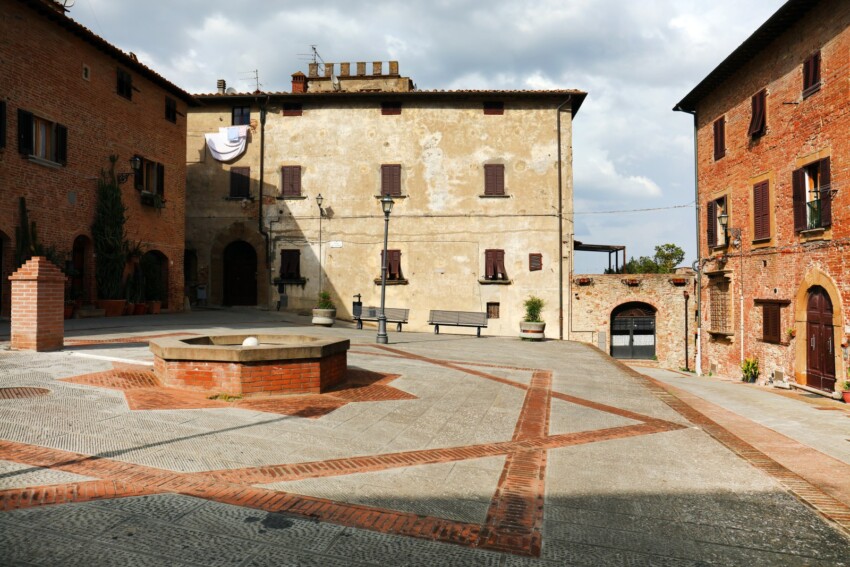
Gambassi‘s present-day ‘historic centre’ still preserves many remains of medieval structures.
The castle is mentioned only once in 1236. The castle’s remains may be contained by the rise along the Certaldo road near the significant locality ‘la Porta’.
The «castro Montefani» too is recorded only once, in 1272. The toponym has disappeared but we can localise it with fair certainty on the rise called Poggio Tondo, which still preserves remains of buried wall structures.
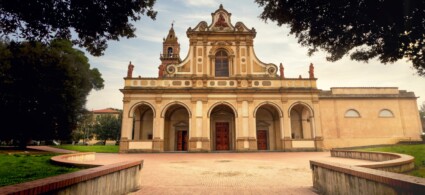
The church of Chianni is one of the most significant monuments of Romanesque architecture in the Valdelsa. Despite the transformations and restorations it has undergone over the centuries, it presents itself as a late Romanesque building of considerable interest. The basilical three-nave layout rests on a substantial projecting transept, in whose end wall five semicircular apses originally opened, the central one having been replaced around the 1520s by a quadrilateral sacristy (the terracotta formelles in the vault are probably work from the Gagni kilns of Gambassi).
During restoration work in the late 1950s, elements of the foundation of the Romanesque semicircular apse were brought to light (visible via the sacristy entrance). Note the particularity of the four minor apses set within the thickness of the end wall, following a typology found in Volterra Cathedral. The naves are separated by six relieving arches on each side, supported by columns not all monolithic but with distinctly pronounced entasis, whose varying heights are compensated by appropriately sized plinths. The terminal columns assume the character of robust cylindrical pillars, as they must support the load of the transverse arches that separate and simultaneously link the three naves with the transept’s transverse body. This, consisting of a spacious vault, is slightly elevated from the church floor (today accessed by two steps); against its walls are set non-structural semicolumns. The church’s ceiling reveals the wooden roof structure, but the rafters of the main nave rest on a clay cornice that suggests a later replacement of the roof, accompanied by a raising of the elevation walls.
The church is lit by a window in the upper part of the façade and by openings in the perimeter walls and elevations above the nave, though several are now blocked by adjoining buildings. Double-splayed small windows are also present in the transept apses and in the wall above them (except for the last one on the left), as well as in the ends of both arms. The church’s wall facing is executed in regular courses of well-squared sandstone ashlar blocks, despite various repairs and reconstructions. The exception is the central nave’s walls which, above the arches, display clay-brick facing on both sides. This has led to various hypotheses, such as reconstruction following a collapse, or perhaps more plausibly, different construction periods, considering that the arches appear to be the originals and that the clay-brick sections also clearly belong to the Romanesque tradition.
To see all the facilities and book accommodation in Gambassi Terme use the form below, entering the dates of your stay.
 Hotel
Hotel  Budget accommodations
  Apartments
  Family Hotel
  Luxury Hotel
  Resorts