Corte Di Valle
Greve in Chianti - Via Vicchio 28
Book now
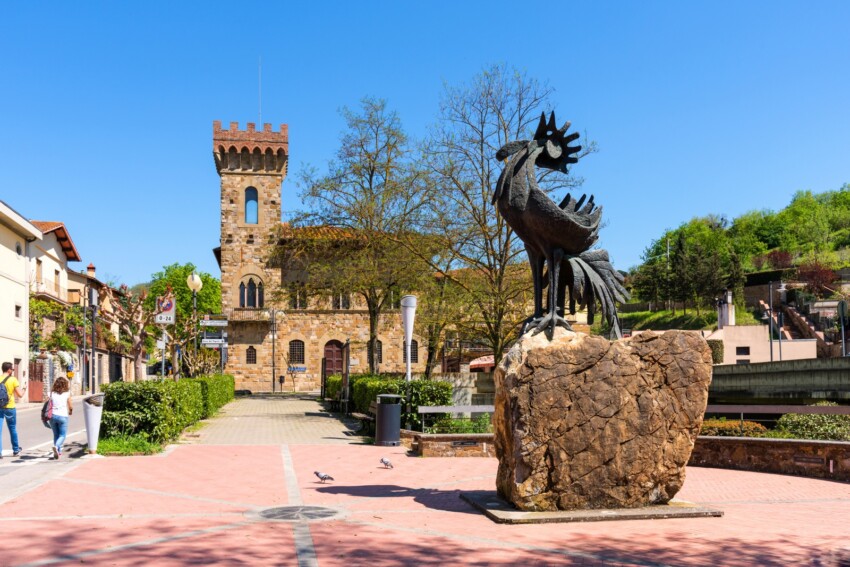
The oldest inhabited settlement from which the centre of Greve originated can be traced to the present-day hill of San Francesco, mentioned in an 11th-century document relating to a donation by S. Bernardo degli Uberti to the Monastery of San Salvi. It later became the site of an ancient hospital and, from the late 15th century onwards, housed a small monastic settlement of the Franciscan Order (from which it took its name), now transformed into the home of the Sacred Art Museum.
Greve in Chianti emerged on the fringes of important communication networks centred on the Volterrana road and the Via Francigena. However, the territorial routes made it easy to reach Florence and, via the present-day Passo del Sugame pass, the Arno valley upstream of Florence, where important trading hubs were located (such as Figline Valdarno).
It was precisely this openness towards different commercial destinations that led to the creation of Greve’s market settlement, the present-day Piazza del Mercato, at the centre of a densely populated area already rich in rural churches and parish churches and scattered with castles and feudal villages, which after conquest and subsequent transformation by the Florentines became stately residences, villas and villa-farms. The Florence Chianti region was prized for its agricultural output: among other things, a highly esteemed wine was produced there, mentioned in 14th-century documents, which graced the tables of wealthy Florentines. The position midway between Florence and Siena, at a time of great cultural, artistic and economic growth for the two main cities of Tuscany, had important consequences for the development of the entire Greve territory, also supported by the regular presence of a qualified ruling class in country residences, represented by the leading Florentine families.
The oldest part of the village revolves around the San Francesco convent and the market square: this structure remained substantially unchanged until the 19th century. Only after Italian unification, with the assignment of the Town Hall seat, did the old “Greve market settlement” become the most important centre in the valley.
The square, with its characteristic funnel-shaped layout, has been called for centuries the “Greve Market Settlement“, because the marketplace, located in the valley bottom, close to the Greve watercourse and the route of the Cassia road that linked Florence to Siena, served as a meeting point for the population of many villages and castles in the area (Monteficalle, Montegonzi, Uzzano, etc.).
The first reliable record of this marketplace dates to 4 March 1300, though it is believed to have been founded as early as the 13th century. Around 1363, during the plague, there was also an invasion by the mercenary troops of Alberico da Barbiano, a military commander in the pay of Gian Galeazzo Visconti, who in 1397, as Scipione Ammirato writes, plundered “the Greve Market Settlement and all the surrounding areas”. In July 1773, Pietro Leopoldo I travelled from Florence to Siena passing through Chianti and described Greve in his notebooks as follows: “…the place is large and clean with a fine square. At Greve there is a large livestock and produce market every Saturday. The terrain of those hills and the plain along the Greve are excellent and fertile”.
Like most market settlement squares, that of Greve in Chianti also features masonry arcades which, here too, replaced the temporary huts and sheds under which the merchant stalls were positioned.
On the right side of the square stands a statue of the navigator Giovanni da Verrazzano, discoverer of Hudson Bay and native of the nearby Verrazzano Castle. The attraction exerted by this meeting place gradually gave rise to a permanent settlement which, unlike Figline, only partially caused the phenomenon of abandonment of the summit areas that occurred in the Valdarno di Sopra, since here strong economic motivations constituted a barrier to the abandonment of the rich crops throughout the hilly area surrounding Greve.
With its extension, Piazzetta Santa Croce, the square retains a familiar yet stately character and represents the most distinctive urban centre and feature of Greve in Chianti.
The imposing municipal palace, in Neo-Renaissance style, overlooks the ancient market square, on the opposite side from the Church of Santa Croce. The current palazzo stands on the remains of the old praetorian palace, whose construction was begun in 1485 and completed in 1489: of this old building we have little significant information beyond its presumed purpose as the seat of the Lega della Val di Greve, which depended on the corresponding Podesteria.
The new town hall was built above this building and was started in 1894 and completed at the end of 1895. The administration took up residence here for the first time on 24 January 1896, as can be read on the plaque in the entrance corridor.
The project was by engineer Carlo Baglioni, who chose “bugnato” (rusticated masonry) as the palazzo’s architectural style, in homage to the renowned Florentine Renaissance palaces, and sandstone from the nearby Caprolo quarry as the façade’s cladding material.
In the palazzo’s entrance you can also see the coats of arms of the Podesteria of the Lega della Val di Greve, dating from the late 1400s to the 1700s, and four commemorative plaques for municipal citizens who fell during the Italo-Abyssinian War, the Italo-Turkish War and the two World Wars.
The villa di Pescille, situated on the south-western slope of the hill on which the village of Panzano in Chianti stands, owes its architectural layout to the 16th-century transformation of an ancient medieval tower house, probably belonging to Luca di Totto dei Firidolfi from Panzano, who was lord of the castle in the first half of the 14th century.
The villa-farm, which governed a large portion of territory consisting of around twenty smallholdings, most likely fell within the possessions of the Medici family. The ancient structure of the villa can still be recognised, with the medieval tower standing out, which was enlarged through the addition of surrounding rooms with two internal courtyards.
The western side of the villa opens onto an expansive Italian-style garden of 18th-century layout, overlooking the beautiful Renaissance lemon house, now home to art exhibitions and cultural activities.
Since 2006 the villa has served as a residential facility for disabled persons called “Pescille Protected Accommodation Community” and in 2007 a new disability centre was opened, further expanding the extensive network for disabled persons of the South East Health Authority.
The San Francesco convent has housed, since September 2002, the Sacred Art Museum of Greve in Chianti, with an attached documentation centre on the sacred art of Chianti, which informs visitors about the principal works contained in the churches and parish churches of the area, collectively forming the so-called “dispersed museum”.
In December 2004, an archaeological section was inaugurated featuring finds uncovered during archaeological surveys conducted in the area. The current collection comprises mainly pottery items used at table as well as everyday objects that trace an ideal path from proto-history to the early Renaissance. The museum itinerary is structured around three main thematic sections: paintings and sculptures, jewellery and sacred furnishings from the 14th to 19th centuries, and vestments of Tuscan manufacture from the 16th–18th centuries, of various types and origins.
In the chapel, noteworthy works include the Annunciation, a 14th-century panel from the Church of Santa Croce in Greve, a Madonna and Child between Saints Bartholomew and Francis by Francesco Granacci, from the Church of Santa Maria a Cintoia, a Madonna and Child between Saints Anthony Abbot and Lucy from the early 16th century, from the Church of San Martino a Sezzate, and a 15th-century marble bas-relief of Saint Francis from the Church of San Pietro a Sillano. Maintaining its original position above the oratory altar is arguably the most important work in the entire collection: a large polychrome terracotta group depicting the Lamentation over the Dead Christ, composed of seven statues and surrounded by a frame with garlands of flowers and fruit. Following recent restoration work, the piece has been attributed to the style of Baccio da Montelupo.
The sacristy, along with sacred vestments, houses other interesting works: a precious and rare Reliquary Cross in rock crystal of Venetian craftsmanship from the second half of the 14th century, a painted glass depicting Saint Sylvester from the 16th century from the Gesuati Friars’ Workshop, set into the structure of a small confessional, and an oval painting from the second half of the 19th century depicting the Assumption of the Virgin.
On the first floor there are further valuable works, such as the Assumption of the Virgin between Saints Lucy and Anthony of Padua by Francesco Curradi, the Madonna of the Rosary and Saints by Francesco Boldrini, the Saint Rose attributed to Michele Gordigiani, an Ivory Peace carved, painted and gilded with inlaid wood from the Embriachi Workshop, and a sculpture of the Madonna and Child in painted stucco, attributed to Nanni di Bartolo.
Within the splendid Romanesque parish church (situated a short distance from Panzano castle) is preserved a rich heritage of pictorial and sculptural works of art, including two tabernacles attributed to Giovanni della Robbia, a 13th-century Dossal attributable to Meliore, the triptych with the Madonna, Child and four Saints by Mariotto di Nardo, and the Madonna with Child and Saints Peter and Paul by the Master of Panzano.
To see all the facilities and book accommodation in Greve in Chianti use the form below, entering the dates of your stay.
 Hotel
Hotel  Budget accommodations
  Apartments
  Family Hotel
  Luxury Hotel
  Resorts