hu Firenze Certosa camping in town
Impruneta - Via San Cristofano 2
Book now
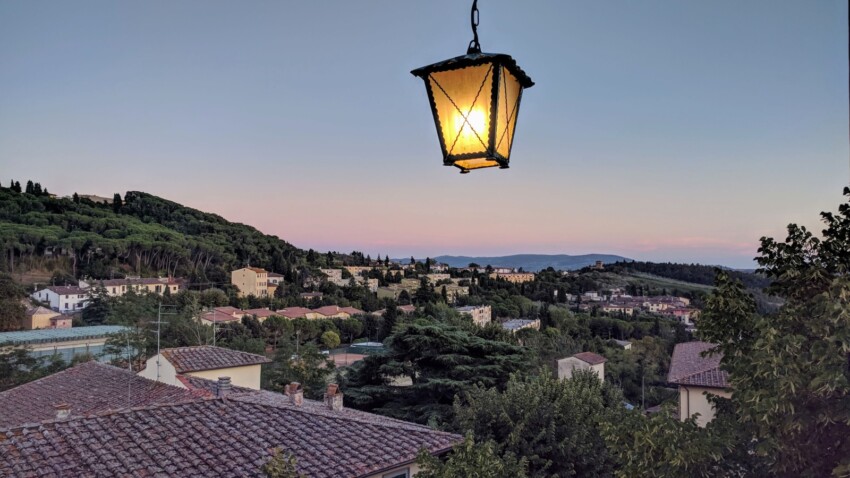
The territory of Impruneta lies within a system of gentle hills stretching between the Greve river and its tributary, the Ema, which slopes gradually from south towards north in the direction of Florence.
The history of Impruneta, whose name is thought to derive from “in pruinetis” or “in pinetis”, dates back to the Etruscan period, as evidenced by archaeological finds linked to the presence of a place of worship from the 6th century BC onwards.
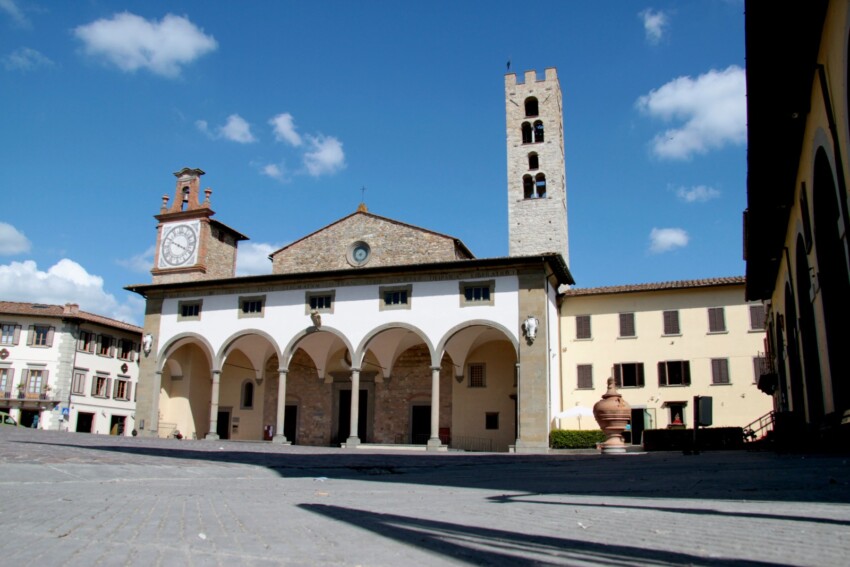
During the medieval period, Impruneta gained prominence as the seat of one of the 72 rural leagues of Florence’s territory. In the early 12th century, Florence began to challenge the power of the rural nobility, and it was during this time that the fortress of Montebuoni, owned by the Buondelmonti family who controlled the entire Impruneta community, was razed to the ground. The family held patronage over the Parish Church of Santa Maria all’Impruneta, consecrated in 1060 and celebrated for its veneration of the Image of the Virgin, which was the object of particular devotion among the Florentines.
The ancient art of terracotta pottery is documented in this area from medieval times, facilitated by the extraordinarily favourable nature of the soil and the proximity to Florence, where terracotta was used throughout the centuries both as a building material and as an ornamental component and art object. A notarial deed drawn up in Impruneta in 1308 (Florentine style) bears witness to the existence of a guild of pottery and vessel makers.
Already in the 13th century, the countryside around Impruneta, like much of the territory surrounding Florence, experienced rapid expansion of city-owned property, initially promoted by ancient noble families – the Bardi, Scolari, Adimari, Gherardini, Acciaioli, Rossi and Quaratesi – and subsequently by the city’s merchant and artisan classes and professional groups. Over time, these citizens created compact land units (farms) complete with farmhouses and a series of infrastructure, and organised their lands using the sharecropping system. Then, as until recent times, mixed farming predominated, combining cereal cultivation – which was fundamental – with tree plantings (olive and fruit trees) and vines. Over the centuries, the hills became dotted with a dense network of manor houses – villas and palaces – built on privately owned land, not far from the farmhouses.
From an administrative perspective, after the medieval period Impruneta was incorporated into the jurisdiction and later the municipality of Galluzzo. In 1929, the Municipality of Impruneta was established.
During the Second World War, the town suffered a terrible bombing – in July 1944 – which caused casualties among the civilian population and extensive damage to the settlement.
In the Impruneta territory, the skilful work of mankind over the centuries stands out immediately: it is a unique territorial setting, formed by a remarkable interweaving of the Tuscan landscape with roads, buildings, crops, and on the other hand, pine forests, woodlands, quarries and mines. The route is based on a proposal to interpret this complex of features, with a series of stops from which one can observe landscapes and systems of assets of particular evocative value.
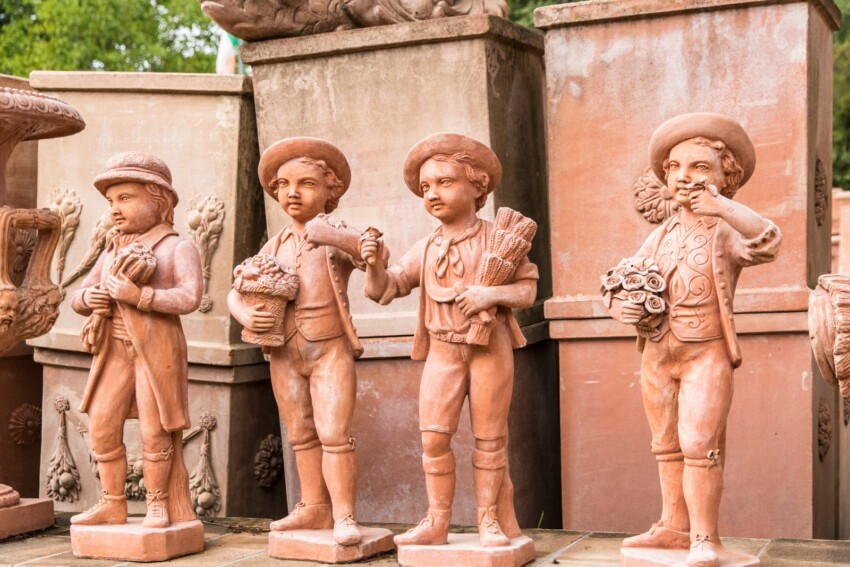
The art of terracotta represents for Impruneta a heritage of great value and a primary element of cultural identity. In this territory, what has been defined as the civilisation of terracotta became established, and thanks to the presence of numerous local productive enterprises, it remains vibrant and widespread to this day.
In recent years, the activity has diversified and specialised into two sectors:
The success of terracotta in this area is explained by the presence of a reliable type of clay, the rich woodland heritage that once provided fuel for the kilns, and the favourable geographical location of the town, situated within the road network connecting Florence, Arezzo and Siena.
Important to the history of the pottery makers is a document dated 23 March 1308 (Florentine style): at that time, jar makers and vessel makers were united in a guild whose purpose was to protect and regulate production and product quality in an already flourishing craft. The deed drawn up by notary Benintendi of Guittone da Santa Maria Impruneta informs us that the guild had 23 members, and the majority, 11, belonged to the populi plebis Sancte Marie Impinete. From that time onwards, terracotta production continued through the centuries and true dynasties of pottery makers were established.
Today, a visit to the kilns provides an up-close look at the stages of the production process, in which four primary elements combine: earth, water, air and fire. The route allows you to discover the places of production and observe the numerous terracotta objects scattered throughout the territory. Alongside traditional forms, you can observe products that are today the result of constant research, designed to be integrated into new urban and architectural contexts worldwide by architects such as Mario Botta, Aldo Rossi and Renzo Piano.
The route is divided into two parts: the first part – which you should ideally explore on foot – takes place in the town centre, particularly in the Kilns Quarter, one of the most typical and characteristic areas of Impruneta. The second part – which we recommend doing by car – will allow visitors to discover the various types of terracotta objects present throughout the territory, along the ancient road routes, in the gardens of villas, in farmyards and near farmhouses.
The first part of the route, organised in a circular manner, begins at Piazza Buondelmonti in the town centre, where you can admire numerous terracotta objects from Impruneta’s manufactures. From the centre, the route continues towards the Kilns Quarter, where kilns are still active, mostly family-run operations that have maintained traditional working techniques such as the “coil” method.
The natural location of the information centre is envisaged within the historic Agresti kiln at the heart of the Kilns Quarter, with the aim of collecting and enhancing everything that constitutes testimony to the historical heritage made up of objects and tools.
For the second part of the route, a radial itinerary has been planned that reaches the more outlying productive facilities, mostly industrial enterprises producing a vast range of goods: from traditional ones to those of cutting-edge design. Some of these enterprises preserve within their facilities machinery that can be considered industrial archaeology (for example, 19th-century machines for automating certain production phases). These productive facilities are situated south of Impruneta, between the areas of Ferrone and Falciani. Also in this zone is a clay quarry still in use and clearly visible from the road. The quarry, included in the route, will allow visitors to observe the raw material (clay) necessary for production. Following this route, it is easy to spot villa gardens adorned with storage jars, decorative vases and statues both inside and on boundary walls, an ornamental tradition typical of Impruneta and Florence where boundary walls and villa façades are often decorated with vases positioned on roof ridges and at their sides.
Regarding shrine tabernacles and the general devotional use of terracotta, we have selected the Church of San Miniato at Quintole (with its terracotta elements above the entrance door and defining the portico arches) and, for tabernacles, that of Sant’Isidoro: a typical example of 18th-century terracotta bas-relief. Through knowledge of these elements, visitors will be able to perceive how terracotta in the Impruneta territory has been and still is today a widely used material for both sacred and secular purposes, and especially how terracotta in the form of bricks has always been used as both a decorative and structural material.
Another aspect that has received attention is the use of terracotta in old farmhouses. This approach documents the use of this material in farmhouse construction. Typical features of terracotta use in rural building are: brick paving in the farmyard, supporting pillars for loggias and porticoes, hay-loft grilles, ancient bell-shaped ovens and roof tiles. The route therefore includes three farmhouses, selected based on the typical nature of their structure and use of terracotta.
It was considered useful to also develop a map of Impruneta’s terracotta products in Florence, showing the major examples of artefacts that testify to the close relationship that has existed between Florence and Impruneta over the centuries. In this case too, it is a guide that allows visitors to readily appreciate the signs of Impruneta’s production throughout Florence.
The cultural heritage of Impruneta, formed over the centuries, is widely distributed across an extraordinary landscape of unique character. The territory is home to historical and artistic collections of great value, such as those preserved in the Sacred Art Museum of the Basilica or, with different characteristics, the terracotta works held at some ancient kilns; for our time, we might mention, for example, the Maria Maltoni archive linked to the beautiful experience of the San Gersolè School. Part of this wealth also includes the ancient tradition of terracotta craftsmanship and the careful work dedicated to agricultural products; we should also recall the network of associative life that manifests itself vibrantly on many occasions, from the famous San Luca Fair to the Grape Festival.
Impruneta holds a particular, pivotal position within the province: on one side it borders Florence, a city of art that attracts a large flow of visitors, and on the other, it appears as the natural gateway to the nearby Chianti area.
The Municipality of Impruneta, starting from these elements, is engaged in a series of initiatives to enhance its own identity and the distinctive characteristics of its resources, within the framework of close relations with the surrounding territories; among these initiatives is the Integrated Project – open to the participation of social entities, cultural institutions and entrepreneurs – which provides for the establishment of the Terre d’Impruneta Ecomuseum. The association Parusia has been entrusted with the task of defining the characteristics and guidelines of this organisation’s programme.
The choice of an ecomuseum appears appropriate given the cultural and environmental heritage present and the type of local development that is intended to be pursued in a balanced manner, mindful of the legacy left by history and traditions.
The ecomuseum model became established, as is well known, in France during the 1950s and today enjoys considerable diffusion in Italy as well. The reflection developing in our country, highlighted during recent conferences, emphasises that the ecomuseum is based on “a covenant by which a community commits to caring for a territory.”
The lines of the model are straightforward: they include, in their structure, “sets of assets and places” representative of the territory’s characteristics and the identification of routes for “knowledge and enjoyment” of the places. The routes may provide an overview of the territory or be specialised by subject. Area information points orient visitors; the ecomuseum’s information point is the heart of the institution’s life, where you will find spaces for information functions, permanent and temporary exhibition halls, spaces for meetings and teaching, library and archives.
Located in the rooms adjacent to the Basilica of Santa Maria, the museum is divided into three main sections that house illuminated manuscripts, goldwork, vestments and other furnishings connected to the basilica’s history, which over the centuries received rich donations, including some from the Grand Duke. The silver section is housed in the Silvani Room, where precious silverware and goldwork objects are displayed, many of them grouped in homogeneous series. Among the most significant pieces are: a processional cross in partially gilt and enamelled silver sheet, attributed to Lorenzo Ghiberti (c. 1425); two silver pax objects attributed to Antonio di Salvi (1515); and a collection of rock crystal objects – four candlesticks with cross-holders and a cross – donated to the Virgin of Impruneta by Christina of Lorraine in 1633. On the left wall of the same room is a 15th-century bas-relief depicting The Discovery of the Image of the Madonna, which evokes the episode from which devotion to the Madonna of Impruneta originated.
In the manuscripts section are preserved eleven precious illuminated codices, seven from the 14th century and four from the 15th, including: a Gradual attributed to Lippo di Benivieni (c. 1310-20); an Antiphonary from the mid-14th century decorated by a miniaturist influenced by Orcagna; and three 16th-century manuscripts with miniatures by Antonio di Girolamo. The section dedicated to liturgical vestments, recently installed, comprises a collection of vestments of exceptional value, with unique pieces, such as the “capelets” used for the venerated image of the Virgin.
A visit to the basilica reveals how centuries of restoration and renovation work have enriched it with important artworks. Alongside the glazed terracottas by Luca della Robbia, housed within the Michelozzo-designed tabernacles flanking the presbytery, there is a significant collection of seventeenth-century paintings, including: The Nativity of the Virgin by Passignano, The Martyrdom of Saint Sebastian by Matteo Rosselli, and The Calling of Saint Peter by Empoli.
To see all the facilities and book accommodation in Impruneta use the form below, entering the dates of your stay.
 Hotel
Hotel  Budget accommodations
  Apartments
  Family Hotel
  Luxury Hotel
  Resorts