Boccioleto Resort
Montaione - Via Collegalli
Book now
According to legend, a young nobleman from Volterra named Ajone once passed through a remote area and deep in the forest came across the home of Ine, who was mourning her beautiful daughter, Figline, who had been abducted by a man called Gambasso. Ajone resolved to bring Figline back to her mother and marched to war against Gambasso. Having restored Figline to her mother, he won her hand in marriage and founded both the settlement of “Monte Ajone” and the castle of Figline, a short distance away. The descendants of Ajone and Gambasso, however, maintained a fierce rivalry.
One day the descendants of Ajone and Figline were attacked by an enemy army which, after a long siege, destroyed the castle and put all its defenders to the sword. The people of Montaione, having lost their leader and their faith, returned to idolatry and decided to sacrifice the most beautiful girl in the town, whose name was Filli, to the gods in hopes of peace and happiness. A Florentine knight, upon hearing the news, rushed to Montaione and, horrified by the human sacrifice (and perhaps drawn by the girl’s beauty), forced the townsfolk to release her and sacrifice a heifer in her place instead. He became known as the “Lord of the Heifer”.
Filli, once freed, gave her rescuer in gratitude the tattered red dress she was wearing, which he proudly used as his banner. Filli and the Lord of the Heifer married and rebuilt the castle of Figline, where they lived for countless years. The Lord of the Heifer was so deeply in love with his bride that he did nothing but call her “my beautiful Filli”, “desired Filli”, “dear Filli”… and so he and the place where they lived came to be called “Fillicara”. Their descendants took the name Fillicara or “Filicaja” or “da Filicaja” and adopted as their emblem the symbol of Filli’s dress.
In 1623 Michelangelo Buonarroti the Younger, nephew of the more celebrated namesake, during a stay in Montaione with the da Filicaja family wrote “L’Ajone”, which interprets the legend in his own way, adding that in his time in the “palazzo” of the da Filicaja in Montaione “one wallows and eats more than acorns / and fine wine fills the goblets”.
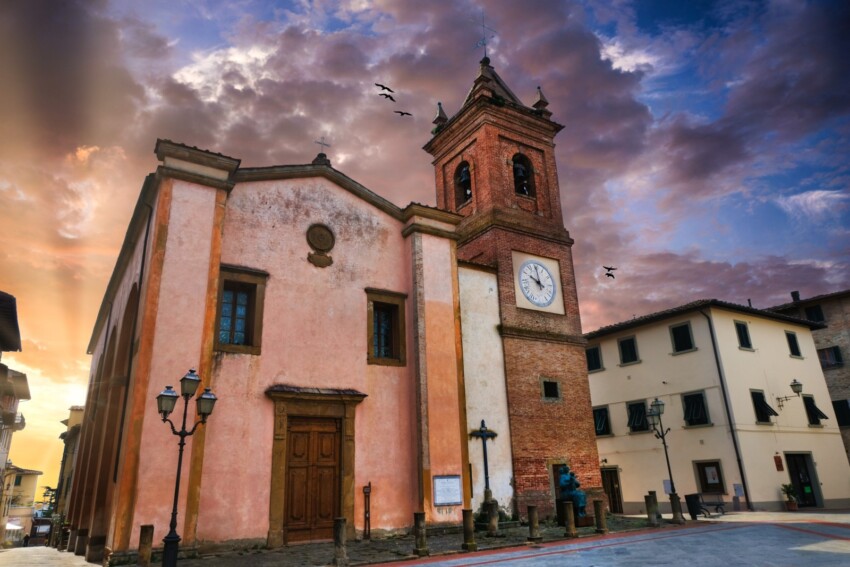
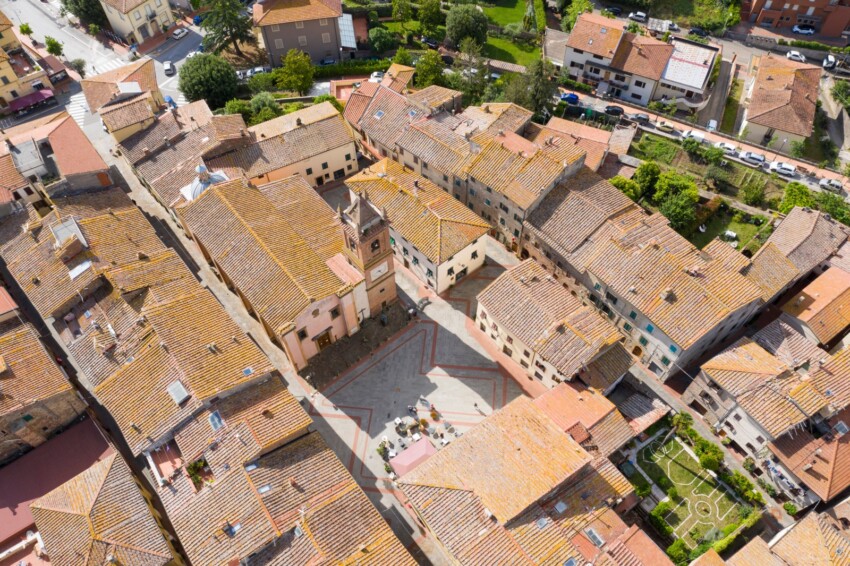
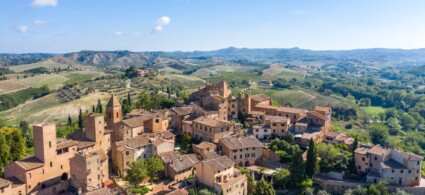
Within the simple urban layout, comprised of three parallel streets, the Palazzo Pretorio (14th century) stands out particularly, its façade still preserving numerous coats of arms in stone and glazed terracotta belonging to former magistrates. Inside you’ll find the Civic Museum and Historical Archive. Also noteworthy is the church of San Regolo, formerly San Bartolomeo, dating from the 13th century, which houses a fine painting (Madonna and Child from the 13th century) attributed to the school of Cimabue.
The municipality contains numerous places of historical and artistic interest. On the road towards Gambassi Terme, approximately 1 km from the main town, stands Villa da Filicaja in the Sant’Antonio area, built on the site of the Roman Figline: it was donated by the Medici family, along with extensive lands and a house in town, to the poet Vincenzo da Filicaja (14th century).
Around 2 kilometres away is the Roman cistern dating from the 2nd century AD, measuring 27 metres long and 3 metres wide, divided into three rectangular tanks which collected 400 cubic metres of water from the springs of Poggio all’Aglione.
Of considerable religious significance, at San Vivaldo, near the convent, lies the famous Sacred Mount or Tuscany’s Jerusalem, a series of chapels created by Friar Tommaso da Firenze in 1500 depicting the essential sites of Christ’s Passion.
Four kilometres from San Vivaldo, downhill from the medieval ruins of the Castles of Pietrina and Camporena, lies the hamlet of Iano, once important for its onyx quarries and hardstone working.
The village and fortress of Castelfalfi, perched on a spur of one of Tuscany’s magnificent hills, were founded around the 8th century by the Lombard Faolfi (hence the name “Castrum Faolfi”). Destroyed in 1395 during wars between Florence and Pisa, the castle was rebuilt and crowned with four towers, bastions and solid walls. Of interest in the village is the Romanesque church of San Floriano.
San Vivaldo is situated amongst the verdant hills of the Tuscan countryside at 450 metres above sea level in the municipality of Montaione, in the province of Florence.
San Vivaldo, whose origins date back to 1300, the year chosen by Blessed Vivaldo, a Franciscan tertiary lay member born in San Gimignano, to live there a life of penance and fasting for “the love of Jesus Christ”.
Today it is considered one of Italy’s most renowned pilgrimage sites and has been recognised as a national monument.
The Sacred Mount of San Vivaldo in Tuscany is one of the sacred mountains found throughout northern Italy that were built between 1500 and 1600, though their origins date back to between 1185 and 1280, when the area was held by the Friars of the Cross of Normandy and contested between Castelfiorentino and San Miniato.
The convent of San Vivaldo is undoubtedly linked to the history of the Franciscan Order, which left an indelible mark here. Over the centuries, the convent expanded, becoming the imposing building you can admire today.
The Church of San Vivaldo was built where a chestnut tree once stood in which, on 1 May 1320, Vivaldo Stricchi was found dead – a site now corresponding to the chapel housing the Saint’s urn and relics. What you see today is the result of an enlargement of the original church, carried out between 1326 and 1355 and consecrated on 30 November 1416 (or 1410) by Franciscan bishop Friar Antonio da Prato.
Originally, there was also another small church on the site, Santa Maria a Camporena, belonging to a small adjacent settlement (now part of Montaione municipality, situated on the road towards Iano), which gradually fell into disrepair after the new church was built. The lateral chapels appear to date from the 1400s as an oratory of the Franciscan Third Order, initially run by two hermits, while in the 1500s a small community of the First Order Franciscan of the Observance branch took over permanently.
The church, following typical Franciscan architecture, is preceded by a loggia, to the right of which, corresponding to the chapel of St Vivaldo, within a Robbian terracotta frame are figures in painted clay of Saint Anthony Abbot (the quintessential hermit saint), Saint Linus, pope and patron of Volterra, and Saint Roch (protector against plague, and plague fears swept the area in 1504).
The Chapels of the Sacred Mount of San Vivaldo date from the early 1500s and contain terracotta sculptural groups inside representing scenes from the life and Passion of Jesus Christ.
In a former hay loft adjacent to the Mount Sion chapel and near the convent of San Vivaldo, a Permanent Exhibition has been set up presenting the history and images of Tuscany’s Jerusalem. The exhibition is divided into four sections: “Life and tradition of the hermit Vivaldo”, “Friar Tommaso da Firenze and the Jerusalem of San Vivaldo”, “San Vivaldo and Jerusalem” and “San Vivaldo, Varallo and the Franciscan tradition of the Sacred Mounts”.
Montaione has a network of trekking trails (some also passable by mountain bike) that traverse the entire municipality.
The routes are organised into 6 itineraries, mostly circular loops, and have been designed to enable visitors to discover much of the territory, showcasing its areas, woodland and slopes, which until recently were frequented only by hunters and mushroom foragers. They follow the traces of ancient roads consisting of farm tracks and the now-disused paths of woodcutters and shepherds. It is important to maintain these routes in good condition for two purposes: to revive historical memory through place names, and to enable quick access to the more remote woodland areas in order to limit damage to the natural heritage caused by summer fires.
The trails vary in length and are characterised by different levels of difficulty. They are marked by progressive numbers found on metal signs throughout the route, as well as other marks painted in white and red. At the beginning and end of each loop you’ll find metal signs summarising the features of that section, indicating: accessibility (on foot, by mountain bike), starting and ending points, distance in km, total elevation gain in metres and estimated walking time for an average hiker.
The trails also differ in the types of terrain they cross: some venture into woodland or along rivers in the valleys, others follow the ridges of hills offering panoramic views stretching to the horizon. It is also worth noting that the routes often cross private property or border areas belonging to tourist facilities. Visitors are therefore asked to respect the privacy of guests and owners by behaving with appropriate civility.
The routes are reproduced on a map at a scale of 1:25,000 (Itinerari nel Verde) and described in detail in a chapter of the guide “Montaione – Il Paese del Turismo Verde”. These publications are for sale in Montaione at stationeries and tobacconists’ shops and in some specialist bookshops in Florence.
To see all the facilities and book accommodation in Montaione use the form below, entering the dates of your stay.
 Hotel
Hotel  Budget accommodations
  Apartments
  Family Hotel
  Luxury Hotel
  Resorts