Agriturismo Tenuta Cantagallo
Montelupo Fiorentino - Via Valicarda 35
Book now
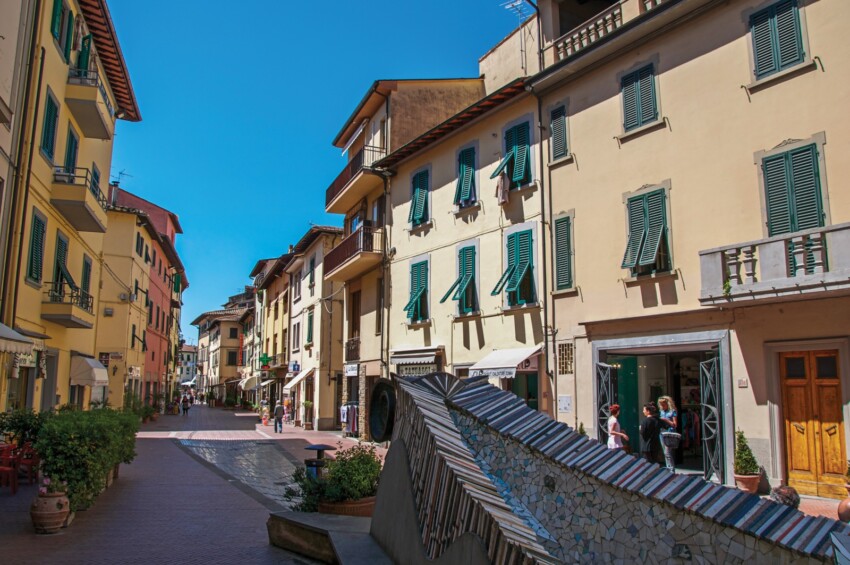
Montelupo Fiorentino, as its name suggests, sits just a few kilometres from Florence and, by virtue of its distinctive history, embodies many of the quintessential traits of “Tuscanness”: a passion for art, quality craftsmanship, the entrepreneurial spirit of local families, alongside breathtaking landscapes, a love of fine food and an innate sense of hospitality.
In 1203-4, the Florentine Republic decided to build a fortification on the hilltop overlooking the confluence of the Arno and Pesa rivers.
This rocca became the first nucleus from which the settlement of Montelupo developed. In 1270, the Church of San Giovanni Evangelista, the town’s patron saint, was built within the Rocca. A larger structure was added to this initial building by the sixteenth century, complete with two side chapels that serve as a modest transept.
Within the alcove carved into the tower, frescoes signed by the Florentine painter Corso di Buono remain visible (Christ amongst the Cherubim and the Miracle of San Giovanni Evangelista), while at the entrance stand two small Gothic temples with frescoes by Piero di Chellino (Stories of San Nicola) overlaid on earlier wall decorations (coordinated with those by Corso).
The church later lost its role as the parish church and today is rarely used for services.
The ascent to the Rocca, which is made from the Montelupo village via a steep narrow lane, is well worth the effort: from the summit, you can see across the entire valley and, at sunset, the jagged profile of the Apuan Alps stands out to the west. The area has also been the subject of several archaeological excavations, which have yielded artefacts from the medieval period.
The Medici Villa dell’Ambrogiana, situated at the confluence of the Pesa and Arno rivers, was purchased by the Medici family in the second half of the sixteenth century and later became the preferred residence of Grand Duke Cosimo III in the late seventeenth century.
The structure is quadrangular in layout, with a spacious courtyard, four corner towers and four entrance gateways.
The original garden was particularly noteworthy, extending all the way to the Arno’s waters, and nearby was an artificial grotto with water features.
During the early decades of the nineteenth century, the Ambrogiana underwent further alterations to its access routes. Then, in 1854, the entire complex was converted into an asylum. Subsequently, the Ambrogiana housed a women’s and juvenile prison, and later the Judicial Psychiatric Hospital (1888), which currently occupies the complex.
Guided tours are organised during certain times of the year, during which visitors can admire some of the rooms, the cloister, the chapel and the magnificent garden.
The new Ceramics Museum boasts a covered area of 2,100 square metres plus an open-air space of 400 square metres, along with a spacious entrance hall with café and bookshop.
The exhibition layout spans three floors.
In the first room on the ground floor is an evocative reconstruction of the so-called “washhouse well”, with an ideal journey through the history of Montelupo ceramics, punctuated by large graphic reconstructions, while from the next room onwards, arranged chronologically and typologically, begin the Museum’s ceramic collections.
In the remaining ground floor rooms are displays of majolica dating from the late thirteenth century to the mid-fifteenth century, including a full-scale reconstruction of a medieval table, while on the upper floor the Renaissance journey begins: a broad showcase of the period’s classic decorative styles.
The golden age of the early Renaissance period concludes finally in the last rooms of the first floor with grotesque decoration, represented by the platter known as “il rosso di Montelupo”, one of the masterpieces of Italian Renaissance majolica.
The production of archaic majolica in Montelupo dates back to the second half of the thirteenth century, but it was in the early 1400s that ceramic activities received a significant boost from the conquest of Pisa (1406), which finally opened Florence’s route to the sea. Located precisely on the navigable stretch of the Arno River, Montelupo’s kilns could link up with maritime ports (Pisa and later Livorno), and their productive, technological and artistic development attracted investment from Florence’s noble and wealthy families.
Montelupo’s golden age can be placed between around 1450 and 1530. During this period, Renaissance decorative styles were developed and refined, and Montelupo majolica reached its maximum commercial expansion, spreading across the Mediterranean basin and along Atlantic trade routes.
From the second half of the sixteenth century onwards, Montelupo’s ceramic production began to suffer the effects of the general economic crisis, and local ceramic enterprises were forced to change both the type and technology of their production. After 1630, the year of the great plague, the number of ceramicists fell considerably and, in the second half of the seventeenth century, production declined drastically, until the kilns dedicated to the finest wares disappeared, leaving only those producing kitchen pottery and terracotta.
Between the late nineteenth and early twentieth centuries, starting with the great Fanciullacci factory, the production of Montelupo majolica was reborn.
Today Montelupo Fiorentino is one of Italy’s major ceramic centres, producing raw materials and artistic majolica for export.
While Montelupo gave birth to sculptor Baccio Bandinelli (a pupil and friend of Michelangelo), among others, it’s only a few kilometres to Vinci, Leonardo’s birthplace, or Pontorme, home to the painter Jacopo Carrucci, known as “Il Pontormo”.
We recommend starting by climbing the castle of Capraia, which has faced Montelupo’s castle for at least 800 years. Then you’ll move on to visit Vinci, with its charming historic centre, dominated by the castle.
A subsequent stop can be Cerreto Guidi, and its Medici Villa, before heading down towards San Miniato, built along the ridge of a hilltop overlooking the Arno plain, and rich in interesting monuments.
Nearby Empoli preserves part of its historic centre with its precious Collegiate Church. Heading towards Chianti, you can quickly reach Montespertoli, an ancient town perched on the summit of a hill that dominates the splendid countryside.
But by now you can imagine it: central Tuscany is brimming with places of great charm and enchanting landscapes, and you won’t fail to discover them yourselves.
The route begins at the historic Viale Umberto I, shaded by plane trees, which opens onto the Ambrogiana Park, surrounding the Medici villa. Following the Arno’s embankment, we pass the Frescobaldi Tower and set off towards the most spacious stretch of the river. The countryside extends, on the left bank, in a vast plain marked by cultivated fields and patches of typical riparian vegetation where cormorants, herons, kingfishers, geese and ducks find shelter.
Continuing your walk along the Arno, you can catch glimpses on our left of the settlement of Fibbiana, which forms the backdrop to the imposing Villa Mannelli, a residence with an eighteenth-century façade. Just beyond the last houses of Fibbiana, the great plain of Arno Vecchio opens up, its name derived from an ancient bend of the Arno. The plain is dotted with fruit orchards, vineyards and cereal crop plots, and is also characterised by several artificial lakes, in which certain bird species nest. Reaching the Tinaia locality, you can continue towards Fibbiana, immersing yourself in a rural landscape of bygone times, where the countryside is interrupted only by a few farmhouses with typical Tuscan character.
Duration: 3 hours – suitable for all
Leaving Montelupo behind and following the road that runs along the base of the hill beside the final stretch of the Pesa river, you’ll reach the Church of SS. Ippolito and Cassiano, viewable from the outside only. Just past the church, on the left, you’ll find Via di Bracciatica, which climbs towards the Malmantile locality, cutting across the surrounding countryside.
Worth noting are the remains of the Malmantile walls, a small medieval village, the Church of S. Pietro in Selva and, nearby, the Hermitage of Lecceto. Past the village, along Via S. Vito, you’ll reach the S. Vito in Fiore di Selva estate where you can taste and purchase local products.
Descending towards Camaioni, a fantastic panorama will unfold before your eyes overlooking the Arno valley and, amidst the green woodland, you’ll find a small and evocative medieval church, S. Michele a Luciano.
The return takes you through the hamlet of Samminiatello.
Duration: a full day – suitable for all
To see all the facilities and book accommodation in Montelupo Fiorentino use the form below, entering the dates of your stay.
 Hotel
Hotel  Budget accommodations
  Apartments
  Family Hotel
  Luxury Hotel
  Resorts