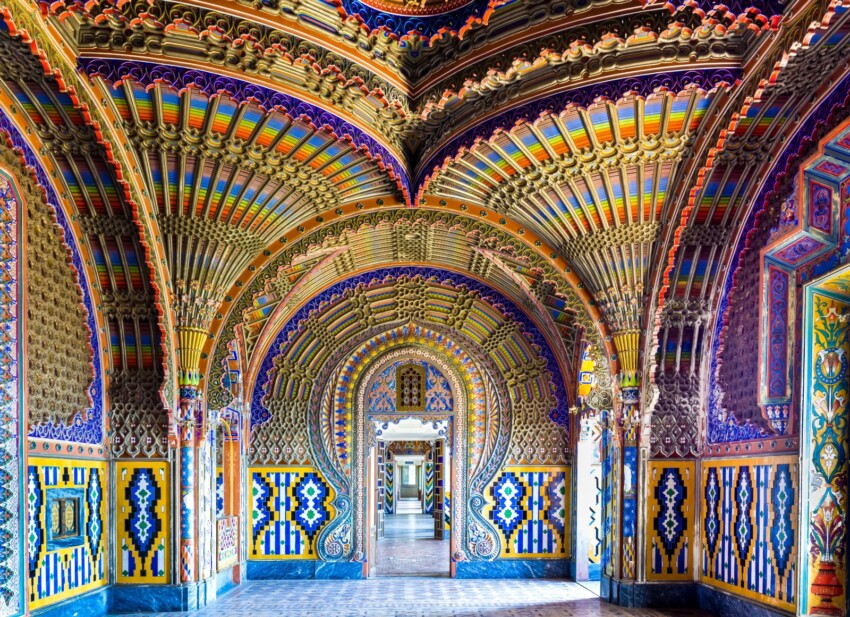
Legend has it that the ancient Castello di Sammezzano, which occupied the site where the Villa now stands, was visited in 780 by Charlemagne on his return from Rome, where he had his son baptised by Pope Adrian I. This account, reported by historian Robert Davidsohn in his History of Florence, is presented with some uncertainty: Charlemagne’s passage through this place is a tradition rather than a documented fact. This should not be confused with the Lombard campaign: Desiderius had been deposed and taken prisoner six years earlier, in 774.
Many centuries later, the castle belonged to the Florentine Gualtierotti family, who would have held it until 1488; it then passed to the properties of Bindo Altoviti and subsequently to Giovanni Jacopo de’ Medici, Marquess of Marignano.
In 1564, Grand Duke Cosimo I established the so-called bandita di Sammezzano (a vast territory corresponding to much of the present-day municipality of Reggello, where hunting and fishing were forbidden without permission), which he gave to his son Ferdinando, the future Grand Duke. The estate also included a beech forest, known as the “Comunanza di Sammezzano”, situated in the Macinaia area, near the Vallombrosa Abbey.
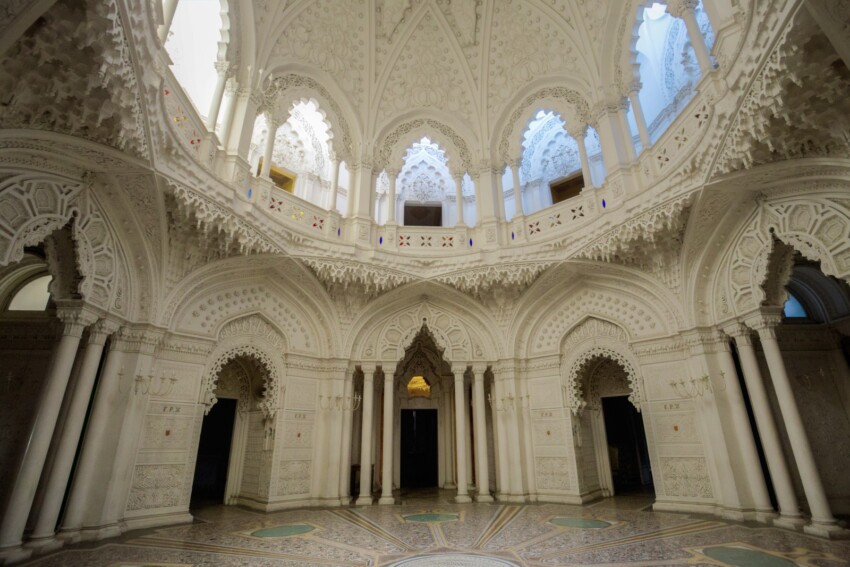
The castle-villa of Sammezzano was purchased in 1596 by Ferdinando di Odoardo Ximenes d’Aragona at the behest of Grand Duke Ferdinando I de’ Medici, as documented by a parchment deed preserved in the Panciatichi Archives (17 August 1596). The date of 1605, cited by many secondary sources, derives from Repetti’s Geographical Dictionary (1839) and has been propagated in error. The castle remained with the Ximenes d’Aragona family until 1816, the year Ferdinando died as the last heir of the line. Following a lengthy legal process concerning Ferdinando Ximenes’ will, the estate, name, coat of arms and titles of the family passed to Pietro Leopoldo Panciaticki, son of Vittoria Ximenes d’Aragona, Ferdinando’s sister, and wife of the Pistoia nobleman Niccolò Panciaticki. Upon Pietro Leopoldo’s death, the estate was inherited by his son, the Marquess Ferdinando Panciaticki Ximenes d’Aragona.
The present appearance of the complex is due to the work of Ferdinando Panciaticki Ximenes d’Aragona, acting in both capacities as patron and architect. The first evidence of the Neo-Moorish interventions carried out by Ferdinando dates to 1853.
The construction of the White Hall dates to 1863, and the execution of the Gallery between the Hall of Mirrors and the octagonal Smoking Room dates to 1870. The crescendo of creations included the Halls of the Peacocks, the Lilies, the Stalactites, the Spanish Basins, and the Lovers. In these spacious interconnected rooms, brimming with niches, hidden corners, openings, elevated vistas, rows of columns and almost labyrinthine passages, an inexhaustible array of capitals, corbels, arches, portals, fan vaults, domes and pendentives dripping with ornamental detail came alive; surfaces embellished with ornate plasterwork filigree.
Panciaticki continued to design in the same style the Guard House in Sammezzano Park, the Gateway to a Park, Interiors of two halls and a Richly decorated oriental cenotaph (studies published between 1879 and 1885 in the Florentine journal Ricordi di Architettura).
In 1889, a prominent tower-gate was erected at the centre of the façade and the other segments of the front were decorated with brick string courses connected to the window frames and diamond motifs inserted in the spaces between the openings on the second floor.
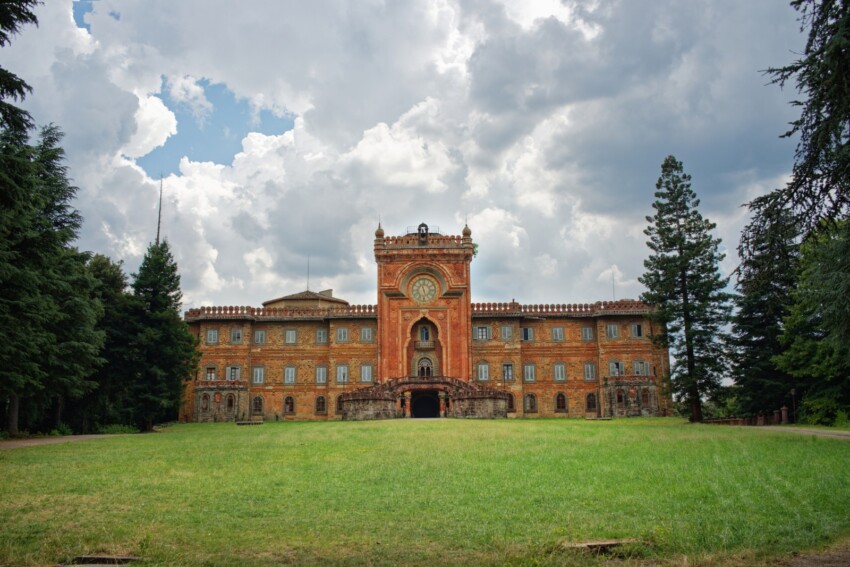
The park of Sammezzano villa, one of Tuscany’s most extensive parks, is comprised of a large net-training structure formed by a high forest of holm oak.
Within this and on land reclaimed from agricultural cultivation, in the mid-1800s Ferdinando Panciaticki planted a variety of exotic and rare species (including Sequoia sempervirens, Sequoiadendron giganteum and other American conifers, still visible), and embellished the park with structures in Moorish style: a bridge, a grotto with water (which once contained a statue of Venus, now removed), pools, fountains and other decorative terracotta works (some statuary groups were later transferred to Florence, to the Ximenes palazzo in Borgo Pinti).
From a report drawn up in 1890 by Maria Paolucci, daughter of Panciaticki, we learn that the sequoias were planted around 1851, and that a considerable sum was expended for the first specimen: when Paolucci wrote, only 37 of the 134 plant species planted by her father were still alive. Among these were Araucaria, Sequoia, Taxodium, Cryptomeria, Biota, Thuja, Thuiopsis, Libocedrus, Taxus, Cephalotaxus, Cupressus (various species), Pinus, Abies, various palms, Yucca, Quercus (various species) as well as some plants of purely ornamental interest.
Many of the plants mentioned in the 1890 report no longer exist; others have been replanted and additional species have been added to those that survived. Particularly noteworthy is the group of giant sequoias, possibly the largest in Italy: there are 57 mature sequoias (all over 35 metres tall), one of which has a trunk approximately ten metres in diameter, another eight metres. Also notable are the Lawson cypress specimens (one of the largest is visible from the lower perimeter road of the park), covering an area of about 85 square metres, identifiable by the silvery colour of the underside of the leaves.
Sammezzano Castle is currently closed to the public and not open to visitors. After decades of abandonment, legal disputes and failed auctions, in April 2025 a restructuring plan was approved and the entire complex was assigned to the Moretti family. In May 2026, a garden restoration project was announced, entrusted to Florentine architect Tommaso del Buono, with the aim of restoring the park to its nineteenth-century splendour by combining Tuscan botanical tradition with British landscaping sensibility.
The castle had been included in 2015 on the Red List of cultural heritage at risk by Italia Nostra and in 2016 had achieved first place in the FAI census “Places of the Heart”, gathering over fifty thousand votes. For updates on reopening and work progress, visit the savesammezzano.com website.
City Card allow you to save on public transport and / or on the entrances to the main tourist attractions.
 Hotel
Hotel  Budget accommodations
  Apartments
  Family Hotel
  Luxury Hotel
  Resorts