Salvadonica
San Casciano in Val di Pesa - Via Grevigiana 82
Book now
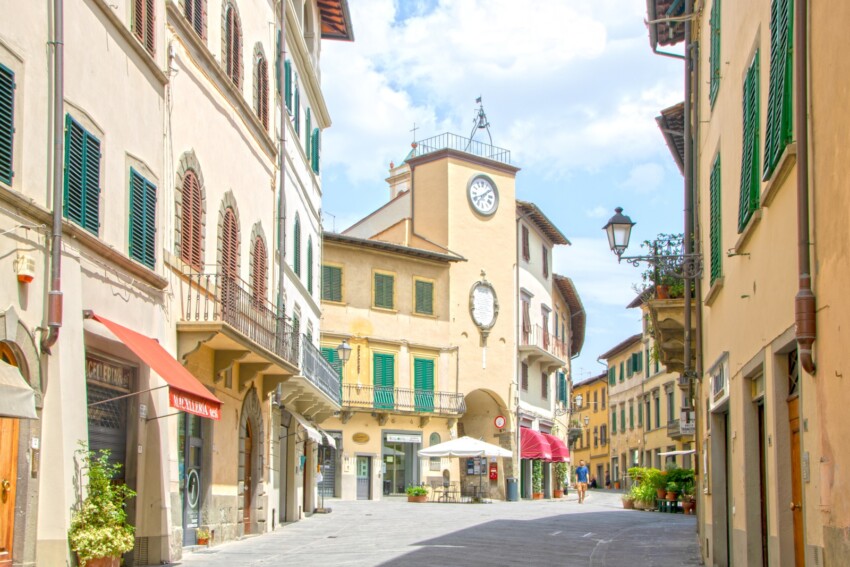
Just south of Florence lies the territory of this municipality, surrounded by the neighbouring communes of Scandicci and Impruneta to the north, Greve to the east, Tavarnelle Val di Pesa to the south and finally the municipality of Montespertoli to the west.
In antiquity it was known as San Casciano a Decimo because it was situated at the tenth milestone of the Roman road. This town too arose under the auspices of Florence, as it received its first statute from the Florentine bishops in 1241; in 1272 it came under the Florentine Republic. Henry VII, descending into Italy, stopped here for several days in December 1312. In 1326 San Casciano suffered various raids by Castruccio Castracani, who set the town ablaze. Gualtieri di Brienne, Duke of Athens and Lord of Florence, began to fortify it in 1343.
Like Empoli and many other Tuscan towns, San Casciano was considered by the Florentines as a strategic stronghold for their defence. Indeed, in 1355 they built a fortress there and equipped it with massive walls and towers. Grand Duke Ferdinand II later donated the Fortress of San Casciano to Giovanni Santi Lucardesi, known as the Indian; subsequently, the same fortress became a convent for Benedictine nuns.
Of note in San Casciano is the Church of Misericordia, formerly Santa Maria del Prato, of Gothic-Tuscan architecture dating from 1335; the Collegiate Church, where in the right-hand chapel there is a baptismal font in lunette form with Madonna and Saints from the 14th century and at the third altar on the left the Annunciation, in the manner of Ridolfo Ghirlandaio; the Church of San Francesco, from 1436 and renovated in 1492; inside, Madonna with Child and Saints, a panel by Biagio di Antonio da Firenze, and in the convent refectory, a Last Supper fresco attributed to Passignano.
The San Casciano Museum originated from an art collection set up as early as 1989 in the church of Santa Maria del Gesù. The sacred art museum, created to ensure the safety of works once scattered throughout the San Casciano Vicariat, was enriched in 2008, thanks to the recovery of some rooms previously occupied by administrative offices, with an archaeological section and a section dedicated to primitive dwellings.
The original choice to use a place of worship as a museum, albeit one rarely used for services, stemmed from practical and scientific reasons: its central location within the urban fabric, the convenience of access, and the preservation of the works on the altars for which they were created.
Today, according to a broader cultural project, the San Casciano Museum aims to establish itself as a cultural hub for the local community: the museum becomes a living testimony to the city’s history, it is the mirror in which the civic reality is reflected, it is a place of debate and discussion, first and foremost with new generations.
From the entrance hall, also used as a tourist information office, the museum tour begins in the sacristy where the carved shaft by the Master of Cabestany is kept, among other works. From here you access the Church of Santa Maria del Gesù.
From the sacristy, the tour continues into the paintings hall and the sacred vestments section. In the first room are the museum’s most precious works, first among them the two paintings from the church of Sant’Angelo a Vico l’Abate: the altarpiece depicting Archangel Michael and scenes, attributed to Coppo di Marcovaldo and dated to the fifth decade of the 13th century, and the Madonna and Child by Ambrogio Lorenzetti, dated 1319, both placed on the right wall. In the same room are gathered all the gold-ground panels, the oldest of which is a Madonna and Child dating to the second decade of the 14th century and attributed to the Master of the Horne Triptych, an anonymous painter among the minor figures of 14th-century Florence, but possessing a marked individuality. Of particular interest is the Madonna and Child by Cenni di Francesco, one of the most significant exponents of late Gothic Tuscany, whose style is characterised by a narrative tone and extraordinary chromatic and expressive vivacity.
Along the walls are further works: the Madonna and Child with angels and saints by Master Francesco, the triptych with the Madonna enthroned among four saints by the Master of San Jacopo a Mucciana, the Madonna and Child by Jacopo del Casentino and the 14th-century Crucifix attributed to the Master of San Lucchese, reshaped at the beginning of the 15th century.
Returning to the entrance hall, dominated by the majestic stele called the “Archer’s”, via the stairs or lift you ascend to the first floor, which houses the archaeological section. From the second room dedicated to archaeology, you access the Primitive Dwellings section, which continues on the second floor.
The visit to the San Casciano Museum concludes with the Primitive Dwellings section. From the typical farmhouse that characterises the Chianti landscape, the view opens up, with this section, to cultures from around the world, with the ambitious aim of showcasing the great variety of building forms and traditional habitats, thanks to scale models, explanatory panels and period photographs. The section was created following the donation to the Municipality in 1988 of the scientific material from the Building Typologies Archive of the Architecture Design Department of the University of Florence, with the purpose of making San Casciano a centre for studies and research on housing culture and environmental and architectural conservation.
This is a rich and important collection of artworks gathered over time by the Misericordia Confraternity and housed within the church of Santa Maria sul Prato. Among the paintings worthy of note are three 14th-century panels by Ugolino di Nerio depicting Madonna and Child, Saint Peter and Saint Francis, and the Crucifix by Simone Martini. On the right wall of the church is a marble pulpit from the mid-14th century, an important work by Giovanni di Balduccio.
Il Palagio is located at Mercatale – formerly Mercatale dei Campoli, an important centre that emerged as a consequence of strong economic growth in the 13th century as a trading point for the castles in the area – in the heart of Chianti Fiorentino. The first mention of the Castle dates to 1252, although the first settlement in the area is much older. Various events marked the history of this fortress which, by virtue of its size and impregnability, withstood numerous incursions over the centuries; indeed, the massive splayed base and the mighty quadrangular walls topped by the central tower, which served as a lookout and keep, combined with the valour of its defenders, prevented the devastation and destruction that befell other buildings in the area.
In 1260 the Ghibellines, following their victory at the Battle of Monteaperti, devastated the area, destroying the nearby village of Campòli, but Il Palagio remained unscathed, as it did during Emperor Henry VII’s descent into Italy. A few years later, in 1320, the castle was enlarged, reaching dimensions considerably larger than its present size. The year 1326 saw raids and destruction by the Lord of Lucca Castruccio Castracani, who spent considerable time in the vicinity, while fifty years later near the nearby Bridge of Romagliano – now in the territory of Sambuca Valdipesa – the army of captain John Hawkwood was halted by militia from the Buondelmonti family coming from Il Palagio; by now the fortress with its impregnable walls was a place of defence used as a springboard for offensive action, as well as a crucial link in the defensive chain that stretched from San Casciano, passing through Mercatale, to Sant’Andrea a Fabbrica.
The building originally had one storey, built above the round stone base of the splayed foundation, and traces of the original pitched roof are still visible, repeated also on the tower, though there it was wooden as was the custom at the time. After the 14th-century enlargement, an entire wing is raised, with the consequent demolition of the old roof, replaced with a flat structure also on the tower, which is itself raised by one storey. The original structure had no crenellations; the existing ones are part of the neo-Gothic restructuring carried out at the end of the 19th century. Originally belonging to the Visdomini family of Petrojo (from whom descended the patron saint of Chianti, San Giovangualberto) and subsequently to the Canigiani who also owned the small castle of Montefolchi, Il Palagio belonged to the Florentine Republic for two centuries. With the Medici Renaissance and the end of continuous military emergencies, Il Palagio too, under the hands of its new owners, the Miniati Barons, was transformed into a villa and enriched with artworks, while new impetus was given to agriculture where vines and olives took centre stage.
What we see today at the Palagio is largely the result of restoration from a century ago and although many parts of the building still reveal ancient structures, others are the fruit of the medieval-romantic wave that dominated early 20th-century architecture. The restoration also gave new impetus to the vast estate, so that alongside it new spaces were created for the farmhouse with its oil mill, the new wine cellars and warehouses where, 120 years on, wine is still made according to traditional methods and the wine still bears the emblem of this ancient fortress which, given its majesty and importance, was given the name Il Palagio.
To see all the facilities and book accommodation in San Casciano Val di Pesa use the form below, entering the dates of your stay.
 Hotel
Hotel  Budget accommodations
  Apartments
  Family Hotel
  Luxury Hotel
  Resorts