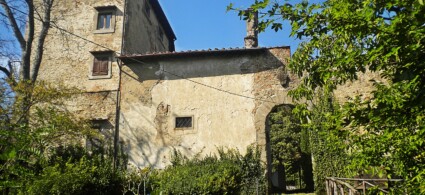
Podere Badia Valdrago Agriturismo Mugello Circuit
Scarperia - Via Grezzano 113
Book now
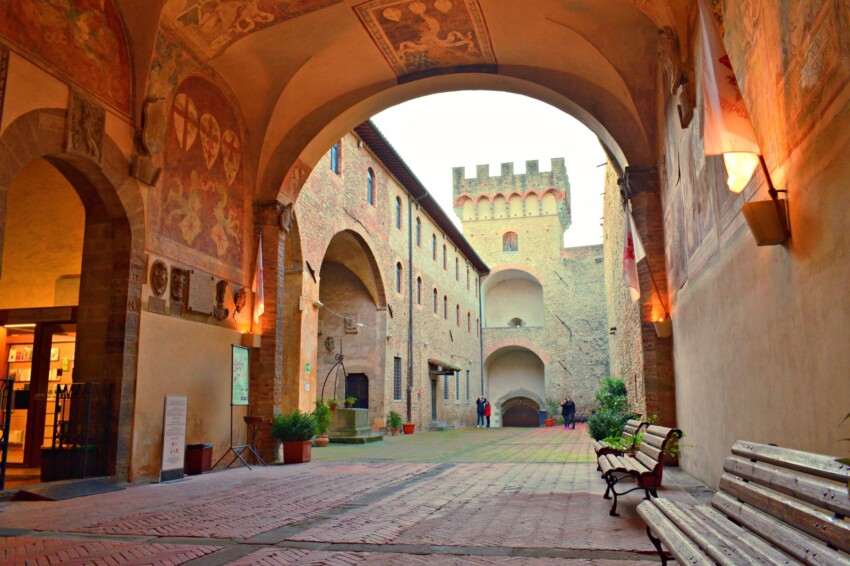
In 1306, after defeating the Ubaldini, the ancient feudal lords of the Mugello, Florence’s Council of One Hundred decreed on 18 July the construction of a “new town”, Castel S. Barnaba, in the area known as “Scarperia” on the main route of the Giogo Pass. This was the principal communication route between Florence and Bologna. On 7 September, the streets and walls were mapped out before the gathered country dwellers who were called to settle in the new centre, which was officially founded the following day with a ten-year exemption from taxes and levies for all those who built their homes there.
In 1415, Scarperia became the seat of the vicar, Florence’s representative of administrative and judicial power, and the castle was enlarged to accommodate him. Every vicar left their coat of arms in the palace, either sculpted or painted. The Vicariate of Scarperia comprised the districts of Barberino di Mugello, Borgo S. Lorenzo, Campi, Carmignano, Dicomano, S. Godenzo, Sesto, Fiesole and Vicchio. Scarperia’s commercial activity flourished thanks to its strategic position on the Giogo road, through which one could reach Emilia and northern Italy. Throughout the 15th and 16th centuries, innkeepers and tavern owners were numerous, and craft workshops were widespread, particularly those where iron was forged and agricultural tools and cutlery were produced.
In 1752, the new Lorraine government improved trans-Apennine routes by building the Futa carriage road, which cut Scarperia off from the traffic flows that had made its fortune. Taverns, inns and osterie ceased operations, and the lives of cutlery makers became difficult. In the first decades of the 19th century, only 50 remained.
In 1908, a law prohibiting the trade and use of penknives longer than the span of a hand dealt a final blow to the sharp-metal craft, which nonetheless survived with ups and downs until its revival in recent decades.
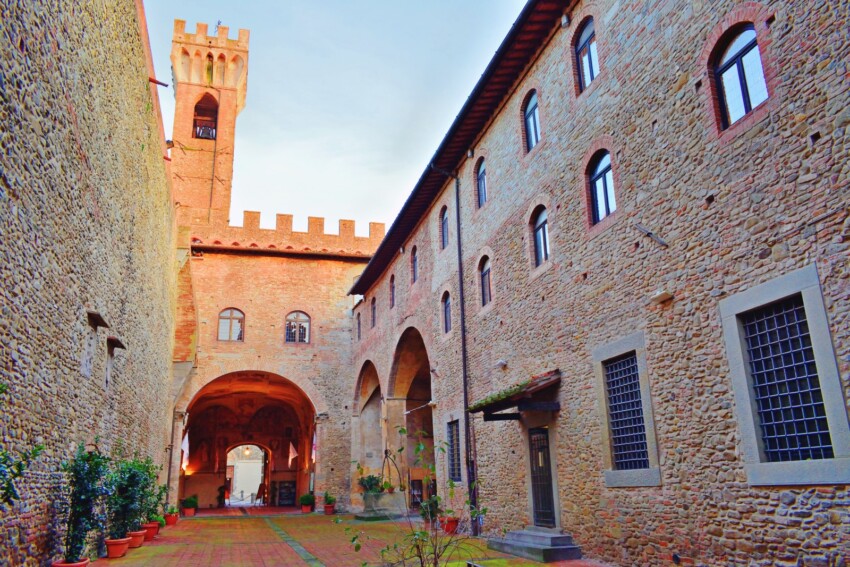
The Palazzo dei Vicari is the result of successive expansions around an original core built around the tower.
During the 14th century, a residential nucleus for the Captain must have been added to the tower; in 1366 extensive work was carried out on the castle, including work “on the cassero chamber”, “restoration” of the “crenellation” and “on the tower of the chestnut guard let four crenels be made which are broken and fallen”.
The 16th century was a pivotal moment in the Palace’s configuration; following the 1542 earthquake, the building suffered considerable damage, which was followed by restoration work that gave the palace its final arrangement, close to its present appearance (at least as far as the Vicar’s residence and reception rooms are concerned).
The reconstruction also led to the final arrangement of the prisons, housed in the vaulted spaces on the ground floor (now a loggia).
Further modifications and repairs to the Palace occurred during the 17th century, following another earthquake on 8 September 1611.
The repair work was completed in August 1612, and by the end of the work the palace had somewhat changed its appearance. Buttresses to reinforce the walls, a sloping roof on the façade, plastering of the façade, and the arrangement and roughcast of the large side wall towards Porta S. Agata are the most evident external works.
With only a few further modifications, the Palace assumed the morphological characteristics that remained unchanged until the mid-19th century, when the building underwent further restoration and alteration.
The damage caused by the 1960 earthquake, together with the precarious foundation ground, was the subject of an extensive consolidation and restoration project (from 1980 onwards) which was completed in 1999 with the recovery of the monumental spaces and the reconstruction of the north wing, which now houses the Museum of Sharp Edged Tools.
In this Museum—a place of memory—documents and collections are arranged to guide visitors towards understanding the tool through the lens of historical knowledge.
The museum itinerary begins with a history of the knife’s multifaceted presence in human activities, confirmed by images drawn from Italian artistic production and pictorial representations.
Through hands-on experience (assembly stations), visitors can learn about the component parts of various knife types. You can assemble a real knife and thus appreciate the full complexity of tools that appear deceptively simple, such as the table knife.
A journey through the production of sharp-edged tools and blades from various Italian centres allows for comparison between materials, techniques and objects that may be very distant from each other, both temporally and geographically.
The culture and production of cutlery in Scarperia represent the culmination and pivot of the museum itinerary; the lives and work of families of Scarperia cutlers unfold through memories, stories and contemporary accounts, via images and reconstructions of the working environment, social and family organisation, and the controversial relationship between artisan professionalism and the agricultural world.
The designs of the knives, their constructive characteristics, and the breadth of Scarperia’s productive repertoire are finally illustrated by objects that bear witness, such as work knives with blades worn thin from countless sharpenings, delicate “palmerini”, desk penknives and Scarperia’s timeless “zuava”.
The cutler’s workshop (Via Solferino, 15) represents the part of the museum itinerary where you can follow the stages of artisanal knife-making through direct experience and thus with an emotional involvement of the visitor.
The forge, work bench and anvil were the equipment around which the cutler worked, assisted in the lighter tasks by child workers and by the “giratora”, female labour whose skills were limited to providing movement to the grinding wheel for sharpening blades.
Various devices have been adopted that allow you to handle, disassemble and reassemble a knife so that you can assess its size and shape in relation to its potential uses.
The Museum of Sharp Edged Tools belongs to the “Museo Diffuso” museum circuit, which extends across the municipalities of Barberino di Mugello, Borgo San Lorenzo, Dicomano, Firenzuola, Londa, Marradi, Palazzuolo, Pelago, Pontassieve, Reggello, Rufina, San Godenzo, San Piero a Sieve, Scarperia, Vaglia and Vicchio.
An extension of the Museum of Sharp Edged Tools, this is a sort of living museum where you can follow the various stages of artisanal knife-making, thanks to local craftsmen working at assembly benches in a workshop that has barely changed since the 1940s. The experience is entirely immersive: the forge, work bench and anvil are still there to bear witness to the cutler’s work, who was assisted in the lighter tasks by children and by the “giratora”, the woman who provided movement to the grinding wheel for sharpening blades.
To see all the facilities and book accommodation in Scarperia use the form below, entering the dates of your stay.
 Hotel
Hotel  Budget accommodations
  Apartments
  Family Hotel
  Luxury Hotel
  Resorts