Fantastic Garden
Sesto Fiorentino - Viale XX Settembre
Book now
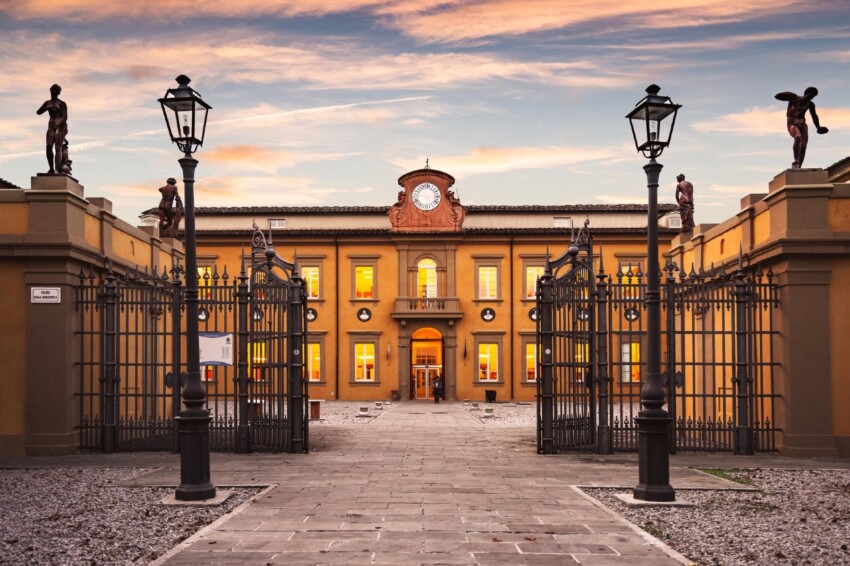
During your tour of Tuscany, when you’re near Florence you’ll certainly spot signposts for Sesto Fiorentino. Follow them, and within minutes you’ll find yourself in the heart of the third largest municipality in the Florence metropolitan area, home to over 50,000 residents and a historic centre worth exploring.
Sesto Fiorentino, or simply Sesto as locals call it, isn’t a typical tourist destination, but we’d strongly recommend stopping by – or even making it your base for your Florence holiday. Why? Simple: a 12-minute train ride gets you to Florence Santa Maria Novella station, whilst heading the other way, you’ll reach Prato Centrale in just 7 minutes.
That’s not all: there are two motorway exits, the airport within spitting distance, all facilities on your doorstep, numerous events held in the town centre year-round, a Saturday market that draws thousands from neighbouring towns – including Florence itself – hassle-free parking, honest prices at restaurants and ice cream shops, and a glorious mountain backdrop, Monte Morello, crisscrossed with numerous hiking trails managed by the CAI that you can explore on foot or by bike.
In short, if you want to experience your Florence stay like a local, skip the historic centre and its tourist traps: choose Sesto and you won’t regret it.
As mentioned, Sesto Fiorentino isn’t a tourist destination in the traditional sense. There are no medieval buildings, baroque churches or walled historic centres. The town centre has a late 19th and early 20th-century character, whilst the surrounding area is home to some fine villas, plus plenty of opportunities for days out in the open air.
Start exploring Sesto Fiorentino from its town centre, a task that shouldn’t take more than a couple of hours. The main square is Piazza Vittorio Veneto, known to everyone as Piazza del Comune because it’s where the imposing town hall stands, dating from 1869. The square is rectangular, and at its centre stands an evocative statue commemorating those who died for their country.
Piazza del Comune is the beating heart of the town centre for numerous occasions: in winter, an ice skating rink is set up; in summer, bars place tables outside; during the fine season it hosts concerts that draw thousands; and throughout the rest of the year, fairground rides and other structures for children are periodically installed.
From Piazza del Comune, looking towards Monte Morello, three pedestrian streets branch off: these are Sesto’s shopping streets, namely Via Cavallotti, Via Alighieri and Via Verdi. Most of the town centre’s shops are concentrated here, and all three are highly pleasant to walk along. At the end of Via Verdi you’ll find the lovely Piazza Ginori, overlooked by the Palazzo Pretorio, dating from 1447, with its iconic façade displaying the coats of arms of the podestà who succeeded one another over the centuries.
Also worth visiting is Piazza IV Novembre, which is oblong in shape and runs parallel to Via Cavallotti. This is where the small Coldiretti market is held on Wednesday mornings, and it’s also where Sesto’s nightlife is concentrated, thanks to several nightspots that from May to October attract hundreds of young people from neighbouring towns.
The Pieve di San Martino is located in Piazza della Chiesa, a small square to the south of the town centre, easily reached on foot from Piazza del Comune. It’s a church built in truly ancient Romanesque style: it was consecrated in 868, though it was rebuilt around 1200.
Inside, the space is divided into three naves supported by pillars, whilst the façade has an elegant portico dating from the sixteenth century. Once inside, admire the side altars from the seventeenth century, whilst beneath the high altar stands a crucifix by Agnolo Gaddi, a pupil of Giotto.
Every Saturday Sesto puts on its finest clothes and is transformed to welcome thousands of people who flock to its main squares. It’s market day, and Sesto Fiorentino’s is one of the most important in the entire Florence province. There are countless stalls, spread across three town centre squares: Piazza Lavagnini and Piazza del Mercato, which are actually adjacent and form one continuous space, plus Piazza del Comune.
At the Sesto market, clothes are the main purchase, but there are also dedicated sections for kitchenware, flowers, household goods, and of course food: fruit and vegetables primarily, but also some stalls selling local specialities, prepared on the spot.
It goes without saying that on Saturdays all the town centre streets are packed, shops are open and the atmosphere is most pleasant.
Sesto Fiorentino is home to two Etruscan tombs dating from the seventh century BC: La Mula and La Montagnola, both located near the locality of Quinto Alto.
La Mula4 is found at Via della Mula 2, and is a tholos tomb – a false dome – in excellent condition and declared a national monument in 1905. Its covering measures approximately 9 metres in diameter and is characterised by the absence of a supporting pillar: the walls curve upwards from the base before closing at the top.
La Montagnola Etruscan Tomb5, located at Via Fratelli Rosselli 95, is also a tholos tomb and was only discovered in 1959; today it forms part of a private villa and is open by request. The finds discovered inside have been transferred to the Florence National Archaeological Museum.
A true icon of Sesto, Monte Morello is the mountain that rises behind the town, facing north. All locals love Monte Morello as it’s the perfect place to escape the summer heat: by car you can drive up to the Leonardo da Vinci esplanade, from which you can enjoy a fabulous panorama of the Florentine plain, with views stretching from Prato to the west to Florence’s Duomo to the east, with a privileged view of Peretola airport’s runway.
Continuing on foot, you climb the various peaks of Monte Morello, the highest of which stands at approximately 950 metres altitude. Thanks also to numerous historical remains, the massif is among the protected areas under regional regulations.
Some of the hikes most popular with locals on Monte Morello include those to Fonte dei Seppi, Ceppeto and Gualdo.
The so-called Viottolone Ginori path is particularly interesting, starting from Villa Ginori in the Doccia locality and climbing straight up Monte Morello, as if it were an actual avenue. The Viottolone, which is almost 8.5 kilometres long and climbs over 500 metres in altitude, is visible from afar and looks like a scar on the mountain.
All locals know that the Parco del Neto actually sits within the municipality of Calenzano. However, as it’s located right on the border between the two towns, the Parco del Neto is a true icon of the area, a gathering place for runners, elderly residents, families with children and young couples.
It’s a park spanning 8 hectares, the former gardens of Villa Gamba, a stately villa whose illustrious owners have included the poet Lord Byron, now converted into residential units. Inside the Parco del Neto you can observe numerous species of trees, some planted in the 1800s, including lindens, plane trees and horse chestnuts. Of interest is the presence of taxodium, or “swamp cypress”, which has the characteristic of losing its leaves and branches in winter.
Among pathways, open lawns, play areas for children and small lakes, strolling through Parco del Neto is ideal especially in summer, as thanks to the extensive shaded areas it’s an excellent escape from the heat. Finally, the park’s external circular route is designed for runners, with a length of one kilometre.
In recent years, Parco della Piana has been at the centre of endless controversy, as it’s feared that the new Florence airport project could lead to its loss. The city is therefore divided between those in favour of preserving the park and its ecosystem, renouncing a modern, up-to-date airport, and those willing to sacrifice the park in the name of progress.
Whatever its future, at present Parco della Piana, also known as the Oasi della Querciola, is a wetland area south of Sesto Fiorentino, where you can stroll among migratory birds and reeds. The park is open to the public and is free on Saturdays, Sundays and public holidays. It comprises two lake areas called Lago della Querciola and Lago dei Cavalieri, with a series of observation huts and a small wood alongside.
At present, Legambiente is studying the feasibility of a path that runs from Parco della Piana through the centre of Sesto Fiorentino and reaches the 950-metre peak of Monte Morello.
The Richard-Ginori Museum of the Doccia Manufactory is located in Viale Pratese in Sesto Fiorentino and houses the finest works produced by the Ginori manufactory, which later became Richard-Ginori. It’s managed by the Ministry of Culture and Heritage through the regional museums directorate.
The museum opened in 1965, designed by Pier Niccolò Berardi and Fabio Rossi, and in 2017 was acquired by the Italian State. Inside are numerous objects in majolica, porcelain and earthenware, produced by the Ginori manufactory until 1895, the year it merged with Richard. A substantial portion of the museum tour is therefore dedicated to porcelains produced by Richard-Ginori.
Inside the rooms, objects are arranged in chronological order, and there are also pieces produced by other manufactories in the 19th and 20th centuries. Complementing the visit, there’s also an educational section for children, a library and archives.
The museum is currently closed for refurbishment.
In the following map you can see the location of the main places of interest mentioned in this article.
The history of Sesto Fiorentino is inextricably linked to that of the Doccia manufactory, founded in 1737 by Marquis Carlo Ginori, which more than 100 years later merged with the Richard ceramic company of Milan, giving rise to Richard-Ginori, one of Europe’s most important porcelain manufacturers.
Sesto’s enormous expansion during the twentieth century was also thanks to Ginori, directed by Gio Ponti from 1923 to 1933, and renewed in 1985 thanks to Italy’s finest designers. In 2013 the manufactory was acquired by Gucci, whilst in 2016 the company, by then known as Ginori 1735, came under the control of the Kering group.
Over the centuries, the manufactory brought enormous economic development to the town. But at the same time, especially between the 1800s and 1900s, it reinforced workers’ struggles, so much so that at the end of the 1800s local man Giuseppe Pescetti defeated the conservative Carlo Ginori, becoming Tuscany’s first socialist MP. Two years later, Sesto became the second municipality in Tuscany after Colle Val d’Elsa to have a socialist mayor, Pilade Biondi.
In recent years accommodation in Sesto Fiorentino has expanded considerably, thanks to numerous bed and breakfasts and apartments that have opened, many located near the centre or in the greener, more residential areas of the town. There’s no shortage of hotels, scattered throughout: ranging from small boutique hotels in villas on the slopes of Monte Morello, to large international chains such as Novotel and Ibis, located in the Osmannoro locality, an industrial area just a stone’s throw from the airport.
Sesto Fiorentino is remarkably easy to reach, as the town sits between two motorways: the A1 and the A11. Visitors arriving from northern or southern Italy via the A1 Milan-Naples motorway should exit at the Calenzano-Sesto Fiorentino junction, then it’s less than ten minutes to the town centre via Via Vittorio Emanuele and Viale Pratese. Those coming from the coast can reach Sesto via the A11 Florence-Sea motorway, taking the Sesto Fiorentino exit near Osmannoro; this route also takes around 10 minutes to reach the centre.
Sesto Fiorentino is equally well-served by public transport. The railway station, just a short walk from the town centre, serves regional trains running between Florence Santa Maria Novella and Prato. Florence’s main station is only 12 minutes away by train, with a stop at Florence Rifredi. Prato Centrale station is just 7 minutes away.
The local bus number 2 line runs through Piazza del Comune, taking you directly to Piazza Dalmazia in Florence, from where you can continue to the city centre on the tram line 1. An expansion of Florence’s tram network that would connect directly to Sesto Fiorentino via the Scientific Pole area is currently under consideration.
What's the weather at Sesto Fiorentino? Below are the temperatures and the weather forecast at Sesto Fiorentino for the next few days.
Sesto Fiorentino lies at the heart of the Florentine plain, just a few kilometres from Florence's historic centre, yet equally close to Prato. Rising majestically behind it is the distinctive silhouette of Monte Morello.
 Hotel
Hotel  Budget accommodations
  Apartments
  Family Hotel
  Luxury Hotel
  Resorts