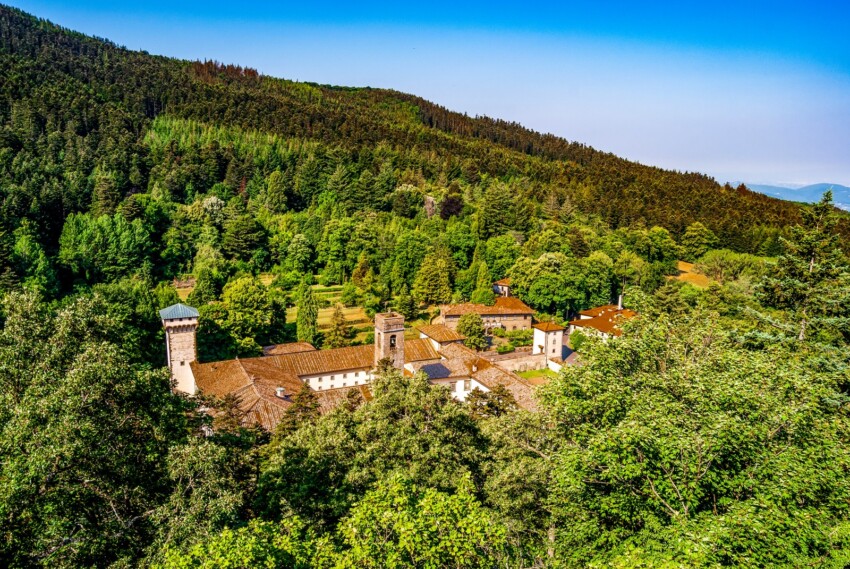
The Vallombrosa Abbey is situated within a magnificent forest that was created and maintained by monks over the centuries, and was declared a Natural Biogenetic Reserve in 1973. In 1008, Giovanni Gualberto, a Florentine nobleman who had recently taken monastic vows, left the monastery of San Miniato in Florence with a companion in search of a more secluded place for contemplation.
After meeting San Romualdo, founder of the hermitage of Camaldoli, he travelled to a place called “Acquabona” where a small hermitage already stood—this is where the Vallombrosa monastery now stands. Wooden cells were built for the new disciples who joined Gualberto.
In 1015, the monks elected Gualberto as their superior, and the new congregation of Vallombrosan monks was born, following the rule of Saint Benedict based on the precept “ora et labora” (pray and work).
In 1036, work began on constructing stone cells and an oratory. Around 1450, significant expansions were undertaken: a new sacristy and novitiate quarters were built, and by the end of the 15th century, the complex had assumed its present characteristics and appearance.
In 1529, following Charles V’s pillaging, the eastern tower was raised to protect the most precious furnishings and books; in the 17th century, the wall enclosing the courtyard was constructed, and at the end of the 18th century, the large basin in front of the Abbey (used for trout farming and ice production) was built.
The monastery, suppressed during the Napoleonic era, was reopened in 1817 by Grand Duke Ferdinand. In 1866, the newly formed Kingdom of Italy evicted the monks and the monastery passed to the Forestry Authority. The Benedictines returned only in 1949.
A visit to the monastery is truly worthwhile: the imposing structure, dominated by a tall 13th-century bell tower and tower, has the appearance of a castle. Beyond the gate, one admires the beautiful 17th-century façade designed by Gherardo Silvani. The church façade is also from the 17th century, though it retains its medieval layout, even if its current appearance is characterised by Baroque interventions.
The Abbey houses numerous works of art: a Robbian relief in the vestibule facing the refectory, fifteen canvases by Ignazio Hugford in the refectory, the wooden choir of the church carved and inlaid by Francesco da Poggibonsi. Surrounding the Abbey, within the forest and at the most significant sacred sites linked to miraculous episodes from Gualberto’s life, are chapels and tabernacles dating from the 16th and 17th centuries.
The paths leading to these small religious buildings offer visitors many opportunities for reflection and meditation.
form a branch of the Benedictine order; their name derives from Vallombrosa, a mountainous location about thirty kilometres from Florence, where the founder, Saint Giovanni Gualberto, withdrew around 1036 with several companions to live with renewed fervour the original spirit of Saint Benedict’s rule, devoting themselves to prayer, labour, and the welcome of pilgrims. Giovanni Gualberto was led to embrace this austere monastic life by a miraculous event: whilst in prayer in the church of San Miniato al Monte before the Crucifix, after he had courageously forgiven his brother’s murderer, he saw Christ bow his head in approval.
Soon, other monasteries in Tuscany and beyond joined the monastic reform of Vallombrosa, united under the charismatic leadership of Gualberto, thus forming the Vallombrosan Congregation, which was officially recognised by Pope Urban II in 1090. The origins of the Vallombrosan congregation are marked by a powerful desire for reform, both within the Church and monasticism, and by the determination to live the rule of Saint Benedict literally.
The congregation experienced a long period of expansion that continued until the 16th century; decline then set in, and in 1866 the Italian government decreed the general suppression of religious orders. Meanwhile, the monastic community had relocated to Pescia, where it remained until 1949. It was only in 1961 that the community was able to return to the Vallombrosa monastery, though ownership of the property has remained with the State.
City Card allow you to save on public transport and / or on the entrances to the main tourist attractions.


 Hotel
Hotel  Budget accommodations
  Apartments
  Family Hotel
  Luxury Hotel
  Resorts