Bestseller
Florence: Santa Maria Novella Entry Ticket & Audioguide
From 15,50 €
Buy the ticket
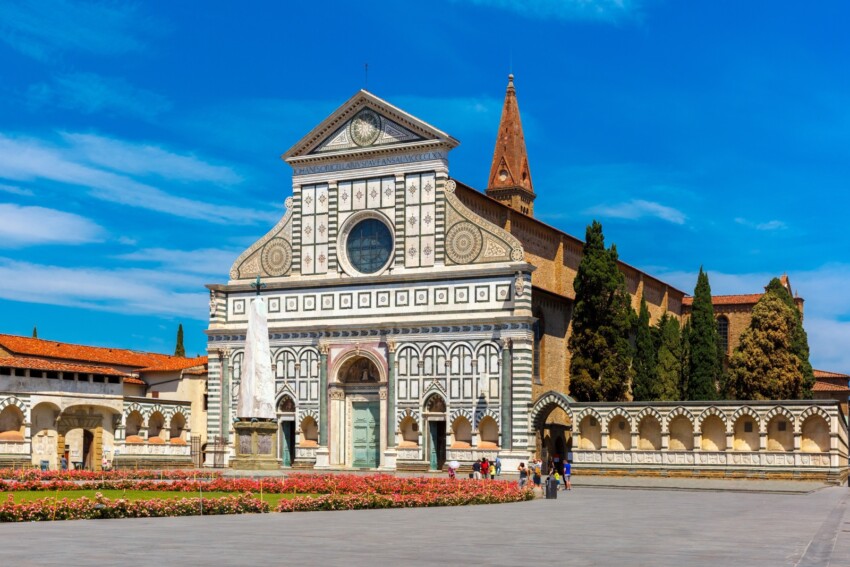
Overlooking the square that bears its name, the basilica of Santa Maria Novella makes a striking impression with its magnificent white marble façade richly inlaid with decorative work, a masterpiece by Leon Battista Alberti, and the pointed bell tower rising behind it. It is one of the city’s most important churches, originally the principal point of reference for the Dominican friars, built from 1279 onwards in Gothic and Renaissance style.
The church is inextricably linked to Florence, if only through its name. Santa Maria Novella is also the name of the city’s railway station, so called precisely because of its proximity to the basilica, which stands immediately adjacent. For this reason, it is the first monument that Florence’s visitors encounter if they choose to arrive by train.
But whatever mode of transport brings you to the city, spend a few hours exploring the basilica of Santa Maria Novella and its magnificent adjoining museum, whose route allows you to visit a series of interior spaces, including the famous Cloister of Green with works by Paolo Uccello, the Spanish Chapel and much more besides.
The basilica of Santa Maria Novella is fully open to visitors. Inside are works of absolute value, including Masaccio’s Trinity, the crucifixes by Giotto and Brunelleschi, and a series of frescoes by Ghirlandaio, Filippino Lippi, Botticelli and many other Renaissance artists. By purchasing an entrance ticket you can also access the museum, the sacristy and the Avelli cemetery.
The basilica of Santa Maria Novella contains a series of chapels, one of the most interesting of which is that of Filippo Strozzi. It is famous for the frescoes painted by Filippino Lippi, commissioned by Filippo Strozzi himself.
The artistic work took over 10 years, partly due to other commitments Lippi had in Rome. However, the result is magnificent, with the paintings depicting scenes from the life of St Philip the Apostle and St John the Evangelist. This choice was no accident: St Philip bore the same name as the patron, whilst St John was the chapel’s previous patron saint.
Behind the altar rests Filippo Strozzi, within a porphyry tomb created by Benedetto da Maiano. Above it is a marble relief depicting the Madonna and Child, with a garland of roses around her neck and four angels surrounding her. Benedetto da Maiano also sculpted the bust of Filippo Strozzi, now on display at the Louvre.
The Main Chapel, also known as the Tornabuoni Chapel, was entirely frescoed by Orcagna in the 14th century, but just a few years later the walls suffered severe damage from a fire. The frescoes we can admire today are the work of Ghirlandaio, created about a century later. The walls feature scenes from the life of the Virgin Mary, St John the Baptist, and the four Evangelists.
The details are notable, with Ghirlandaio characteristically portraying prominent figures from Florence of the period, as well as details of daily life, both in the decorations and in the clothing.
Within the Main Chapel are also other interesting works, including a beautiful marble altar designed by Enrico Romoli, sculptures by Egisto Rossi and the crucifix by Giambologna. There is also an attractive lectern, positioned at the centre of the chapel, dating from the late 16th century.
The largest cloister in Florence is located within the Santa Maria Novella museum circuit. It is not only its dimensions that astonish: the lunettes are completely frescoed, making it a heritage of immense value.
Built between 1340 and 1360, it comprises 56 internal arcades creating 60 lunettes, of which 53 are frescoed. The paintings were damaged by the 1966 flood, and restoration work is still ongoing.
Part of the original structure of the ancient Dominican convent, and today the first space on the Santa Maria Novella museum route, the Cloister of the Dead acquired this curious name because it was originally a cemetery. The presence of altars and chapels within it is because this is where masses and services were held when the Gothic basilica was still under construction.
The Cloister of the Dead was partially demolished at the end of the 19th century when Florence’s Santa Maria Novella station was built. The frescoes on the vaults, unfortunately, were irreversibly damaged by the 1966 flood.
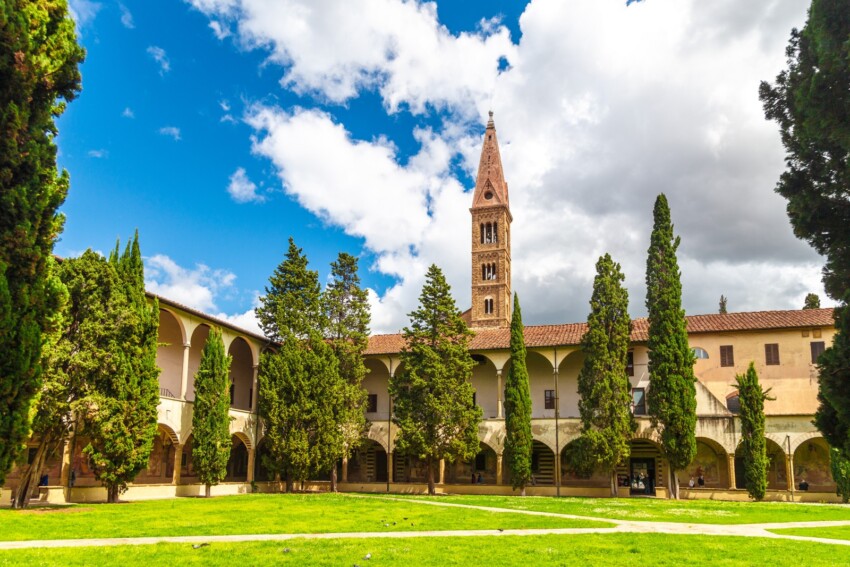
The Cloister of Green represents the heart of the Santa Maria Novella basilica complex. From here you can access both the other two cloisters and the Spanish Chapel.
The structure dates to 1332, designed by Frà Jacopo Talenti; it takes its name from the fact that it was frescoed with green earth pigments during the first half of the 15th century. Today, owing to the 1966 flood, several frescoes are still undergoing restoration. Among the most significant are Paolo Uccello’s scenes of Genesis, as well as scenes of Abraham on the south side and scenes of Jacob on the west side, the work of unknown artists.
The former chapter house of the basilica of Santa Maria Novella is represented by the Spanish Chapel, which took its name from the Spanish community that gathered here from the time of Eleonora of Toledo, wife of Cosimo I de’ Medici.
Access to the Chapel is from the Cloister of Green, and inside is a beautiful cycle of frescoes by Andrea di Bonaiuto. The structure has a single bay, with a barrel vault, featuring frescoes depicting the Navicella of St Peter the Apostle, the Resurrection, the Ascension and Pentecost.
Tickets for visiting the basilica of Santa Maria Novella and the museum can be purchased on site or conveniently online. Reductions are available for young people aged 11 to 18, whilst children up to 11 years enter free, as do Florence residents, disabled visitors, journalists, tour guides and group leaders or school group supervisors.
As one of Florence’s most beautiful churches, the basilica of Santa Maria Novella is a very popular destination with tourists. We therefore recommend booking tickets in advance, preferably online before you depart, to ensure availability, especially as opening times are quite limited.
The basilica of Santa Maria Novella is open every day of the year from 10:00 to 17:00; on Sundays and religious holidays, opening is reduced to 13:00 from mid-September to mid-July, and to 12:00 from July to mid-September. Last admission coincides with the ticket office closing, one hour before closing time.
The official tour of the Santa Maria Novella complex departs every hour, lasts 50 minutes and is available in Italian, English, French and Spanish. It accommodates a maximum of 14 participants and is accessible to disabled visitors. It costs 5 euros, in addition to the normal entrance ticket price.
The tour focuses on visiting the church and the surrounding areas, and throughout the route you will be given explanations of all the details, including the history of the Dominican order and the numerous private donations that enabled the creation of magnificent works by some of the greatest artists of the Medieval and Renaissance periods.
In addition to the official basilica tour, you can participate in various group or private tours offered by the city’s tour guides, to be booked in advance either on site or online.
Once you’ve finished your visit to the basilica, you’ll find several bars and restaurants with outdoor seating in the square, though we wouldn’t recommend them as prices are rather high for what they offer. That said, they are the only option if you want to eat or drink while enjoying a splendid view of the basilica.
The basilica of Santa Maria Novella, located in the square of the same name, is by far the easiest Florence monument to reach. Those arriving in the city by train need only cross Piazza Stazione, and within less than 2 minutes you’ll be right at the church entrance. Those visiting Florence by car can park at the railway station’s underground car park and reach the church entrance in no time at all.
However, its position on the edge of the historic centre does not give it the fame it deserves, overshadowed by more central monuments such as the Duomo, Palazzo Vecchio or the basilica of Santa Croce. Even so, the distances are certainly manageable: it’s about a 10-minute walk from the Duomo, and the same from Palazzo Vecchio, whilst Santa Croce is about 15–20 minutes away.
The Santa Maria Novella Station is Florence’s principal railway station. This is where high-speed trains depart and arrive, connecting Tuscany’s capital with the rest of Italy, and it is also the starting point or terminus for numerous regional trains to reach the other attractions of Tuscany.
With approximately 60 million passengers per year, it is Italy’s fourth busiest station; the current passenger building dates from the early 1930s and was built in Italian Rationalist style, of which it is considered one of the masterpieces.
Santa Maria Novella Station overlooks the rear front of the basilica, that is, the choir and the bell tower. For many Florentines, the contrast between the rationalist forms of the station and the Gothic of the basilica is too jarring, and therefore not always well received. However, from a tourist perspective, the fact that once you step off the train you can immediately admire one of Florence’s finest monuments is certainly a considerable advantage.
The Basilica of Santa Maria Novella stands at the north-western edge of Florence's historic centre, just a stone's throw from the city's central railway station, which is named Firenze Santa Maria Novella.
City Card allow you to save on public transport and / or on the entrances to the main tourist attractions.

 Hotel
Hotel  Budget accommodations
  Apartments
  Family Hotel
  Luxury Hotel
  Resorts