Bestseller
Florence: Boboli Gardens Reserved Entry Ticket + Audio App
From 16,00 €
Buy the ticket
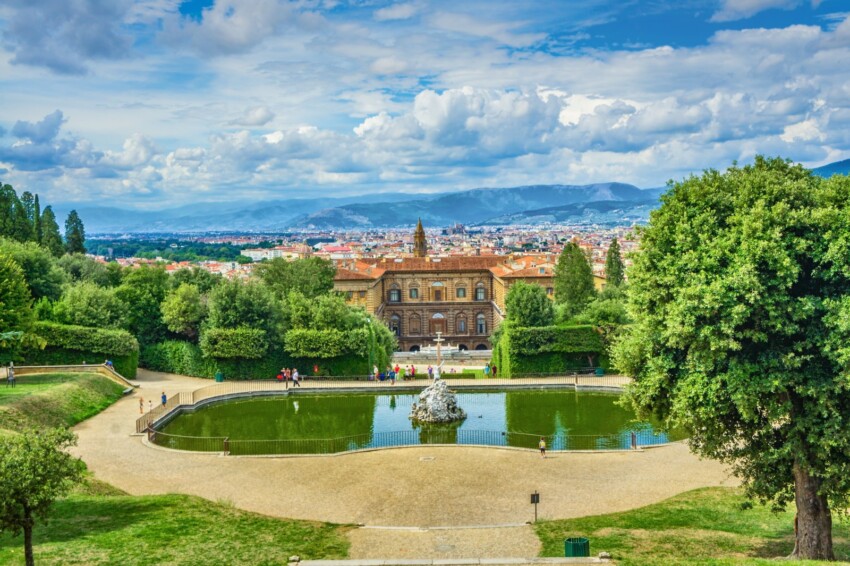
In Oltrarno, one of Florence’s most cherished and visited landmarks is the Boboli Garden. Unlike many other city-centre monuments, Boboli is equally beloved by Florentines: long a favourite escape for students playing truant, it’s bustling with locals seeking a few peaceful hours – reading a book on the lawn or simply taking a stroll.
The beauty of Boboli Garden lies in its setting, elegantly positioned in the heart of the historic centre on the slopes of a hill, offering splendid views across the Duomo, Palazzo Vecchio and, of course, Palazzo Pitti, as this was originally the palace gardens where the Medici family lived.
Nearly 500 years on, Boboli Garden has lost none of its allure – indeed, it’s only grown in appeal, thanks to an impressive collection of sculptures and works of art scattered throughout the grounds. Its beauty and significance are such that UNESCO inscribed it on the World Heritage List in 2013.
There are countless walking trails to explore within the garden, and a thorough visit can easily take a full day. Bear in mind that exploring the grounds can be quite strenuous, as the terrain features several steep climbs.
The former grand-ducal garden of Palazzo Pitti was begun in the 16th century, originally by the Medici, who ruled Florence during its greatest splendour. Over the following centuries, the dynasties that succeeded the Medici – including the House of Habsburg-Lorraine and the House of Savoy – continued developing and expanding the garden into what we see today.
The architect who first laid out Boboli Garden was Niccolò Tribolo, drawing on his experience with the gardens at the Medici villa of Castello, which he had worked on just years earlier. On Tribolo’s death in 1550, the project was continued by Bartolomeo Ammannati and Bernardo Buontalenti.
It was Cosimo I de’ Medici who first expanded Boboli Garden, enlarging it to nearly three times its original size. The grounds remained private until the late 18th century, when Pietro Leopoldo of Lorraine opened them to the public.
Boboli Garden has four entrances. Access is via Palazzo Pitti, Forte Belvedere, Via Romana and the Piazzale di Porta Romana. Exit is through a single point at Piazza Pitti. Once inside, beyond simply wandering at leisure, here are the main attractions.
Among the key architectural features of Boboli Garden is the Amphitheatre, located directly behind Palazzo Pitti. It’s Florence’s oldest surviving court theatre, and undoubtedly one of the garden’s highlights.
It’s entirely surrounded by elegant statues in the classical style: some are originals, whilst others, such as Michelangelo’s Apollino, are copies. The southern side features tiered seating for spectators, whilst the north side is left open due to a natural rock outcrop.
Over its long history, the Boboli amphitheatre has hosted performances and events, beginning with Proteus and Fame in 1652, in honour of the Archduchess of Austria, through to gymnastics displays during the Fascist era. In modern times, it was home to the Maggio Musicale Fiorentino festival until 1997.
The Boboli Obelisk, standing over 6 metres tall, is Tuscany’s only surviving ancient obelisk, brought from Egypt to Rome in the 1st century AD. It’s crafted from stone quarried at Aswan, and its decorations reference Atum, the deity of Heliopolis. Scholars date its original construction to around 1250 BC.
Cardinal Ferdinando de’ Medici acquired the obelisk in the 16th century and placed it among the antiquities at Villa Medici. In June 1788, Pietro Leopoldo of Lorraine, as heir to the Medici estates, had it transported by sea to Livorno and then overland to Florence, where it was installed in the Boboli amphitheatre.
In front of the obelisk stands a basin in grey granite, over 7 metres long, salvaged from ancient Rome and positioned here only in 1840. Some of the decorative elements that once adorned the ensemble have since been removed and are now housed in the Bargello Museum.
On the terrace closing off the north-east side of the Ammannati Courtyard, part of Palazzo Pitti, sits the Fountain of the Artichoke. Positioned to command a view of the garden from the palace, it stands directly above the Grotto of Moses.
Sculpted by Francesco Susini and Francesco del Tadda and dating to 1640, the fountain replaced Bartolomeo Ammannati’s earlier Fountain of Juno, which was destroyed save for fragments now in the Bargello Museum.
Its curious name derives from decorative elements on either side of the fountain’s steps, which resemble artichoke leaves. At the corners stand marble sculptures of putti, captured in carefree, playful poses.
In 1776, Boboli Garden’s collection of works and monuments was enhanced with the Kaffeehaus, originally a pavilion where Pietro Leopoldo, following the fashion of the day, would take coffee with his court.
The Kaffeehaus overlooks the Meadow of Ganymede and was designed by architect Zanobi del Rosso. It’s worth noting that the Meadow of Ganymede itself resulted from an expansion of Boboli Garden that came nearly 20 years later.
The building’s inspiration is purely Rococo, with subtle echoes of Viennese Baroque and Oriental architecture so beloved by the Habsburgs. The pale green hue, known as “Lorraine green”, dates only to 1990.
Inside the Kaffeehaus are magnificent frescoes by Giuseppe del Moro, Giuliano Traballesi and Pasquale Micheli, depicting illusionistic views and rural landscapes. Some frescoes only resurfaced following restoration work in the 1990s.
Among Boboli Garden’s unmissable features is the Grotto of Buontalenti. Work began under Giorgio Vasari, who created the lower facade; however, the lion’s share of credit goes to Bernardo Buontalenti, who laboured on it for ten years, between 1583 and 1593.
The entrance is broad, with spongy, dripping decorations evoking stalactites and stalagmites. On either side are niches housing two statues by Baccio Bandinelli: Ceres and Apollo. The exterior is completed by decorative mosaic borders, with the Medici coat of arms at the centre.
Inside, the grotto is divided into three chambers. The first is considerably larger than the other two and contains sculptures, paintings and fine architectural works. The theme throughout is chaos and formlessness, brought to order and harmony through metamorphosis. There are also copies of Michelangelo’s four Prisoners, the originals of which are in the Accademia Gallery.
Originally, the Grotto of Buontalenti featured water displays, traces of which – terracotta channels and basins – were uncovered during restoration work in the 1990s. Unfortunately, these are no longer functional, though the chamber does contain a fountain with a rocky outcrop.
The Viottolone is one of Boboli Garden’s defining features – essentially a broad avenue that forms the south-west axis of the grounds. It’s quite steep, whether ascending or descending, and is lined with two rows of centuries-old cypress trees dating from the early 1600s. Along the Viottolone stand numerous statues positioned at intersections with cross-paths. Some date back to Roman times, whilst others were sculpted in the 1700s.
To enter the Viottolone, you cross the Meadow of Birds; the entrance is marked by statues of the Greek Tyrannicides, whilst the three cross-paths define the garden’s six compartments. Walking along any of the cross-paths, you’ll encounter countless statues spanning different eras and styles.
Among the must-sees at Boboli Garden is the Isolotto, located at the end of the Viottolone. It’s a large basin dating to 1618, designed by Alfonso and Giulio Parigi, positioned in a plaza surrounded by holly-oak hedges that frame a collection of stone and marble statues.
The focal point, however, is the basin itself – circular in form, with a central island reached by two footbridges. Each bridge has large gates supported by columns topped with a capricorn, symbol of the Grand Duchy of Tuscany.
At the island’s centre stands the Fountain of the Ocean, a sculpture by Giambologna with an ornately decorated base featuring fine relief work, supporting a large circular basin that serves as the plinth for a Neptune statue. Today’s statue, whilst splendid, is merely a copy; the original is displayed in the Bargello Museum.
The Boboli Garden opens daily from 8.15am, with closing times varying by month from 4.30pm to 7pm. The grounds are closed on the first and last Monday of each month (except June and October), as well as 1 January and Christmas Day.
Tickets can be purchased at the garden gate or online; your ticket also grants free access to Villa Bardini’s gardens. Reduced rates apply for ages 18–25, whilst children and Florence residents receive free entry via the Via Romana entrance, also known as the Annalena Gate. Booking is mandatory on Saturdays and public holidays, except for Florence residents.
You can also purchase a combined ticket valid for 5 days, called the Passepartout 5 days, granting access to the Uffizi, Boboli Garden and Palazzo Pitti, or an annual pass valid for 365 days from your chosen issue date, with unlimited entry.
Boboli Garden is among the attractions included with the FirenzeCard – consider purchasing one if you plan to visit multiple museums over 3 days in Florence.
There are no official tours of Boboli Garden, though you can certainly join group or private guided tours led by local specialist guides. Search online to find the option that suits you, considering factors such as price, tour length and reviews.
Boboli Garden is vast, so even on busy days you’ll easily find a peaceful spot to relax. However, entrance queues can be lengthy, so we recommend purchasing your ticket in advance online.
Don’t underestimate Florence’s summer heat! Whilst Boboli Garden may seem like a refreshing oasis at first glance, the walk can be taxing, with significant stretches uphill and exposed to the sun.
There are no sheltered pathways, so if the weather’s poor, it’s best to postpone your Boboli Garden visit.
The Boboli Garden is located in Oltrarno, an area abundant with apartments and B&Bs. The location is excellent, as you’re still in Florence’s historic centre, with most of the city’s attractions within a comfortable 10–15 minute walk.
Florence’s Santa Maria Novella railway station is a bit further, some 20–25 minutes on foot, crossing the Ponte Vecchio. Consider taking a taxi if you’re travelling with heavy luggage, as wheeling suitcases across the historic centre’s cobblestones isn’t exactly comfortable!
The Via Romana entrance to Boboli Garden, also known as the Annalena entrance, is just a short walk from Palazzo Pitti. Simply head south along Via Romana for a few minutes. It’s straightforward to find, the area is lovely and largely pedestrianised.
Boboli Garden is also reasonably accessible by car: simply head towards Porta Romana, which sits in a strategic location along one of the city’s main thoroughfares. Once there, park where you can and continue on foot through the historic city gate, then walk along Via Romana for about 5–10 minutes. You’ll find the Annalena entrance on your right.
Boboli Gardens sprawls across a vast area to the south of Florence's historic centre. The main entrance is accessed via Via Romana, just a few hundred metres from Palazzo Pitti.
City Card allow you to save on public transport and / or on the entrances to the main tourist attractions.


 Hotel
Hotel  Budget accommodations
  Apartments
  Family Hotel
  Luxury Hotel
  Resorts