Bestseller
Florence: Brunelleschi's Dome Climb Entry Ticket & Duomo
From 45,00 €
Buy the ticket
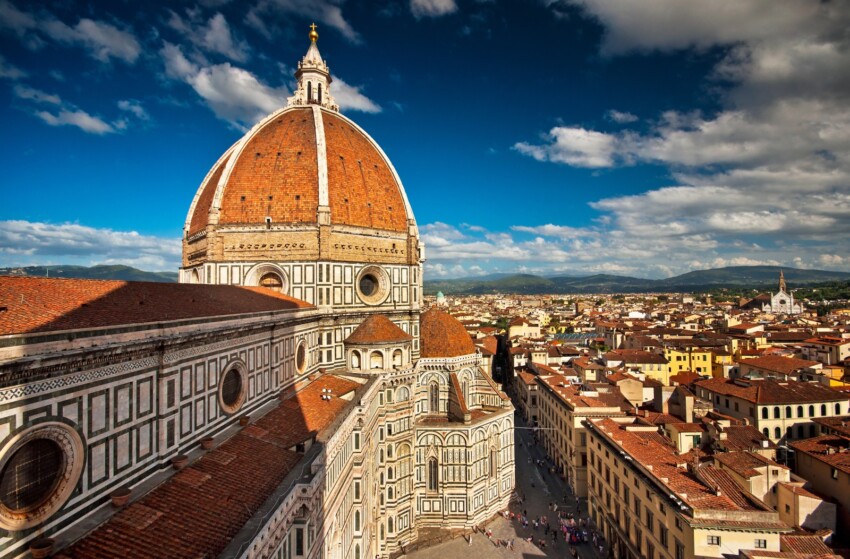
Florence’s cathedral, officially known as the Cathedral of Santa Maria del Fiore, is the city’s principal church and, for many, its most beautiful. Located in the square of the same name, its history spans centuries: construction began in 1296, but continued well into 1903, when the bronze doors were finally completed.
Even more impressive than the magnificent façade is the cathedral’s signature feature: its enormous dome, the largest masonry dome in the world, designed by architect Filippo Brunelleschi. You can climb onto the dome and enjoy spectacular views across Florence, though even from ground level, its roughly 50-metre diameter makes quite an impression.
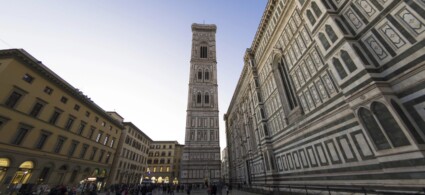
Beside the cathedral stands its bell tower: the Giotto’s Campanile, another of Florence’s undisputed symbols, completed in 1359. The campanile aligns with the façade, houses 12 bells and stands as a completely independent structure, further emphasising its importance.
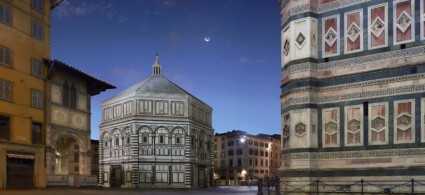
Completing the cathedral complex is the beautiful Baptistry, dedicated to St John, the city’s patron saint. With its octagonal plan and finely decorated bronze doors, it’s one of Tuscany’s most distinctive monuments, deserving a visit both as an integral part of the cathedral complex and as a standalone building.
Many original artworks once housed within the complex have been relocated to the Opera Museum, located right at the junction of Cathedral Square and Via Calzaiuoli. Don’t miss visiting this museum to deepen your connection with this spectacular piazza and its buildings, symbols of the Renaissance.
Needless to say, visiting Florence’s cathedral and its treasures is an absolute must for anyone in the city. Honestly, it’s hard to miss it when you’re in Florence, as it sits right in the city centre, just a short walk from the railway station and at the start of Via Calzaiuoli, the city’s main shopping street leading all the way to Piazza della Signoria.
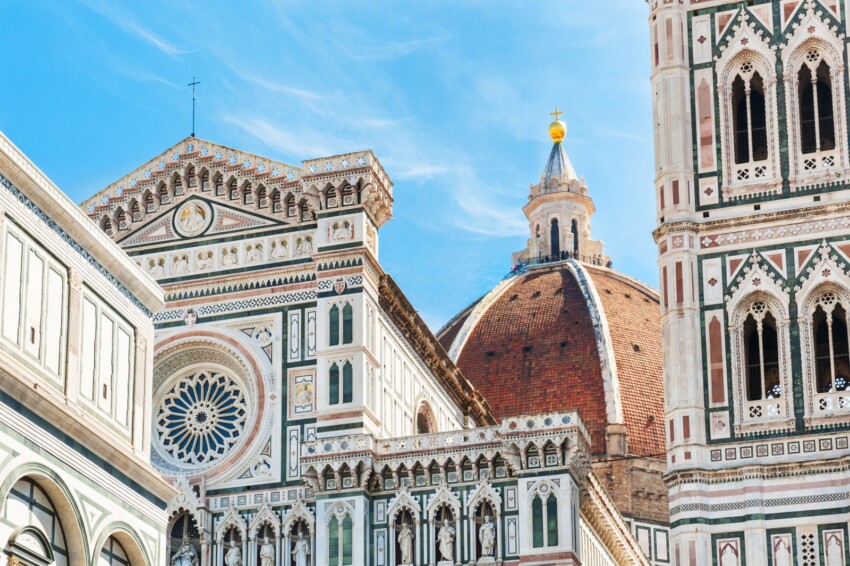
As mentioned, Florence’s cathedral actually comprises 4 distinct elements: the cathedral itself, the dome, the campanile and the baptistry. Alongside these stands the Opera Museum, which houses treasures and artworks that occupied these buildings throughout their centuries-long history.
When its main structure was completed around the mid-1400s, the Cathedral of Santa Maria del Fiore in Florence was the world’s largest church. Whilst other places of worship have since surpassed it in size, Florence’s cathedral remains among the most beautiful, imposing and important churches of the Roman Catholic faith.
The cathedral is accessible from the inside, provided you’re willing to face an extremely long queue. If you’ve better things to do during your Florence visit, focus on the exterior, starting with the beautiful façade, which has a truly troubled history: work began in the fifteenth century, but it wasn’t inaugurated until 1887—nearly 500 years later—based on the design of architect Emilio De Fabris, who sadly never saw his work completed, as he died shortly before the project’s conclusion. Today, the Cathedral’s façade stands as one of Italy’s most important examples of neo-Gothic style.
Inside, however, the Cathedral of Santa Maria del Fiore reveals a simple, austere character, almost as if empty. You can admire the gallery running along the entire perimeter of the church and its 44 stained-glass windows, alongside 55 windows. Notable works on display include Domenico di Michelino’s Dante with the Divine Comedy, Andrea del Castagno’s Monument to Niccolò da Tolentino and Paolo Uccello’s Equestrian Monument to John Hawkwood.
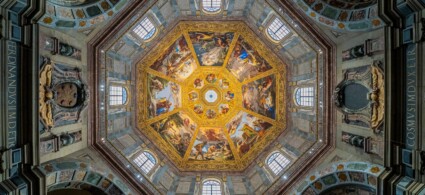
Don’t forget to look up and admire the dome’s dazzling interior decoration, featuring the fresco of the Last Judgment, initially by Vasari but later continued by Federico Zuccari and his collaborators. The idea of depicting the Last Judgment was Cosimo I de’ Medici’s.
Beside the cathedral, completely detached from it, stands the Giotto’s Campanile, constructed in Gothic style between 1298 and 1359. Managed by the Opera of Santa Maria del Fiore, the institution overseeing the museum and other monuments overlooking the square, it ranks among Florence’s most visited and appreciated tourist attractions: around the year 2000, it welcomed approximately 300,000 visitors.
The campanile features beautiful sculptural decoration, intricate and detailed, with bas-reliefs and icons showcasing the arts and crafts, religious themes and references to ancient Greece. Honestly though, the highlight of Giotto’s Campanile is the chance to climb to its summit via steep stairs. The effort is rewarded with truly unique views of Florence, offering privileged vistas of the cathedral, dome and entire historic centre.
The Brunelleschi Dome stands as one of Florence’s principal symbols and a key reason why Tuscany’s capital is renowned worldwide. Its dimensions make it one of Europe’s most important architectural achievements ever constructed, and its creation sparked various theories, as the building techniques of the time weren’t designed to create domes of such magnitude.
Viewed from inside, you’ll understand why: it’s not actually a true dome, but rather a solid structure with an octagonal base. Moreover, its inner sides feature a splendid fresco of the Last Judgment, visible when visiting the cathedral.
The beauty of Brunelleschi’s dome, from a purely tourist standpoint, is being able to climb to its summit, ascending 463 steps. Once at the top, you’ll enjoy a truly unique perspective of Florence, with views of Giotto’s Campanile and the city’s various monuments from above.
Florence from Above: Dome or Campanile?
Of course, to make the most of your visit, it’s best to choose just one between the dome or campanile: the views from the top of both are similar, and if you have limited time in Florence, we don’t recommend visiting both: choose based on which monument you’d prefer to observe: climbing the campanile lets you see the dome, and vice versa.
The fourth and smallest building within the cathedral complex, though certainly not the least important, is the Baptistry of St John. View it from the exterior, where you can admire its handsome octagonal plan and especially its magnificent entrance doors, notably the Gate of Paradise, created by Lorenzo Ghiberti and divided into 10 rectangular panels depicting Old Testament scenes. The door you see is a copy; the original is housed within the Opera Museum.
Inside the baptistry, you’ll appreciate the octagonal plan and decorations inspired by Roman buildings. The marble floor with its geometric and animal motifs—some fantastical—is particularly striking, whilst the high altar, in neo-Romanesque style, dates only to the early twentieth century, replacing the original eighteenth-century altar, also part of the Opera Museum’s collection.
On the north-east side of Cathedral Square stands the impressive Opera Museum, one of Florence’s most interesting art museums. Established in 1891 and opened on 3 May that year, it now occupies over 6,000 square metres, comprises 28 rooms and is directed by Timothy Verdon.
On display are numerous artworks, originally housed within the cathedral, Giotto’s campanile, the baptistry and Brunelleschi’s dome. Outstanding pieces include the original Gate of Paradise panels from the Baptistry of St John, by Lorenzo Ghiberti, Michelangelo’s Bandini Pietà and an extensive selection of works by Donatello, second only to the collection at the Bargello Museum.
Visiting the Opera Museum is a unique experience, particularly following the complete 2015 renovation, which transformed it into an educational journey allowing you to discover the places and artists who shaped Florence’s cathedral complex, a masterpiece of the Italian Renaissance.
You can purchase admission tickets for the Baptistry of St John, Brunelleschi’s Dome and Giotto’s Campanile either on-site or online.
Admission to the Cathedral of Santa Maria del Fiore is free, but be aware of queues that can be extremely long. Entry is via the right door of the façade and requires appropriate dress: covering your legs and shoulders is recommended. Additionally, large bags and rucksacks aren’t permitted. Disabled access is via the Canonici Door on the south side. Florence’s cathedral is open Monday to Saturday from 10:45 to 17:00, with last entry at 16:30.
The Opera of Santa Maria del Fiore, the official institution managing Florence’s Cathedral, organises guided tours of the entire complex, enabling you to fully appreciate its centuries-long history. Guided tours vary in type:
Of course, you can also rely on private guides, who offer group or individual tours. Search online to find the most experienced, well-reviewed and highly-rated guides.
The queue to enter the cathedral can be daunting. Objectively, especially during hot summer afternoons, it’s quite disheartening to see so many people queuing in scorching heat. If possible, don’t waste an afternoon risking heatstroke in a queue; take the initiative and book tickets online in advance, or alternatively, visit at off-peak times and avoid the high season.
The abundance of things to see throughout Florence’s cathedral complex can be overwhelming: visiting all 4 buildings and the museum can easily take an entire day. If your time in Florence is limited, we recommend focusing only on the exteriors and climbing either the dome or campanile to enjoy views from above.
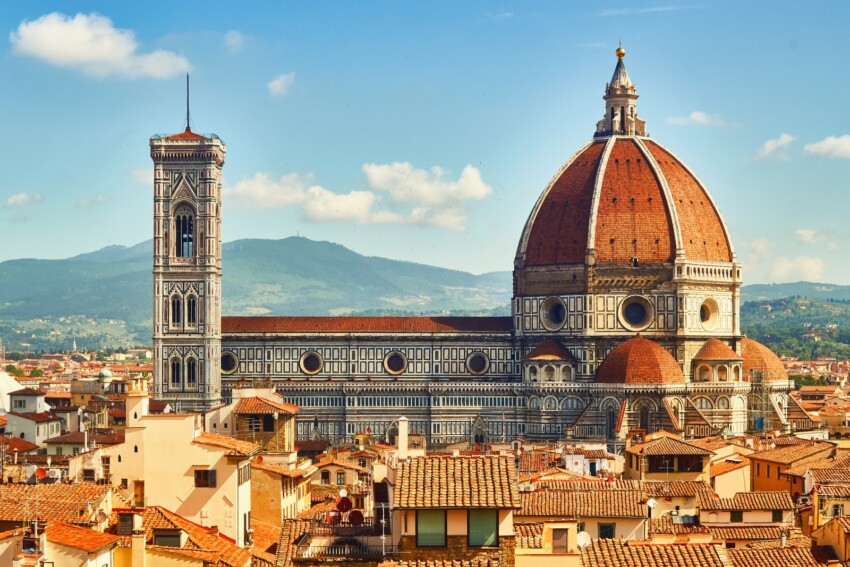
Reaching Florence Cathedral is straightforward, as it’s located right in the historic centre. From the main station at Santa Maria Novella, walking along the elegant Via Panzani and Via Cerretani takes you directly to Piazza del Duomo. The walk takes between 5 and 10 minutes, though it’s worth noting that the route is lined with countless shops, making it easy to stop along the way.
From Piazza della Signoria, you can reach Piazza del Duomo via Via Calzaiuoli, which is equally packed with shops of every description, whilst from Ponte Vecchio, it’s a straightforward walk along Via Por Santa Maria, passing through Piazza della Repubblica and finishing on Via Roma. This journey also takes no more than 5-10 minutes at a steady pace.
It’s important to note that Piazza del Duomo is entirely pedestrianised and closed to vehicular traffic. You cannot drive to it, particularly as ZTL cameras are positioned on surrounding streets, such as at the entrance to Via Panzani. Therefore, unless you’re a resident or authorised by a car park or hotel, it’s not possible to approach the Cathedral by car.
If you have mobility difficulties, you can use the buses that run along Via Panzani, though they stop a few dozen metres before the square, or hire a car from car-sharing companies, which are permitted to enter the centre. Even so, you’ll need to park before entering Piazza del Duomo.
Florence's Cathedral stands in Piazza del Duomo, at the heart of the city's historic centre. It's just a few minutes' walk from Santa Maria Novella station, via Panzani and Cerretani Streets.
City Card allow you to save on public transport and / or on the entrances to the main tourist attractions.

 Hotel
Hotel  Budget accommodations
  Apartments
  Family Hotel
  Luxury Hotel
  Resorts