Bestseller
Florence: Brunelleschi's Dome Climb Entry Ticket & Duomo
From 45,00 €
Buy the ticket
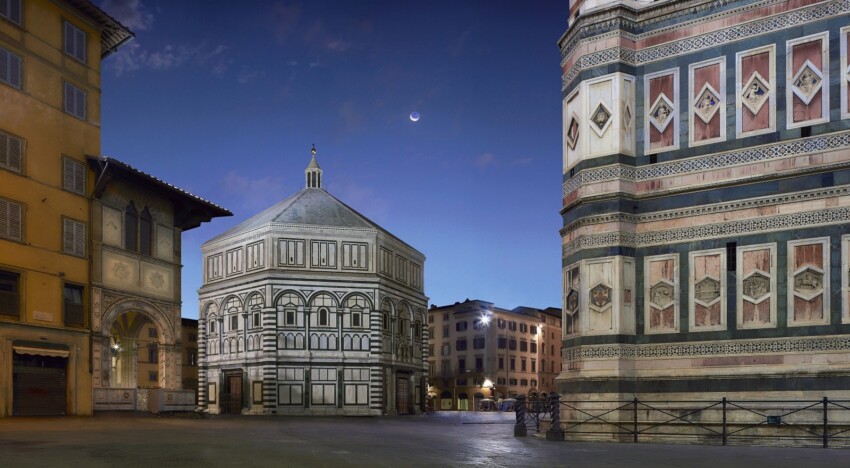
Dante Alighieri called it simply my beautiful San Giovanni. The Baptistry of San Giovanni in Florence is one of Italy’s oldest and most significant religious buildings, as well as the starting point for every great artistic adventure the city has experienced: it was here that Renaissance sculpture was born, when in 1401 a competition to create its bronze doors pitted the greatest artists of the age against one another, with Lorenzo Ghiberti emerging victorious over Filippo Brunelleschi. It was here that generations of illustrious Florentines were baptised, from Dante himself to the Medici family. And it is here, facing the façade of the Cathedral, that every visitor instinctively pauses to gaze upon that golden door which Michelangelo would later rename the Gate of Paradise.
The building that can be visited today was constructed between the 11th and 12th centuries in Florentine Romanesque style, on foundations dating back at least to the 4th-5th century AD, when the site was already frequented by the city’s Christian community. Its octagonal plan, the cladding of white and green marble, the three monumental bronze doors and the gilded mosaics of the inner cupola make it one of the most extraordinary decorative complexes of European medieval art.
This guide takes you on a journey of discovery through the Baptistry of San Giovanni: from Ghiberti’s bronze doors to the cupola mosaics, from the building’s thousand-year history to practical information for planning your visit.
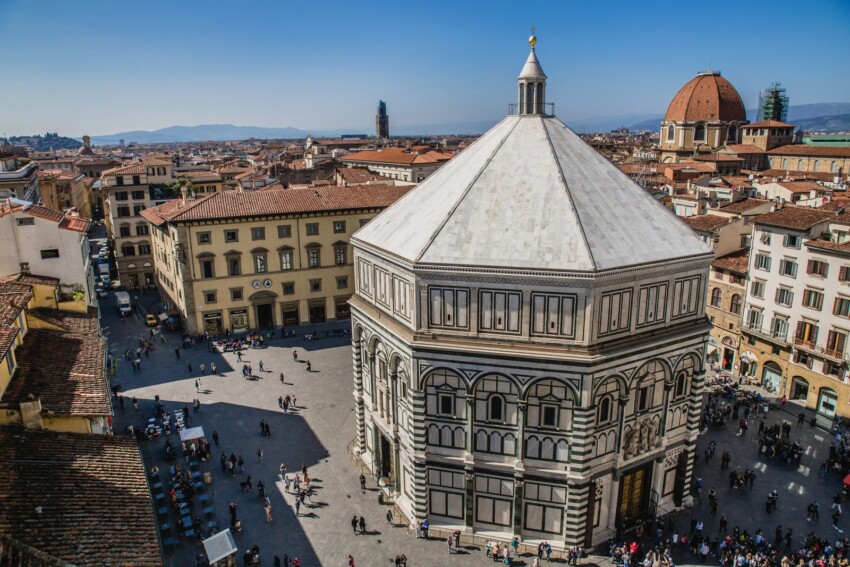
The Baptistry can be visited both from the outside — where the three bronze doors are the main draw — and from within, which surprises visitors with the magnificence of the cupola mosaics, the quality of the marble flooring and the exceptional acoustics of the space. A complete visit takes around 30-45 minutes, but those wishing to observe the door details carefully should allow more time.
The Gate of Paradise, which occupies the eastern side of the Baptistry — the side facing the Cathedral — is the absolute masterpiece of Lorenzo Ghiberti and one of the pivotal moments in the entire history of Western art. Completed between 1425 and 1452, after nearly thirty years of work by Ghiberti and his workshop, the door revolutionised the language of bronze sculpture by abandoning traditional square or Gothic panels in favour of ten large rectangular panels covering the entire surface of the doors.
Each panel tells a story from the Old Testament — from Adam and Eve to Solomon and the Queen of Sheba — using for the first time in relief sculpture the rules of mathematical perspective codified by Brunelleschi. Figures in the foreground are carved almost in the round and physically emerge from the surface; those in the background progressively diminish in size until they become almost engraved, creating an unprecedented illusion of spatial depth in bronze. The entire surface is gilded, and in sunlight the panels gleam with an intensity that fully justifies the nickname bestowed by Michelangelo.
The doors visible on the Baptistry today are high-quality copies: the originals, damaged by the 1966 flood and subsequently subjected to decades of restoration, are displayed in the Opera Museum of the Cathedral, where it is possible to admire them from a close distance that the door’s position does not permit. In the door’s frame are portrayed, in small roundels, the faces of prophets and sibyls, plus a portrait of Ghiberti himself — one of the earliest self-portraits in Italian art.
The North Door is chronologically the second door to be created, but it is the first signed by Ghiberti and is connected to one of the founding episodes of the Florentine Renaissance: the 1401 competition, announced by the Arte di Calimala — the guild of cloth merchants who had jurisdiction over the Baptistry — to choose the artist to entrust with the new bronze door. Seven sculptors participated in the competition, including Filippo Brunelleschi, Jacopo della Quercia and Nanni di Banco. The assigned theme was the Sacrifice of Isaac.
Ghiberti won and Brunelleschi came second: the two trial panels are now both preserved in the Bargello Museum, where it is possible to compare them and appreciate the differences in approach — Ghiberti’s serene classicism against Brunelleschi’s narrative drama. The defeat is said to have prompted Brunelleschi to abandon sculpture and dedicate himself to architecture: without that competition, the Cathedral’s Dome would probably not exist.
The North Door, completed between 1403 and 1424, is organised into 28 Gothic panels: the twenty upper ones depict scenes of the New Testament, while the eight lower ones show the four Evangelists and the four Doctors of the Church. In Ghiberti’s workshop that worked on this door, artists of the calibre of Donatello, Paolo Uccello, Michelozzo and Masolino were trained: an entire generation of Florentine Renaissance masters took their first steps among these bronze panels.
The South Door, created by Andrea Pisano between 1330 and 1336, is the oldest of the three and was the first to be installed — originally on the eastern side, the place of honour facing the Cathedral, where it remained until Ghiberti’s door arrived and displaced it to the southern side. It is organised into 28 Gothic quatrefoil panels — a frame with four lobes typical of Gothic style — of which the twenty upper ones depict episodes from the life of St John the Baptist, Florence’s patron saint, and the eight lower ones personifications of the theological and cardinal Virtues.
Pisano’s door is less celebrated than Ghiberti’s two doors but no less artistically interesting: the Pisan sculptor updated the Romanesque language of medieval portals with refined Gothic solutions, creating a fluid and psychologically expressive narrative that influenced all Florentine sculpture of the 14th century. A hidden and little-known detail: on the door’s columns are carved in low relief two rectangles representing the medieval units of measurement used in Florence — the Lombard foot and the Florentine foot — used as official reference for the city’s commercial contracts.
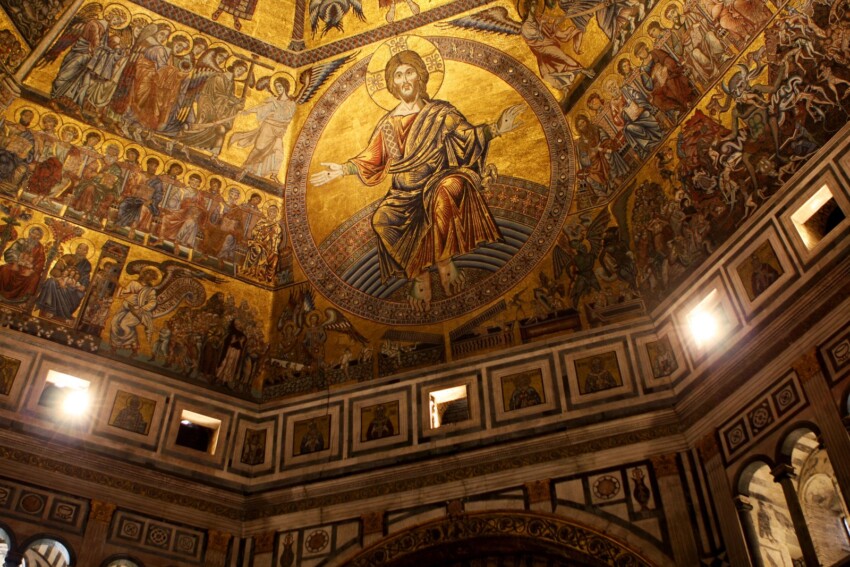
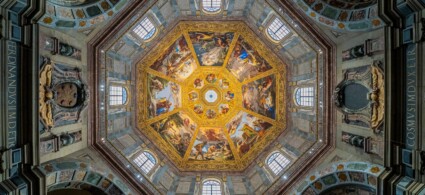
The interior of the Baptistry is dominated by the cupola mosaics, one of the absolute masterpieces of medieval Italian art and one of the largest and most complex examples of Byzantine-style mosaic decoration in the entire Western world. Created between 1270 and 1300 approximately, the mosaics cover the entire surface of the eight-section vault and upper walls, for a total surface area of over 1,000 square metres of gilded glass tesserae.
The cycle involved some of the most important artists of the era: Coppo di Marcovaldo, who designed the scenes of the Last Judgement in the apse; Cimabue, considered the precursor to Giotto; Jacopo Torriti. The iconographic programme is extraordinarily ambitious: starting from the apse (the scarsella) with the Last Judgement, the mosaics develop along the cupola’s sections with the Stories of Joseph, Mary, Christ and John the Baptist, concluding with the Angelic Hierarchies and the signs of the Zodiac. The figure of Christ the Judge, approximately eight metres tall, dominates the apse with a visual authority that leaves no one unmoved.
Important note: at the time of writing this guide, the vault mosaics are undergoing restoration work and may not be completely visible. We recommend checking the status of the work on the official website before your visit.
The flooring of the Baptistry is an artwork often overlooked by visitors focused on the mosaics and doors, but of exceptional quality. Created with polychrome marble inlays, it features geometric, botanical and zoomorphic motifs with an Orientalising taste — fantastic animals, plant interweavings, eight-pointed stars — inspired by fabrics and ivories from the Islamic and Byzantine Mediterranean, the very materials that Florentine merchants of the Arte di Calimala imported from the East and traded throughout Europe.
Around the perimeter of the hall there are also signs of the Zodiac, arranged in sequence around the building: they were functional to an ancient sundial installed in 1048 on the initiative of Strozzo Strozzi. A hole in the cupola allowed the sun’s rays to penetrate, and over the course of the year they would progressively strike the different zodiac signs carved into the marble, marking the months of the year. At the centre of the flooring, an octagon in cocciopesto (crushed brick) marks the original position of the baptismal font, which once occupied the centre of the hall and around which the baptism by immersion ritual took place.
The interior of the Baptistry surprises first-time visitors with its monumentality and quality of materials. The octagonal plan, with a diameter of 25.6 metres, is punctuated by columns of grey granite from Roman buildings — some of which probably belonged to the pagan temple on which this building stands — and by white marble pillars. The walls are clad with polychrome marble panels of Roman inspiration, an explicit reference to the Pantheon in Rome which the 11th-century builders considered a model of architectural perfection.
In the rectangular apse (the scarsella, added in 1202) the high altar originally stood. The Baptistry originally housed many other important artworks, now transferred to the Opera Museum of the Cathedral for conservation reasons: Donatello’s Magdalene — one of the most intense statues of the Florentine Renaissance — the Silver Altar, the embroideries of the San Giovanni Parament and the bronze groups by Rustici, Sansovino and Danti that decorated the portals.
The Baptistry is renowned among musicologists and architects for its exceptional acoustics: the octagonal shape and cupola create a natural resonance that amplifies and distributes sound uniformly throughout the hall. Even whispers, from one point to another across the octagon, can be heard with surprising clarity. In the Middle Ages this property was interpreted as a sign of divine presence; today it is studied as one of the most interesting acoustic phenomena in Italian medieval architecture.
One final curiosity: on the flooring, near the north door, is engraved a slab with the palindromic inscription “en giro torte sol ciclos et rotor igne” — a Latin phrase that reads the same from left to right and right to left, referring to the movement of the sun. Its exact meaning is still debated by scholars.
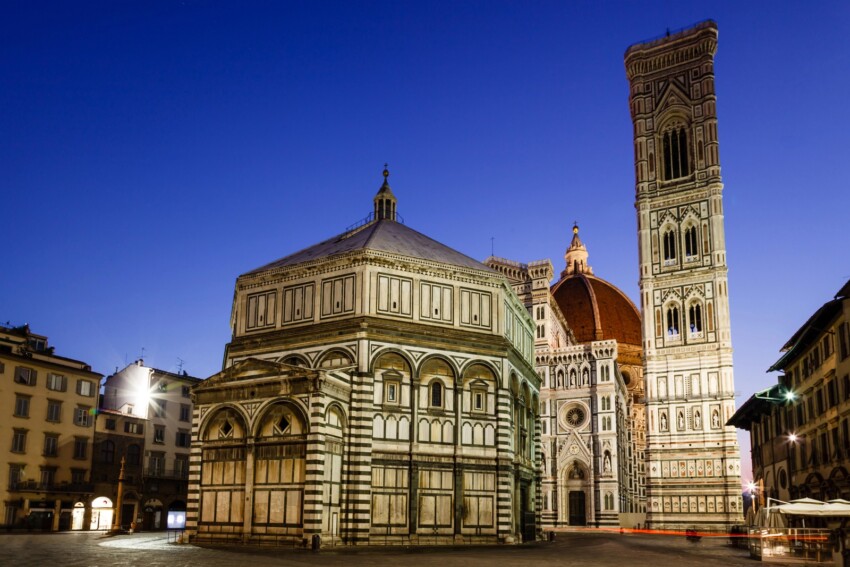
The origins of the Baptistry are shrouded in medieval legend so deeply rooted that it was still believed in the 16th century: it was claimed that the building was an ancient Roman temple dedicated to the god Mars, later converted into a Christian church. The legend was false — archaeological investigations have shown that beneath the flooring lie the foundations of a Roman domus from the 1st-2nd century, not a temple — but it helps explain the aura of exceptional antiquity that Florentines have always attributed to their Baptistry.
The first Christian structures on the site date back to the 4th-5th century AD, when Florence was already an episcopal seat. The present building was constructed between the 11th and 12th centuries in full Florentine Romanesque style — the same style that had already produced San Miniato al Monte — and consecrated on 6 November 1059 by Pope Nicholas II. In 1128 it officially became the city’s baptistry, the only place where baptisms were administered to Florentine newborns. In 1202 the scarsella was added and in the second half of the 13th century the cupola with its mosaics was completed.
For centuries the Baptistry stood at the centre of Florence’s civic and religious life: every year, on the feast days of St John (24 June, the city’s patron saint), the entire population gathered here for ceremonies, baptisms and public celebrations. It was the most sacred place in the city, guarded by the Arte di Calimala — the most powerful of the Florentine merchant guilds — which funded its progressive embellishments, including the three bronze doors.
The commission of the South Door to Andrea Pisano (1330) marked the beginning of an unprecedented process of bronze decoration in Italy. Seventy years later, the 1401 competition for the North Door opened the season of the Florentine Renaissance. Ghiberti, the competition winner, worked for the Baptistry for over fifty years, first completing the North Door (1424) and then the Gate of Paradise (1452): an entire lifetime dedicated to a single building, with results that have no equivalent in art history.
The complex of Cathedral Square — Baptistry, Cathedral and Bell Tower — was recognised as a UNESCO World Heritage Site in 1982, as part of the protection of Florence’s historic centre. The Baptistry remains an active place of worship today: baptisms of Florentines are regularly celebrated here, nearly a thousand years after the building’s consecration.
The Baptistry of San Giovanni does not have a separate ticket: admission is included in the combined passes of the Opera di Santa Maria del Fiore. The most economical pass that includes the Baptistry is the Ghiberti Pass, which also includes the Opera Museum of the Cathedral and the Crypt of Santa Reparata. The Giotto Pass adds Giotto’s Bell Tower, while the Brunelleschi Pass includes all the monuments in the complex, including Brunelleschi’s Dome.
San Giovanni Baptistry has opening hours that vary depending on the day of the week, as it remains an active place of worship. As a rough guide: Monday to Saturday from 8:15 to 10:15 and then from 11:15 to 19:30 (the mid-morning closure corresponds to religious services); Sundays and the first Saturday of the month from 8:15 to 13:30. Access is permitted until 30 minutes before closing. Hours may vary during special religious celebrations: New Year’s Day, Easter and Christmas are closure days. We recommend always checking the updated opening hours on the official website before your visit.
The average visit duration is approximately 30 minutes, but those who want to closely examine the external doors and the interior mosaics and flooring should allow 45–60 minutes. The Baptistry is often visited in combination with the Opera Museum — which houses the originals of the Paradise Door, Donatello’s Magdalene and the Campanile sculptures — so it’s advisable to dedicate half a day to the entire complex.
To avoid queues, the best time to visit is first thing in the morning when it opens, or late afternoon in low season. Weekdays are less crowded than weekends. In July and August, the exterior of the door is always busy even without entering: those wanting to examine the panels up close without the crowds should aim for the early morning hours.
The Baptistry is located in Piazza del Duomo, in the heart of Florence’s historic centre, in the pedestrian area accessible on foot from most city-centre hotels. Entry is from the North Door, on the Via Martelli side. From Santa Maria Novella Station you can reach it on foot in approximately 10–12 minutes via Via de’ Cerretani.
The urban transport lines C1 and C2 stop in the immediate vicinity of the square, as do lines 6, 11, 14 and 23. The T1 tram, with the Alamanni stop near the station, allows you to reach the centre on foot in just a few minutes. If you’re arriving by car, you can use the city-centre car parks, bearing in mind that Piazza del Duomo is in a limited traffic zone.
City Card allow you to save on public transport and / or on the entrances to the main tourist attractions.

 Hotel
Hotel  Budget accommodations
  Apartments
  Family Hotel
  Luxury Hotel
  Resorts