Bestseller
Florence: Brunelleschi's Dome Climb Entry Ticket & Duomo
From 45,00 €
Buy the ticket
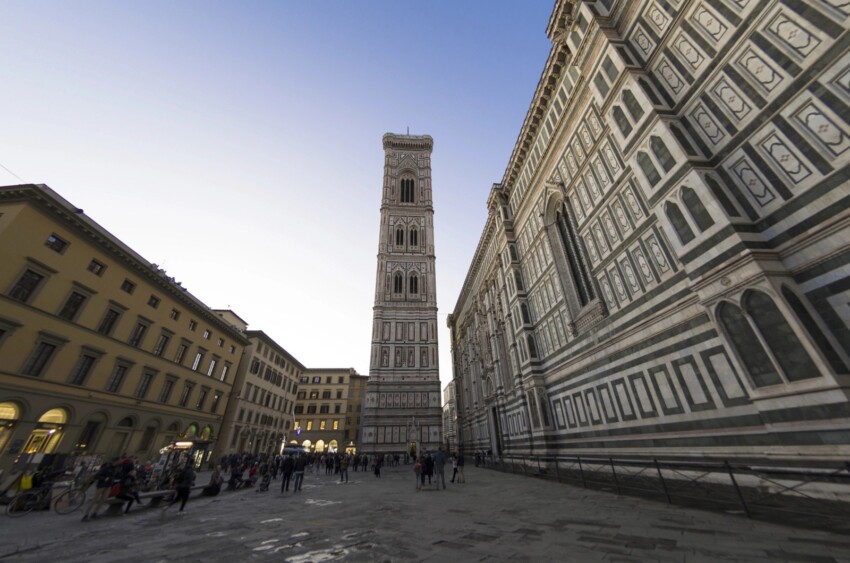
Standing at a height of 84.7 metres, Giotto’s Bell Tower is one of Florence’s most spectacular vantage points and an absolute masterpiece of Italian Gothic architecture. Built between 1334 and 1359, it stands alongside the Florence Cathedral of Santa Maria del Fiore in the city’s most celebrated piazza, forming one of the world’s most photographed monumental complexes together with the Baptistry. Yet its creator, Giotto di Bondone — the brilliant painter considered the father of Western painting — never saw his work completed: he died in 1337, when only the first storey had been finished.
The bell tower bears Giotto’s name but was built over more than twenty-five years by three different masters, each leaving a recognisable stylistic imprint. The result is an extraordinarily harmonious tower, faced with white, green and pink marble quarried from Tuscan mines, decorated with a series of bas-reliefs that form a veritable encyclopaedia of medieval knowledge sculpted in stone. Climbing its 414 steps, passing through three intermediate panoramic loggias and reaching the top terrace offers one of the most memorable visual experiences Florence can offer a visitor.
A visit to the bell tower doesn’t end with the view from the top: each storey offers points of great interest, from the external decoration to the intermediate views of the dome and the city. It’s worth climbing slowly, stopping at the loggias and observing details that many visitors overlook in their haste to reach the summit.
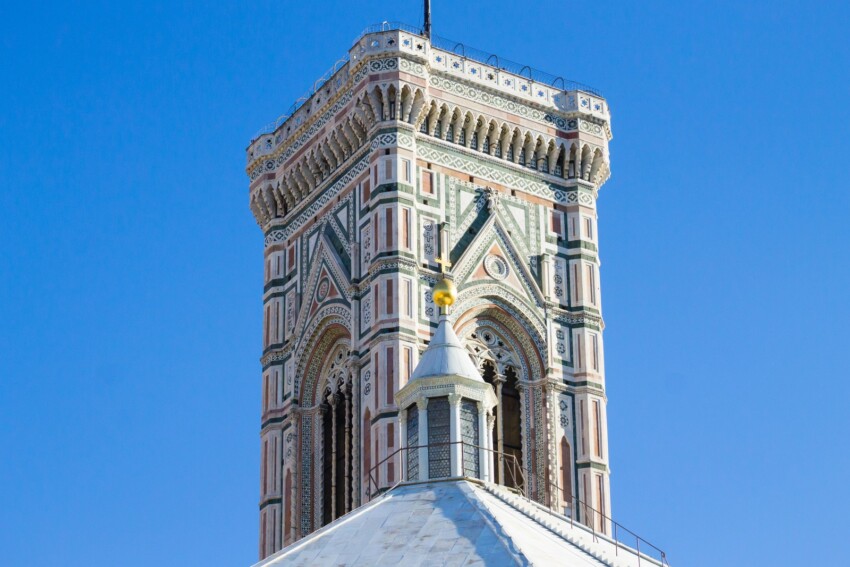
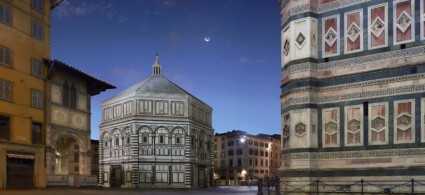
The first thing that strikes you about Giotto’s Bell Tower is the tricolour marble cladding: white Carrara, green Prato and pink Siena, the same materials used for the Cathedral and the Baptistry, which create an extraordinary colour effect and visual coherence. The marbles are not applied flat but worked to form refined geometric patterns — diamonds, dentilled frames, field divisions — that multiply as you go up storey by storey.
The tower is divided horizontally by five superimposed storeys, defined by projecting cornices that mark the vertical rhythm of the structure. The first two storeys are blind — without openings — and concentrate all decorative force in the bas-reliefs of the base. The upper storeys instead open with bifore and trifore with acute arches that progressively lighten the wall mass towards the top, creating an elegant upward tension. From below, the overall effect is one of solidity and thrust at once: a rare synthesis in Italian Gothic architecture.
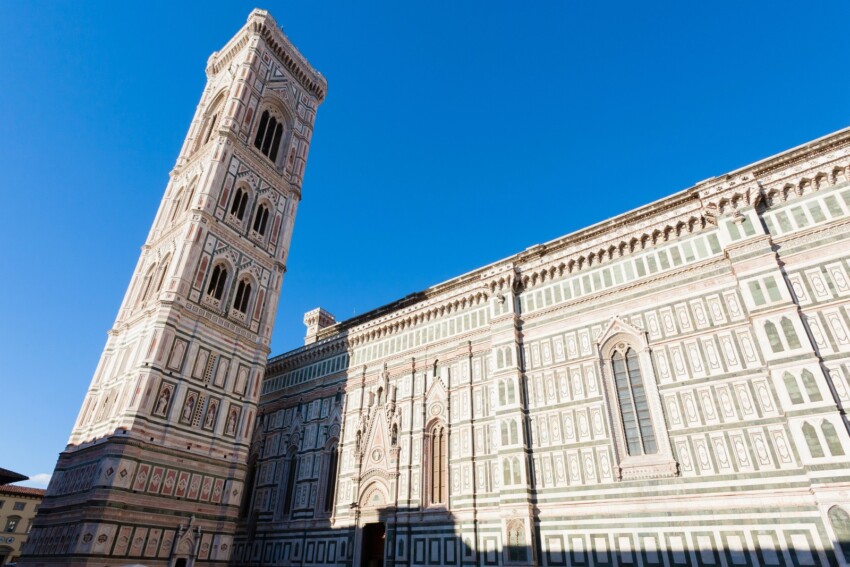
The cycle of bas-reliefs decorating the base of the bell tower is one of the most complex and fascinating iconographic programmes of the Italian 14th century. There are 54 hexagonal reliefs, distributed across three of the four sides of the base, representing the Arts and Works of Man according to the medieval classification of knowledge: from hunting to livestock farming, from navigation to astronomy, from music to medicine, from carpentry to weaving. It’s like leafing through a medieval encyclopaedia sculpted in marble.
The reliefs seen today on the bell tower are copies: the originals, of extraordinary quality, are kept at the Opera Museum, where you can admire them closely in all their fine execution. The panels on the west side and partly on the north side were created by Andrea Pisano around 1337–1341; those on the east side by Luca della Robbia, completed around 1437–1439. The quality of execution varies but the iconographic programme is unified, originally conceived by Giotto and remaining substantially unchanged.
Around the hexagonal reliefs runs a series of 28 diamond-shaped reliefs (lozenges), added by Andrea Pisano in the second register, representing the Planets, the Virtues, the Liberal Arts and the Sacraments. Together with the hexagonal reliefs they form a symbolic system that describes the physical, moral and spiritual universe of medieval man.
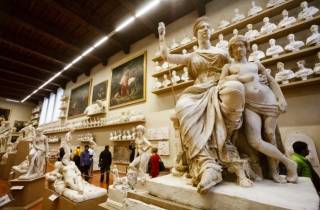
On the second storey of the tower open sixteen Gothic niches that house life-size statues representing kings, patriarchs and prophets of the Old Testament. As with the bas-reliefs, the sculptures visible in the niches are copies: the originals — among which stand out Donatello’s prophets, including the famous Habakkuk nicknamed “lo Zuccone” for his bald head — are in the Opera Museum, where they form one of the most important sculptural groups of the Florentine 15th century.
Donatello’s statues for the bell tower, executed between 1415 and 1436, represent a crucial moment in the history of Western sculpture: the psychological realism, the individuality of the faces, the tension of the bodies anticipate by decades the solutions of mature Renaissance art. Even without being able to see the originals from outside, the sight of the empty niches or those with copies suggests the monumental scale of the original decorative programme.
Climbing the 414 steps of the tower you encounter three panoramic loggias that allow you to stop, catch your breath and enjoy partial views of the city from different heights. These are not merely windows but genuine viewing terraces open on the perimeter of the tower, where you can lean out and look in all directions.
The first and second loggias offer close-up glimpses of the Cathedral’s façade and the rooftops of Florence’s historic centre, with an unusual perspective that you rarely see in photographs of Florence. The third loggia, just below the summit, allows you to already see the city in its full extent and to begin to distinguish the main monuments: the Baptistry, Palazzo Vecchio with its tower, the basilica of Santa Croce, the hills of Fiesole in the background. It’s also the point where you begin to feel the wind more distinctly, a detail that makes the climb physically palpable.
The panoramic terrace at the summit, at 84.7 metres high, is the endpoint of the visit and one of Florence’s finest observation points. The 360-degree panorama embraces the entire city, the surrounding hills and, on clear days, the profiles of the Apennines to the north and the Chianti hills to the south.
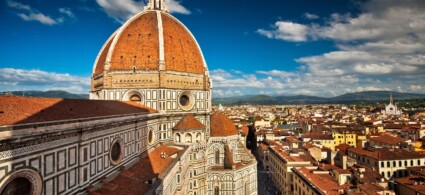
The most extraordinary view is that of Brunelleschi’s Dome: from the bell tower you see the dome from above, which allows you to observe its octagonal drum with the oculus windows and appreciate the structure of the lantern in a way different from any other point in the city. It’s a perspective that even Piazzale Michelangelo cannot offer, because from there the dome is seen from a distance and in a lateral position, whereas from the bell tower you observe it almost from within the Cathedral’s perimeter. For photographers and architecture enthusiasts, this view is the true highlight of climbing the bell tower compared to other Florentine vantage points.
The bell tower houses seven active liturgical bells — the Great Bell, Mercy, Apostolic, Annunciation, Mother of God, The Assumption and The Immaculate — plus five historic decommissioned bells. The Great Bell, the largest and heaviest bell, is the one heard most distinctly in the historic centre and marks the hours of the cathedral’s liturgical service. Passing near the bell chamber during the climb, at times when they ring, it’s possible to feel the vibration of the stone — a sensory experience that very few visitors expect and that leaves a lasting impression.
The history of the bell tower begins in 1334, when the Florentine Republic entrusted the direction of the Cathedral’s construction to Giotto di Bondone, already famous as a painter but appointed as master of the city’s public works. Giotto was then about seventy years old and threw himself energetically into the bell tower project, creating drawings of the tower and supervising the construction of the first storey with its bas-reliefs. When he died in January 1337, only the base was complete: the tower that bears his name barely existed for about ten metres.
The building site passed to Andrea Pisano, a Pisan sculptor already known for the bronze doors of the Baptistry, who continued construction until the interruption caused by the Black Death of 1348. Pisano added the second and third storeys, executed the diamond-shaped reliefs and probably modified some details of Giotto’s original design. When the plague devastated the city and the building sites came to a standstill, the tower had reached about half its current height.
Construction resumed in the 1350s under Francesco Talenti, who completed the tower in 1359 making substantial modifications to the original design. The most important was the decision to abandon the spire that Giotto had planned to crown the top: according to the original plans the bell tower would have reached approximately 122 metres in height, but Talenti stopped at the current 84.7 metres with an open terrace. A choice that radically changed the tower’s silhouette but which, in hindsight, accentuated its solidity and visual balance. Talenti also widened the windows of the upper storeys, transforming Pisano’s bifore into more slender and luminous trifore.
The entire Piazza del Duomo complex — Cathedral, Bell Tower and Baptistry — was declared a UNESCO World Heritage Site in 1982, as part of the recognition of Florence’s historic centre. The bell tower is managed by the Opera of Santa Maria del Fiore, which oversees its maintenance and enhancement together with the other monuments of the complex.
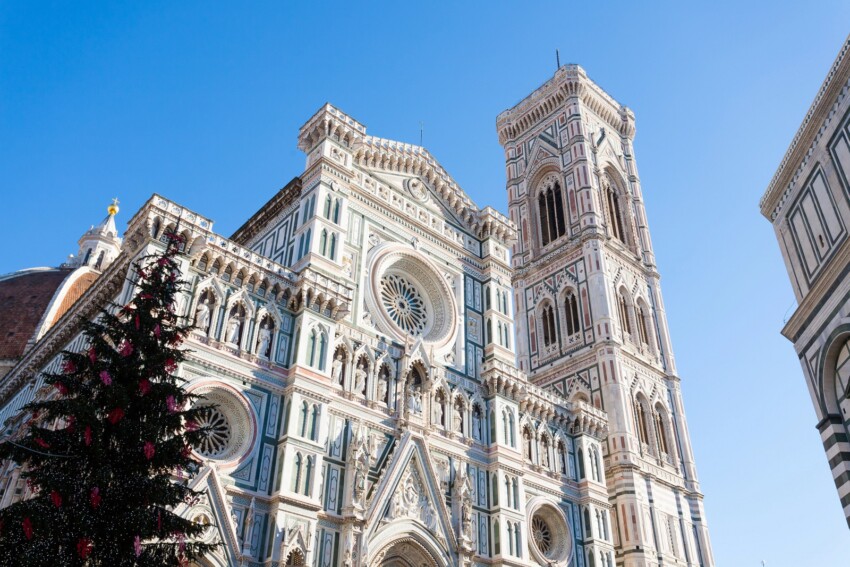
A little-known detail: the position of the bell tower is no accident. Giotto aligned it with the Cathedral’s façade rather than placing it on the side, a choice designed to enhance the tower’s formal independence and not to obscure the view of the future dome — which at the time had not yet been built but was already planned. A far-sighted perspective that demonstrates how Giotto was, beyond being an extraordinary painter, an architect capable of thinking about the city as a whole.
Giotto’s Bell Tower does not have a separate ticket: access is included in the combined passes managed by the Opera of Santa Maria del Fiore, which also cover the other monuments of the complex. The main pass that includes the bell tower is the Giotto Pass, which gives access to the Bell Tower, Baptistry of St John, Opera Museum and Crypt of Santa Reparata. Those who also wish to visit Brunelleschi’s Dome should purchase the Brunelleschi Pass, which includes all the monuments in the Giotto Pass plus entry to the dome.
Giotto’s Bell Tower is open every day, with hours that vary slightly depending on the season: roughly from 8:15 to 18:45 with last entry approximately 40 minutes before closing. Opening times may vary for religious events, major maintenance or special holidays.
The climb takes approximately 45–60 minutes for those wanting to enjoy the intermediate loggias at leisure and spend a few minutes at the top. Those who climb and descend without breaks take less time, but missing the intermediate views would be a shame. The 414 steps are arranged in straight flights — not in a spiral — and the climb, though requiring good physical effort, is manageable for people in good health. There is no lift, and climbing is not recommended for those with heart or respiratory problems, vertigo, claustrophobia or who are pregnant.
The best time to visit the bell tower is early morning, just as it opens, when queues are shorter and the light is favourable for photographs towards the east. Alternatively, late afternoon on summer days offers warm, raking light that enhances the marbles of the Cathedral’s façade seen from above. Avoid midday hours in July and August, when queues and heat make the experience less pleasant. Weekdays are generally less crowded than weekends.
Giotto’s Bell Tower is located in Piazza del Duomo, in the heart of Florence’s historic centre, in an area with limited traffic that is accessible on foot from most city centre hotels. The entrance to the tower is through the Bell Tower Door, on the south side of the Cathedral.
From Santa Maria Novella Station you walk in about 10–12 minutes along Via de’ Cerretani and Via dei Martelli. Alternatively, bus lines C1 and C2 (historic centre lines) stop near Piazza del Duomo, as do lines 6, 11, 14 and 23. Tram T1, with a stop at Alamanni near the station, allows you to reach the centre on foot in a few minutes. Before accessing the bell tower it is compulsory to deposit large rucksacks, suitcases and bulky bags at the luggage storage available in Piazza Duomo 38/r, adjacent to the entrance of the Opera Museum.
City Card allow you to save on public transport and / or on the entrances to the main tourist attractions.

 Hotel
Hotel  Budget accommodations
  Apartments
  Family Hotel
  Luxury Hotel
  Resorts