Bestseller
Florence: Museo Galileo Entry Ticket
From 17,14 €
Buy the ticket
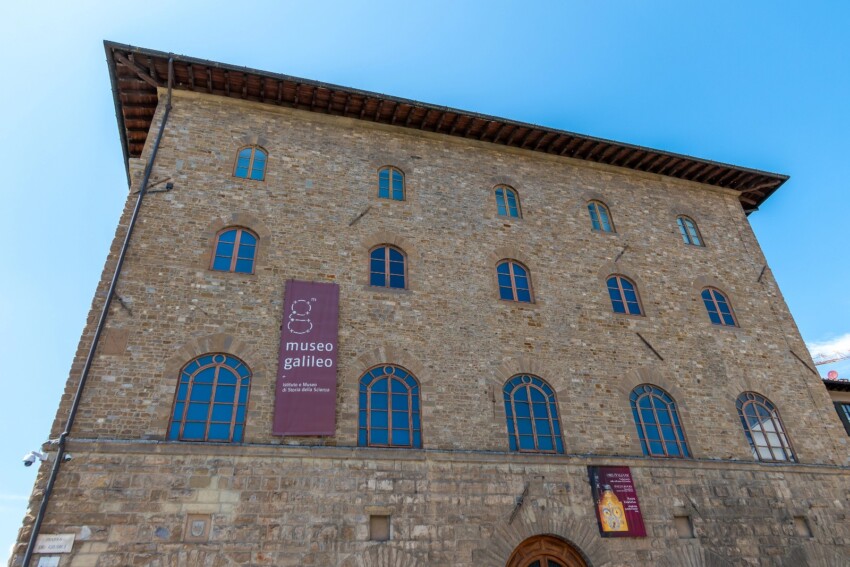
In the heart of Florence, just steps away from the Uffizi Gallery and Ponte Vecchio, stands one of the world’s most important scientific museums: Museo Galileo, a unique institution housing five centuries of scientific history across 18 rooms spread over two floors of Palazzo Castellani. Here you’ll find the only surviving original telescope used by Galileo Galilei in 1610 to observe Jupiter’s moons and the mountains of the Moon — an instrument that forever changed our understanding of the universe.
Unlike other Florentine museums, Museo Galileo rarely gets overcrowded and individual visitors can enter without advance booking — a rare gem in Florence’s museum landscape. A visit typically lasts between one and two hours and proves surprisingly engaging even for those without a scientific background, thanks to the extraordinary aesthetic quality of the collection — astrolabes, armillary spheres, celestial globes, microscopes and philosophical machines that seem plucked from a Renaissance cabinet of curiosities.
The museum suits all ages: for children aged eight and upwards, it’s a particularly stimulating experience, with the option of using the official app to explore the objects on display and educational activities organised at weekends.
The exhibition unfolds across 18 themed rooms, arranged chronologically from the late Middle Ages through to the 19th century. Each room focuses on a specific theme — cosmography, navigation, timekeeping, light, heat — and presents the instruments alongside the historical and scientific context in which they were made.
The museum’s centrepiece is Room VII, dedicated entirely to Galileo Galilei. Here you’ll find his two original telescopes, built around 1609-1610: they are the only surviving instruments made by Galileo anywhere in the world, and seeing them up close — fragile, almost unremarkable objects — brings home just how extraordinary it is that they’ve survived four centuries. Alongside the telescopes is the original objective lens with which Galileo made his most important astronomical observations, and the Galilean compound microscope.
The room also houses one of the museum’s most curious and controversial relics: Galileo’s middle finger, removed during the transfer of his remains in 1737 and preserved in a small glass vial mounted on a decorative stand. It provokes mixed reactions from visitors, yet remains one of the most photographed objects in the entire collection.
Rooms I through VI showcase the extraordinary Medici collection of scientific instruments, begun by Cosimo I de’ Medici in the 16th century and enriched over more than two centuries by the Florentine grand dukes. The collection includes celestial and terrestrial globes, armillary spheres, astrolabes, compasses and superbly crafted navigation instruments: objects designed to be both displayed and used, combining scientific function with the beauty of Renaissance craftsmanship.
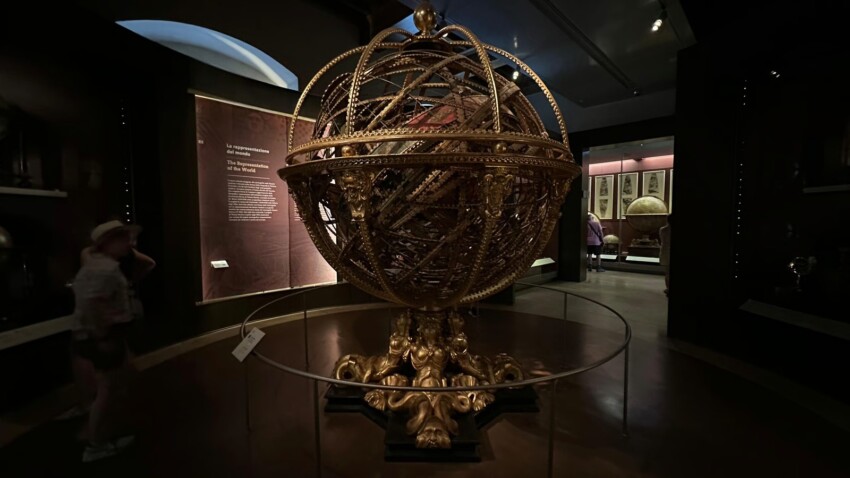
Among the most spectacular pieces stands the large carved and gilded wooden armillary sphere by Antonio Santucci (1588-1593), representing the Ptolemaic geocentric system with planets and constellations. It’s a masterpiece of scientific craftsmanship and an extraordinary document of how the universe was imagined before Galileo.
Room VIII is devoted to the Accademia del Cimento, Europe’s first scientific society, founded in Florence in 1657 by the Medici princes Ferdinando II and Leopoldo. The Academy existed for just ten years, yet during this brief period it produced some of the 17th century’s most significant experimental discoveries, particularly in thermometry and barometry. The room displays the original instruments used by the academicians, including the famous spiral thermometers and the first mercury barometer in history, invented by Evangelista Torricelli in 1644.
The final rooms of the exhibition — from Room X to XI — are dedicated to the scientific collecting activities of the Lorraine Grand Dukes, who in the 18th century transformed Florence into a centre of excellence for experimental scientific research. Among the most impressive pieces are the chemical workbench of Grand Duke Pietro Leopoldo, a complete setup for chemistry experiments, and the disc electrostatic machine, one of the most spectacular instruments of 18th-century physics, capable of producing remarkably intense sparks.
The history of Museo Galileo is inseparably linked to that of Palazzo Castellani, a building of ancient origins dating from the late 11th century, known in Dante’s time as Castello d’Altafronte because of its defensive role on the banks of the Arno. From 1574 to 1841 it housed the Giudici di Ruota, as evidenced by the coats of arms still visible in the entrance hall.
The scientific collection has its roots in the 16th century: Cosimo I de’ Medici began gathering scientific instruments at Palazzo Vecchio in 1519, work continued by Ferdinando I, who moved the collection to the Uffizi. In 1657 the founding of the Accademia del Cimento gave a decisive boost to the collection’s growth. After Italian unification the collections entered a period of decline and dispersal until 1927, when the Institute for the History of Science was founded with a mandate to gather, catalogue and restore Florence’s scientific heritage. In 1930 the Museum of the History of Science opened at Palazzo Castellani. In 2010, on the 400th anniversary of the publication of Galileo’s Sidereus Nuncius, the museum took its present name of Museo Galileo.
Tickets can be purchased directly online by following this link or by filling out the form below.
For those interested in a private guided tour, the museum organises exclusive tours for groups of up to 14 people, lasting 60 minutes, at a cost of €65 per tour plus the admission ticket, with booking required via email.
Museo Galileo is open every day, Monday to Sunday, from 9:30 to 18:00. It closes only on 1 January and 25 December. There are no weekly closure days, unlike many other Florentine museums.
The average visit lasts 1-2 hours, depending on how thoroughly you want to explore each section. For a complete visit including reading the interpretive panels, allow at least an hour and a half.
March and April are the busiest months due to school trips; summer sees the highest numbers of tourists. If you’d like to visit the museum during a quieter period, autumn and winter months (excluding the holidays) are the most peaceful and recommended.
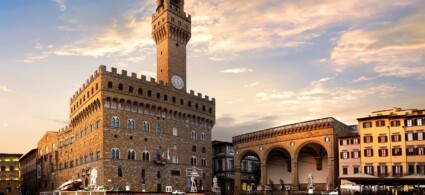
Museo Galileo is located at Piazza dei Giudici 1, less than 200 metres from Piazza della Signoria and the Uffizi Gallery. It’s easily accessible on foot from the historic centre in just a few minutes.
By bus, lines B and 23 run by Autolinee Toscane stop at the Uffizi, just a short walk from the museum. The museum is in a restricted traffic zone (ZTL): those arriving by car must park in one of the external car parks. The nearest is Sant’Ambrogio Car Park at Piazza Annigoni 9, reachable on foot in about 10 minutes.
The main entrance is at Piazza dei Giudici 1. The entrance for visitors with mobility disabilities is located on Lungarno Anna Maria Luisa de’ Medici 2 and is accessible via intercom. The museum is fully equipped for visitors with disabilities.
City Card allow you to save on public transport and / or on the entrances to the main tourist attractions.

 Hotel
Hotel  Budget accommodations
  Apartments
  Family Hotel
  Luxury Hotel
  Resorts