Bestseller
Florence: Timed Entry to Michelangelo's David + Audio App
From 28,75 €
Buy the ticket
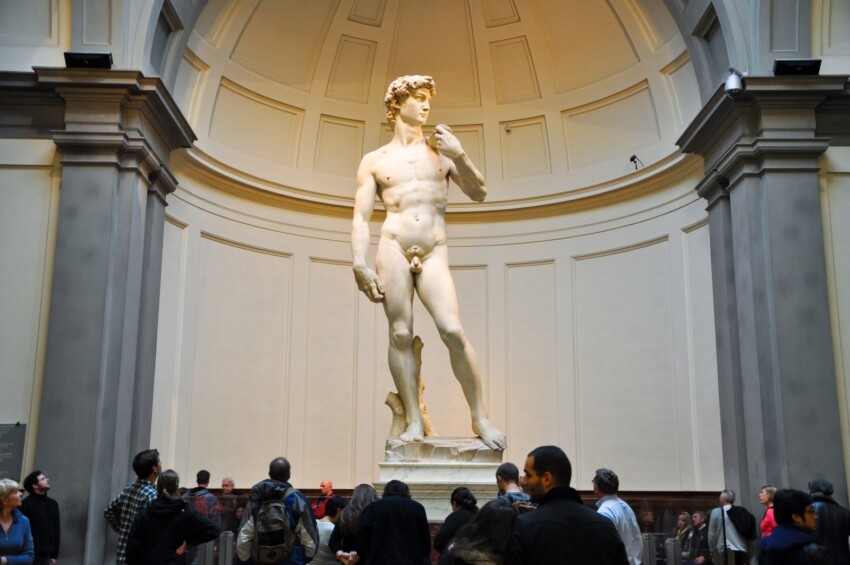
One of Florence’s most spectacular museums and an absolute must-visit for art enthusiasts is undoubtedly the Accademia Gallery. Located at via Ricasoli 60 in the heart of the historic centre, it houses the world’s largest collection of Michelangelo sculptures—a total of seven—with the breathtakingly beautiful David being the most celebrated.
But Michelangelo is far from the only draw. Since opening in 1784, the Accademia Gallery has been home to the world’s most significant collection of gold-background panel paintings, alongside an impressive collection of musical instruments.
Spread across 12 galleries and several exhibition routes, the Accademia Gallery is owned by Italy’s Ministry of Culture and Cultural Activities, and has held special autonomous status since 2014. Today, under the directorship of Cecilie Hollberg, the museum welcomes nearly two million visitors annually.
Beyond the museum’s undisputed star, Michelangelo’s David, the Accademia houses an extraordinary collection of masterpieces and artworks displayed throughout its exhibition galleries.
Michelangelo’s David is the Accademia Gallery’s masterpiece and one of the world’s most iconic sculptures. Since 1873, it has occupied pride of place in a room known as the David’s Tribune, where it stands as the sole protagonist; the side wings of the room showcase numerous Mannerist works, all dating from around the mid-sixteenth century.
The David stands 5 metres and 20 centimetres tall, including its plinth, which alone measures just over a metre. Created by Michelangelo between 1501 and 1504, it has become a symbol of both the Renaissance and Florence. Michelangelo sought to capture King David as he prepared to face Goliath, with the marble’s poor quality and fragility presenting his greatest challenge. For three years of work, Michelangelo received 400 florins.
The room takes its name from a statue of one of the Dioscuri of Montecavallo, now relocated to the Plaster Cast Gallery of the Porta Romana School of Art. Here you’ll find Giambologna’s sketch for the Rape of the Sabines, alongside numerous fifteenth and sixteenth-century paintings from the Florentine school by masters including Paolo Uccello, Botticelli and Perugino.
The Prisoners are four male sculptures by Michelangelo—Atlas, the Bearded Slave, the Awakening Slave and the Young Slave—originally created to adorn the tomb of Julius II in Rome, before Cosimo I de’ Medici repurposed them for the Buontalenti grotto in the Boboli Garden.
Alongside them stand two further Michelangelo sculptures: the Pietà of Palestrina and Saint Matthew, whilst the walls display various sixteenth-century masterpieces by different artists.
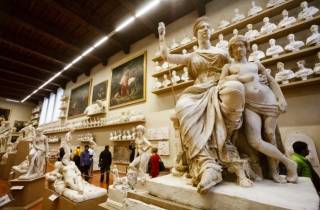
The Nineteenth-Century Salon, or Bartolini Plaster Cast Gallery, showcases paintings and sculptures by nineteenth-century artists. Lorenzo Bartolini is the star attraction, with numerous plaster casts on display, whilst the paintings are works created by artists competing for prizes in the Fine Arts Academy’s painting competitions.
This room houses masterpieces of Florentine Gothic painting, many of them gold-background panels. Here you’ll also find a fragment attributed to Giotto, from the Abbey of Santa Maria in Florence.
Notable works include the Madonna and Child with Saints by Grifo di Tancredi, the Madonna Enthroned with Child by Guido da Siena, and numerous pieces by anonymous painters such as the Master of the Magdalene and the Master of Saint Cecilia.
As its name suggests, the Giotto Followers Room showcases works by followers of Giotto, Florentine artists from the fourteenth century. Many works by Bernardo Daddi and Taddeo Gaddi are featured, along with two precious pieces by Niccolò di Pietro Gerini: Christ Blessing with Two Prophets and Christ in Pietà with the Virgin and Saint John the Evangelist and Saints.
The Orcagna were three painter brothers active in Florence during the fourteenth century. Orcagna was actually the nickname of Andrea di Cione, a corruption of Arcangelo; his brothers were Nardo di Cione and Jacopo di Cione.
This Accademia Gallery room is dedicated to them: by Andrea you can see the Pentecost and the Madonna Enthroned with Child and Saints, whilst Nardo’s Triptych of the Thronum Gratiae is on display. Jacopo’s collection is considerably larger, and works by their followers—some anonymous—are positioned alongside theirs.
Other Accademia Gallery rooms house works of lesser renown: the Giovanni da Milano room, the Late Fourteenth-Century room, the Lorenzo Monaco room and the International Gothic room. The Accademia Gallery is also home to an impressive collection of Russian icons, displayed in a dedicated wing of the museum.
You can purchase your Accademia Gallery admission ticket directly at the ticket office or online to skip the queues. Discounts are available for young people aged 18 to 25, whilst children under 18, disabled visitors with a companion, tour guides, fine arts academy staff and students, journalists and other categories defined by the Ministry of Culture enter free of charge. Note that the ticket office closes 30 minutes before the museum’s closing time.
Several ticket options are available: standard, priority access, and with audioguide.
If you’re planning to visit the Uffizi Gallery in addition to the Accademia, consider purchasing a combined ticket covering both museums to save on overall admission costs.
The museum doesn’t organise guided tours itself, but you can join private tours or group tours led by expert Florentine guides, allowing you to experience the museum from a fresh perspective. There are countless Accademia Gallery tours available: choose your preferred option by researching online, considering factors such as your budget, required visit duration and guide expertise.
The Accademia Gallery is among the attractions included with the FirenzeCard—consider purchasing one if you plan to visit multiple museums over three days in Florence.
The Accademia Gallery is among Florence’s finest and most rewarding museums: follow these tips to make the most of your visit.
The museum’s intriguing name derives from its founding: in 1784, Grand Duke Peter Leopold of Lorraine established the Academy of Fine Arts, an institution that consolidated various existing and former bodies, such as the Academy of Arts and Design founded by Cosimo I nearly 200 years earlier.
From the outset, a gallery was attached to the Academy of Fine Arts, where students could study and copy artworks to enhance their artistic training. Initially, this new gallery of the Academy of Fine Arts housed Giambologna’s Rape of the Sabines and the Allegory of Florence Dominating Pisa, now displayed in Palazzo Vecchio, alongside various plaster casts and a collection of canvases from the Academy of Design’s holdings.
The Gallery rapidly expanded, acquiring paintings from diverse sources and adding numerous artworks around 1817. Today, the Accademia Gallery is the culmination of centuries of collecting and display along its corridors.
The narrow via Ricasoli, home to the Gallery, connects Piazza del Duomo with Piazza San Marco. It’s thus a central Florence street and, as such, is closed to traffic. We recommend arriving on foot: it’s roughly 15 minutes from Santa Maria Novella station, just 5 minutes from Piazza del Duomo, and just over 10 minutes from the Uffizi.
If you prefer alternative transport, San Marco piazza—immediately adjacent to the Gallery—serves numerous bus routes: 1, 6, 7, 10, 11, 14, 17, 20, 23, 25, 31, 32 and 52. You’re sure to find one that suits you! Once you’ve alighted, simply walk just over 100 metres along via Ricasoli: the Accademia Gallery entrance is at number 60.
The Galleria dell'Accademia is located on Via Ricasoli, easily accessible on foot from both Santa Maria Novella station and Florence's other major attractions.
City Card allow you to save on public transport and / or on the entrances to the main tourist attractions.
 Hotel
Hotel  Budget accommodations
  Apartments
  Family Hotel
  Luxury Hotel
  Resorts