Hidden Gems in Florence: 12 Unusual Places to Discover
Florence conceals unusual treasures and secret places: discover mysterious details, hidden sculptures and extraordinary museums far from the beaten tourist track.
Florence hides amongst its streets a treasure trove of curious details, legends and unusual places that escape even the most attentive visitors. Beyond the Renaissance masterpieces that have made the city famous throughout the world, Tuscany’s capital safeguards secret stories sculpted in stone, sculptures with hidden meanings and traditions passed down through centuries.
Walking through the historic centre with curious eyes means discovering self-portraits concealed behind the helmets of mythological heroes, animal heads that tell stories of revenge, stones that punished Renaissance debtors and statues that defy mathematics. Every corner reveals details that only direct knowledge of the city allows you to fully appreciate.
From secret passages that run across Florence suspended above the Arno to collections of anatomical waxworks that have shaped the history of medicine, from street art that transforms road signs into urban art to scientific museums among the oldest in Europe, unusual Florence offers experiences that go far beyond classic tourist itineraries.
We’ll guide you through the discovery of these hidden treasures, unveiling curiosities that will make your visit to Florence even more memorable. Prepare yourself to see the city with fresh eyes, amidst history, art, legends and little-known anecdotes that demonstrate how Florence truly is an open-air museum, where every stone has a story to tell.
The Vasari Corridor
1Lungarno degli Archibusieri, 50122 Firenze FI, Italy
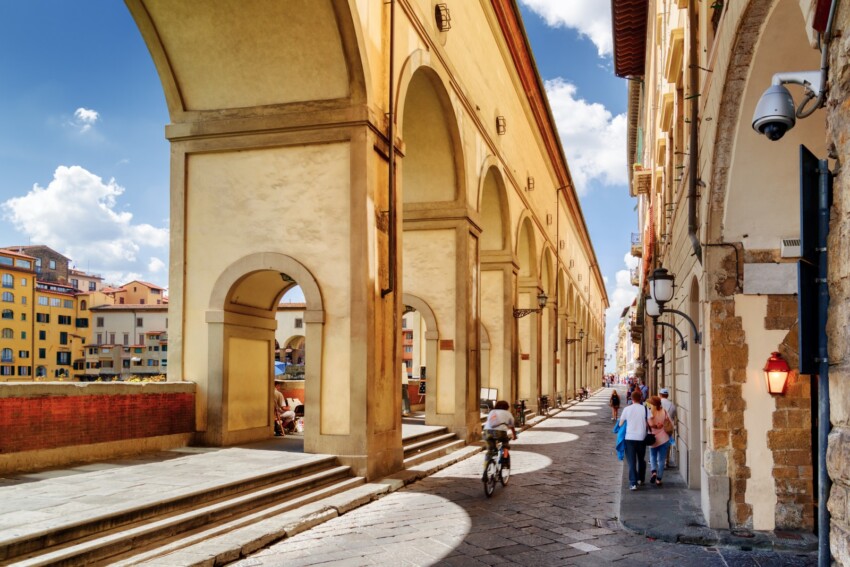
The Vasari Corridor represents one of the most extraordinary architectural achievements of the Italian Renaissance. This elevated passageway, approximately 750 metres long, was commissioned by Cosimo I de’ Medici in 1565 and designed by architect Giorgio Vasari, who managed to complete it in just five months for the wedding of his son Francesco to Johanna of Austria.
The corridor connects Palazzo Vecchio with Palazzo Pitti by passing through the Uffizi Gallery and above the Ponte Vecchio, allowing the Medici family to move in complete safety and privacy between the official and private residences. During the passage, the corridor crosses private buildings, skirts the Arno and even overlooks the interior of the Church of Santa Felicita, where the Medici could attend religious services without being seen.
After eight years of closure for safety works, the Vasari Corridor reopened to the public on 21 December 2024. The restoration has made the route fully accessible to people with disabilities, thanks to an integrated system of ramps, platforms and lifts. Today the corridor presents itself in its original “nakedness”, restored exactly as it appeared in the sixteenth century, offering unique panoramic views of the city.
A visit requires the purchase of a combined ticket with the Uffizi Gallery.
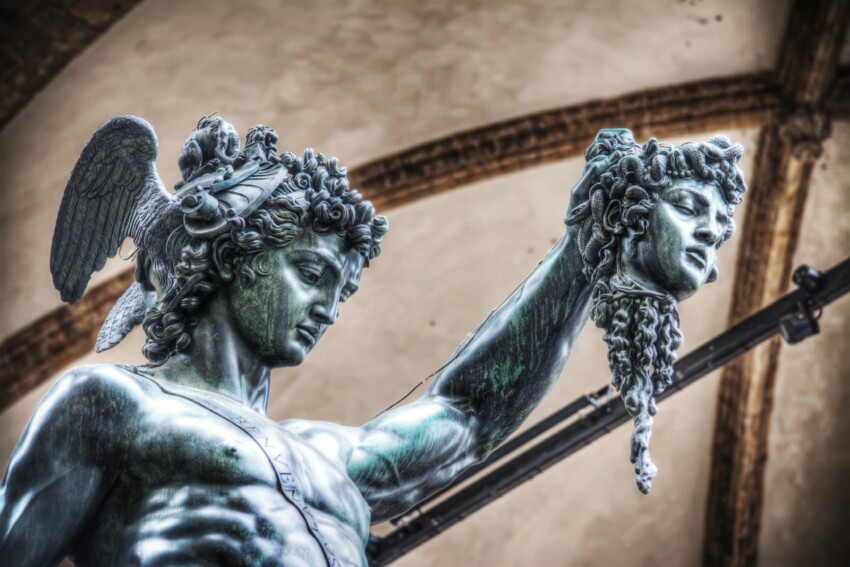
Beneath the Loggia dei Lanzi in Piazza della Signoria, amongst the numerous statues that adorn this public space, the famous Perseus by Benvenuto Cellini stands out. The bronze sculpture depicts the Greek hero who has just beheaded Medusa, but it conceals a detail that few visitors notice: the secret self-portrait of its creator.
Benvenuto Cellini, one of the most brilliant and egocentric artists of the Renaissance, could not resist the temptation to leave his personal signature on this monumental work. If you look carefully at the statue from behind, between the back of the hero’s neck and the helmet, you will spot the face of a bearded man: it is Cellini’s own portrait, hidden in a spot where only the most attentive eyes can find it.
This detail demonstrates not only the sculptor’s extraordinary technical skill, but also his strong personality and desire to immortalise himself alongside his work. The sculpture was completed in 1554 after nearly ten years of labour, and the choice to insert his own face on the hero’s helmet represents a gesture of artistic pride typical of the Renaissance.
When you visit Piazza della Signoria, take a few minutes to walk around the Perseus and search for this voluminous secret. It is one of those details that, once discovered, completely changes your perception of the work and demonstrates how Florence is full of details that only careful observation can reveal.
The Stone of Scandal
3Piazza del Mercato Nuovo, 5 R, 50123 Firenze FI, Italy
Inside the Loggia del Mercato Nuovo, amongst the stalls selling typical Florentine leather products, lies a particular disc of white and black marble: the so-called Stone of Scandal or “Stone of the Acculata”. This apparently innocent place hides a story linked to public justice during the Renaissance.
During the sixteenth century, insolvent debtors who were unable to settle their accounts were brought to this spot for a punishment both humiliating and painful. The unfortunates were chained, their trousers were lowered and they were repeatedly beaten on their backsides against the marble stone, whilst the crowd watched the spectacle.
The term “acculata” derives precisely from this practice, and the public scandal that ensued served as both physical punishment and social deterrent. The circular stone is still perfectly visible at the centre of the loggia, worn by centuries of footsteps but a silent witness to an era when justice was spectacular and public.
This curiosity reveals a lesser-known aspect of Renaissance Florence, where power and justice manifested themselves through public rituals. Today the Stone of Scandal is a place of passage for tourists heading to the nearby Fontana del Porcellino, unaware of its historical significance. When you pass through the Mercato Nuovo, look for this marble disc and reflect on how the city has preserved the memory of its traditions through these urban details.
In the Oltrarno, on the façade of the Torre dei Marsili in via Toscanella, stands one of Florence’s most ironic and contemporary sculptures: the so-called Madonna of the Stench. It is a terracotta bust depicting a woman holding her nose with her hand, whilst her eyes are turned upwards and a little mouse runs along her arm.
This work was created by artist Mario Mariotti in 1984 as a form of social protest. At the time, via Toscanella was characterised by an unpleasant smell emanating from rubbish bins and, worse still, the street was frequently used as a public open-air toilet. The artist decided to denounce this situation through art, immortalising in terracotta the universal gesture of someone holding their nose in the face of a bad smell.
The name “Madonna of the Stench” was coined by the Florentines themselves, who appreciated the irony of the work and the ability to transform a daily discomfort into a work of urban art. The sculpture quickly became a symbol of the neighbourhood and of the characteristic Tuscan humour, capable of facing even the most unpleasant situations with irony and creativity.
Today the hygienic situation in the area has improved considerably, but the Madonna of the Stench has remained in place as a testament to an era and as an example of how contemporary art can dialogue with the city and its problems. When you explore the Oltrarno, search for this curious sculpture: it perfectly represents the ironic and direct spirit of the Florentines.
The Lucky Piglet
5Piazza del Mercato Nuovo, 50123 Firenze FI, Italy
Outside the Loggia del Mercato Nuovo stands one of Florence’s most beloved and touched sculptures: the Fontana del Porcellino. Despite its name, the animal depicted is actually a bronze wild boar, and its shiny snout bears witness to centuries of hands rubbing it in hope of gaining good fortune.
The tradition associated with the Porcellino is quite precise: you must rub the animal’s nose, place a coin in its mouth and let it drop. If the coin manages to pass through the grate beneath the fountain, your wish will come true and you will be assured of returning to Florence. The original in marble, created by Pietro Tacca in the seventeenth century, is kept at the Uffizi, whilst this is a copy that has nonetheless acquired affectionate and superstitious value for Florentines and visitors alike.
The sculpture was inspired by an ancient boar held in the Medici collection, and represents a perfect example of how popular traditions overlap with classical art. The Mercato Nuovo itself is a historic place, built in the sixteenth century for the trade of fine fabrics, and the presence of the Porcellino adds a touch of folklore to this Renaissance corner.
Every day hundreds of visitors participate in this superstitious ritual, creating one of the most photographed scenes in Florence. The area around the boar’s mouth is particularly worn, a sign of how many coins have been inserted over the decades. When you visit the Mercato Nuovo, join in this tradition: it is a way to connect with centuries of visitors who came before you.
Amongst the countless decorations that adorn the Florence Cathedral, one in particular hides a spicy and little-known story: the bull’s head carved on a waterspout on the side of the cathedral. To locate it, you need to position yourself from the side of the ticket office and search amongst the gothic decorations: you will find this bovine head that seems out of place compared to the other decorative elements.
According to the most widespread legend, this sculpture was the work of a master builder who worked on the construction of the Cathedral in the fourteenth century and who was having a clandestine relationship with the wife of a baker who lived directly opposite. When the woman was discovered and driven away from her husband, the master builder decided to take revenge by carving a bull’s head – the universal symbol of betrayal – pointing directly towards the cuckold baker’s house.
An alternative, more elevated but less entertaining version, suggests that the bull’s head was a tribute to the draught animals that transported the heavy materials needed for the construction of the cathedral. However, Florentines have always preferred the first version, more in line with their ironic character and tendency to immortalise human affairs even in sacred places.
This curiosity demonstrates how even a magnificent monument like Santa Maria del Fiore can hide human and spicy stories. The search for the bull’s head has become a real treasure hunt for the most attentive visitors, and finding it means having discovered one of Florence’s funniest secrets. Bring a good camera with a zoom function, because the sculpture is quite high up.
The Impossible Bees of Ferdinando I
7Piazza della Santissima Annunziata, Firenze FI, Italy
In Piazza Santissima Annunziata, one of Italy’s most harmonious Renaissance squares, stands the equestrian statue of Ferdinando I de’ Medici created by Giambologna. But the real curiosity does not lie in the grand figure of the grand duke, but rather in a hidden detail on the back of the base: a swarm of bees arranged in perfect concentric circles around a queen bee.
These bees represent the symbol of the Grand Duchy of Tuscany and its hardworking people loyal to the sovereign. But what makes this detail truly special is the mathematical challenge it conceals: try to count the bees without touching them with your fingers. Legend has it that, due to the perfect geometric arrangement and the concentric circles that create an optical effect, it is practically impossible to keep an accurate count.
According to popular tradition, whoever succeeds in the feat of counting all the bees without losing count will be kissed by fortune. Over the centuries, countless Florentines and visitors have attempted this feat, but the particular arrangement of the figures makes the operation extremely difficult. Some claim there are 91 bees, others speak of different numbers, fuelling the mystery.
The statue was commissioned by the grand duke himself and completed after his death in 1608. The choice to represent bees on the pedestal was not casual: these insects represented industriousness, perfect social organisation and loyalty to the sovereign, all values that the Medici wanted to associate with their rule. When you visit Piazza Santissima Annunziata, walk around the statue and accept the challenge: will you manage to count all the bees?
In the heart of the Dante district, just a stone’s throw from the presumed birthplace of the great poet, lies one of Florence’s most fascinating and least-known details: the profile of Dante Alighieri carved into the pavement of a small square. This peculiarity can be found near the Church of Santa Margherita, where tradition holds that Dante first encountered Beatrice at the age of nine.
Spotting the profile requires patience and a keen eye: it’s a drawing etched into the stone paving that reproduces Dante’s unmistakable face with his characteristic aquiline nose and medieval headwear. Legend has it that this portrait was created by Dante himself, who spent his days sitting on the Sasso di Dante observing the construction work on the Duomo and carving his own profile into the pavement with a stone.
In reality, the profile is likely a more recent work, but its presence has fuelled stories and legends passed down through the centuries. To make the drawing more visible, many visitors pour water onto the stone: the moisture highlights the grooves and allows for better photographs of the profile. This practice has become so common that it’s almost a ritual for those seeking the hidden portrait.
The area around the Church of Santa Margherita is rich with Dante-related references: here you’ll also find the tomb of Beatrice Portinari, the woman who inspired the most celebrated love in Italian literature, and numerous plaques and inscriptions marking the places the poet frequented before his exile. When exploring Florence’s medieval centre, take time for this Dante treasure hunt: it’s a way to connect with the memory of the great poet and with Florentines who have passed down these stories for centuries.
La Specola, located on via Romana in the Oltrarno, is one of Europe’s most unusual and fascinating museums. Inaugurated in 1775 by Grand Duke Peter Leopold of Lorraine, it was the first scientific museum open to the public and remains today a unique experience combining zoology, anatomy and the history of science within a single extraordinary building.
The museum takes its name from the astronomical observatory (the “specola”, as it were) installed in the palace’s turret. The zoological collections comprise over three and a half million specimens, of which around 5,000 are visible to the public. Among the most curious pieces stands the hippopotamus that lived in the Boboli Garden in the 18th century, extinct animals such as the Tasmanian tiger, and thousands of taxidermied species using both ancient and modern techniques.
Yet what makes La Specola truly unique in the world is the collection of anatomical waxworks, the most extensive and ancient in existence. Created between 1771 and the mid-19th century in the museum’s wax-working workshop, these wax sculptures represent a masterpiece of art and science. The anatomical models, extraordinarily lifelike and unsettling in equal measure, were crafted to teach anatomy without the need for constant cadaver dissection.
Particularly striking are the full-size figures, including the “Spellato” – a prone body with muscles and blood vessels visible down to the tiniest capillaries – and the celebrated “Anatomical Venuses”, female figures in romantic poses whose bodies open in layers to reveal internal organs. The collection also includes works by Sicilian wax artist Gaetano Giulio Zumbo, commissioned by Cosimo III de’ Medici between 1691 and 1694, depicting macabre plague scenes with shocking realism.
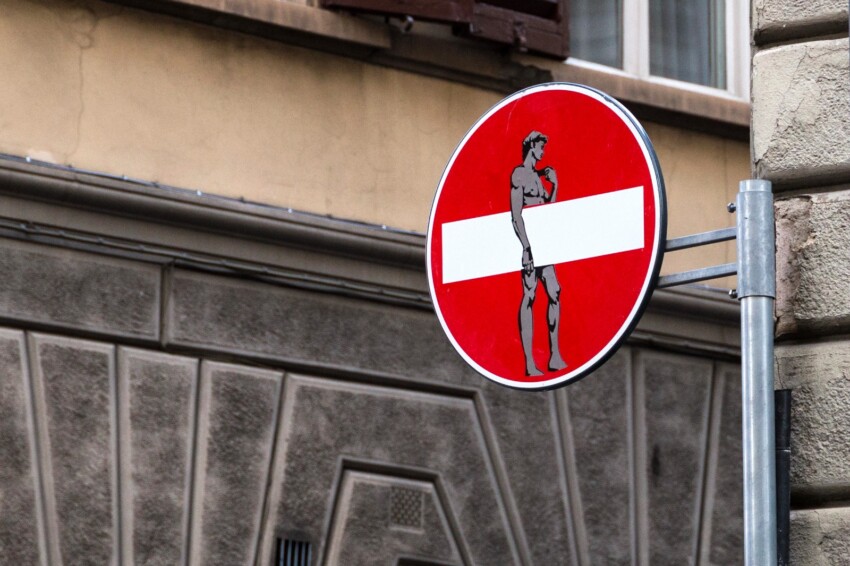
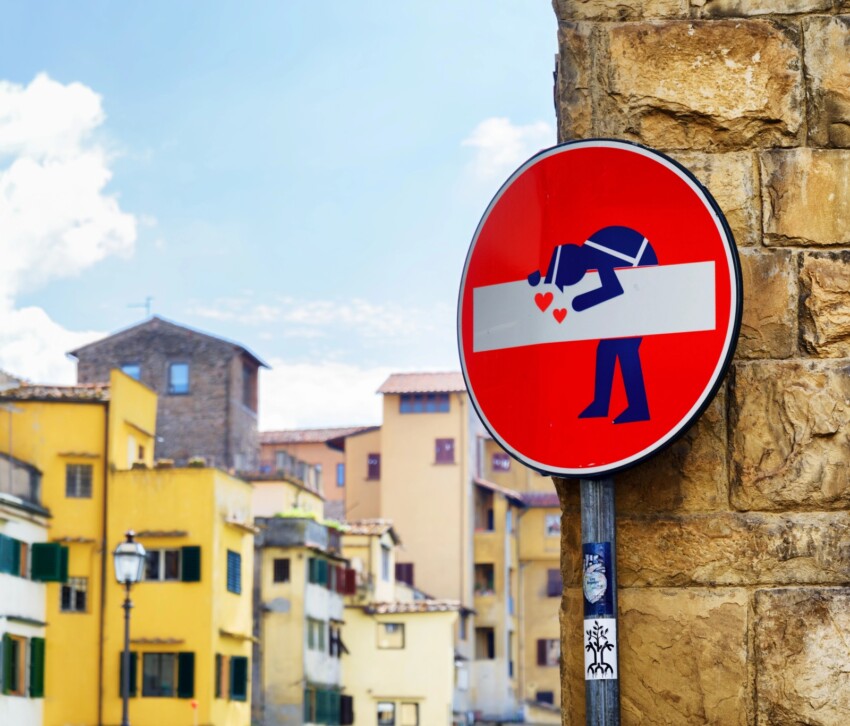
Wandering through Florence’s streets, particularly around San Niccolò and the Oltrarno, you might come across some decidedly unconventional street signs: a no-entry sign transformed into a Crucifixion, a mandatory turn sign becoming Pinocchio’s nose, or a pothole warning mutating into an impudent tongue. These urban street art works bear the signature of Clet Abraham, a French artist who has lived and worked in Florence since 2005.
Clet has managed the feat of transforming mundane street signage into contemporary art through the application of removable stickers on signs, always keeping the original sign and its meaning clearly visible. His works have become so iconic that many Florentines have grown fond of these modified signs, whilst the municipal authorities vacillate between tolerance and removal.
Clet’s technique is simple yet effective: he uses custom-cut stickers that integrate seamlessly with the existing street sign shapes, creating new figures and meanings. A red prohibition circle becomes a saint’s halo, directional arrows transform into cartoon characters, and warning triangles become house roofs or hats worn by historical figures.
Clet’s studio-workshop is located at via dell’Olmo 8, in the San Niccolò neighbourhood, and is open to the public free of charge. Here you can meet the artist himself, see the original signs that authorities have removed from the streets, and discover his other works including paintings and sculptures. The visit represents a unique opportunity to understand how contemporary art can engage with urban space and transform everyday objects into creative works.
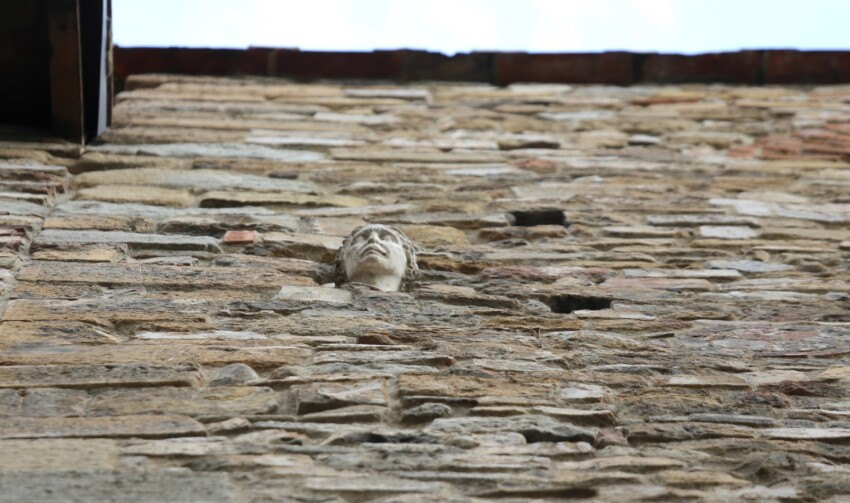
On the bell tower of the Church of Santa Maria Maggiore, one of Florence’s oldest, sits a curious detail that has fuelled legends for centuries: a female stone bust embedded in the tower’s walls. This woman’s face, affectionately called “la Berta” by Florentines, emerges inexplicably from the medieval construction, and no one knows for certain how or why it ended up there.
It is a late Roman sculpture depicting a female figure, likely dating from the 2nd or 3rd century AD. Yet what has captured public imagination is not so much the ancient origin of the artefact, but the mystery of its placement in such an unusual position. How did a Roman sculpture end up on the bell tower of a medieval church? This question has given rise to numerous legends.
The most romantic story tells of a poor vegetable seller from the neighbourhood who saved her earnings for years until she had gathered enough to donate a bell to the church. Her fellow citizens, moved by this gesture of generosity, decided to thank her by immortalising her in stone on the bell tower. A darker version of the legend instead recounts that Berta was a witch condemned to the stake, and that the curse of someone sentenced for witchcraft transformed her to stone during her journey to the execution site.
In reality, the Roman bust was likely simply salvaged material used during the construction or restoration of the bell tower, a common practice in the Middle Ages when Roman ruins were plundered for building materials. Yet Florentines have always preferred the legendary versions, more in keeping with the city’s narrative character. When you pass along via dei Cerretani or Piazza Santa Maria Maggiore, look up and search for Berta’s mysterious face among the bell tower’s stones.
Dante's Stone
12Piazza delle Pallottole, 50122 Firenze FI, Italy
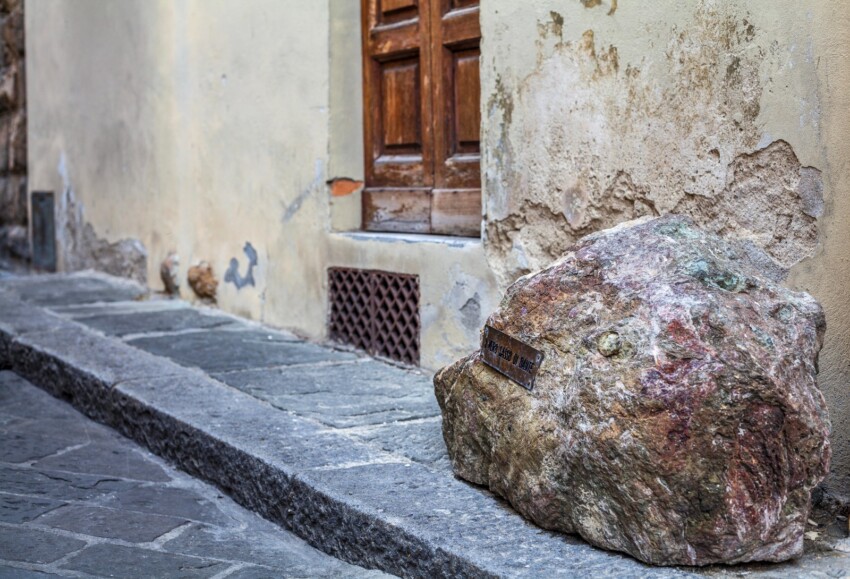
At the corner of via dello Studio and via del Proconsolo, directly opposite the Florence Duomo, stands a large stone block known as the Sasso di Dante. According to tradition, this was the great poet’s favourite spot, where he would spend hours seated on this stone watching the construction work on the cathedral of Santa Maria del Fiore, which was still being built at the time.
The most famous legend associated with this place tells an anecdote that demonstrates Dante’s prodigious memory. One day, whilst the poet sat on his stone, a passer-by asked him: “What do you like to eat?”. Dante simply replied: “A boiled egg”. Years passed, and by chance the same man encountered Dante again, sitting in the same spot. Without preamble, the man asked him point-blank: “With what?”. And Dante, without hesitation, answered: “With salt!”, demonstrating that he had perfectly remembered a conversation that had taken place years earlier.
This anecdote, whether true or invented, has become an integral part of Florence’s Dante folklore and is regularly recounted by tour guides passing the stone. The poet had a habit of sitting here to reflect, observe the city undergoing transformation, and draw inspiration for his work. The Duomo building site in the 14th century was a place of fervent activity, and Dante could watch daily as progress was made on what would become one of the world’s most majestic cathedrals.
Dante’s Stone has become today a pilgrimage destination for poetry enthusiasts and tour guides who bring their groups here to recount anecdotes from Dante’s life in Florence. The stone still stands, a silent witness to seven centuries of city history, and to sit upon it means to symbolically connect with one of humanity’s greatest literary geniuses. When you visit the Duomo area, take a moment to locate this stone and imagine Dante sitting here, watching Brunelleschi’s dome grow and forever change Florence’s skyline.
Map
In the following map you can see the location of the main places of interest mentioned in this article.
 Hotel
Hotel  Budget accommodations
  Apartments
  Family Hotel
  Luxury Hotel
  Resorts