Bestseller
Florence: Reserved Entrance Ticket to the Medici Chapel
From 17,75 €
Buy the ticket
Within the complex of the Basilica of San Lorenzo in Florence, just a short walk from the Central Market, lies one of the city’s most underrated masterpieces: the Medici Chapels. A mausoleum of the family that dominated Florence for three centuries and shaped the Italian Renaissance, the complex houses some of Michelangelo’s most powerful sculptures ever created, a dazzling baroque chapel adorned with marble and semi-precious stones, and even a secret room where the Florentine genius hid whilst fleeing from the authorities.
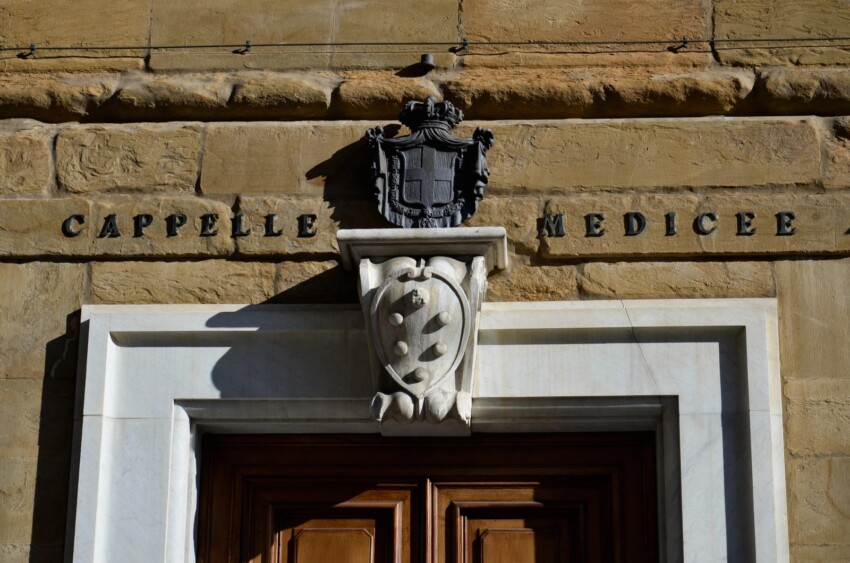
The Medici Chapels have been a state museum since 1869, today part of the Bargello Museums. Entry is not from the basilica’s main entrance but from the rear, at Piazza Madonna degli Aldobrandini 6: an almost anonymous entrance that belies the extraordinary treasures within. The tour route spans multiple levels—the underground crypt, the Chapel of the Princes on the upper floor and the New Sacristy—and requires roughly an hour and a half to explore properly.
Despite the absolute significance of the artworks, the Medici Chapels are less crowded than the Uffizi and the Accademia: a considerable advantage for those wishing to enjoy Michelangelo in relative peace. Booking your ticket online is nonetheless advisable during the summer months.
The tour takes in three distinct spaces, each with a different character and era: the Medici crypt, the Chapel of the Princes and the New Sacristy. From 2023, the Lorraine Crypt is also open to visitors, accessible for the first time to the public via the same museum route.
The tour begins by descending into the underground crypt, designed by Buontalenti in the late 16th century, where the Medici grand dukes and their families are buried, from Cosimo I through to Gian Gastone, with whom the dynasty became extinct in 1737. The space is austere and contemplative, far removed from the baroque magnificence of the chapel above: a striking contrast that invites reflection on the Medici culture’s relationship between power and death.
Adjacent to the Medici crypt lies the Lorraine Crypt, opened to the public in 2023 after decades of closure, which houses the burials of the Habsburgs-Lorraine, the dynasty that succeeded the Medici on the throne of Tuscany in 1737 and governed the Grand Duchy until Italian Unification.
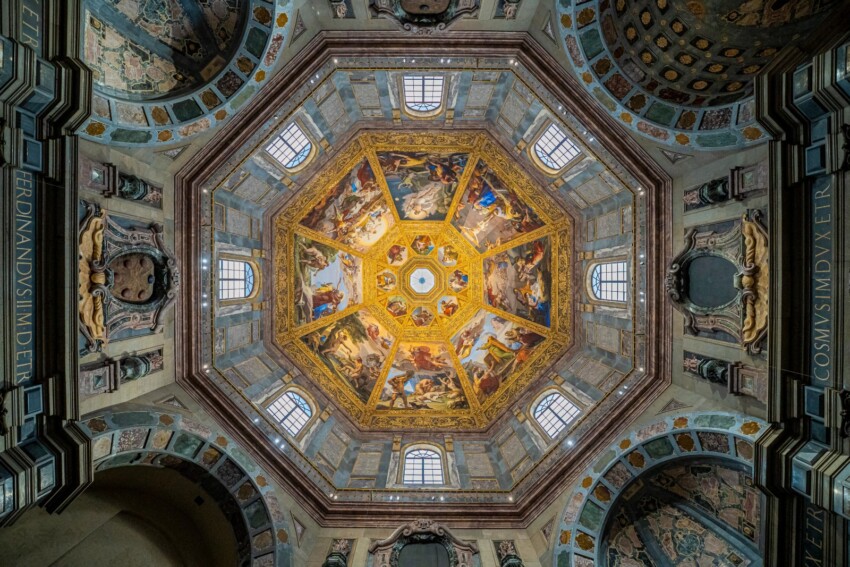
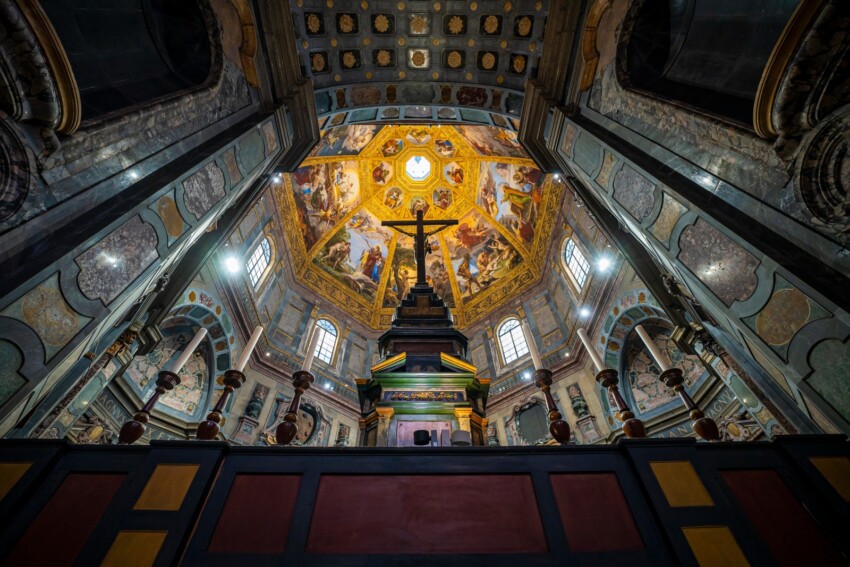
On the upper floor opens the most spectacular sight of the entire complex: the Chapel of the Princes, an octagonal mausoleum of colossal proportions entirely clad in polychrome marble and semi-precious stones—jasper, porphyry, mother-of-pearl, lapis lazuli—worked with a precision and richness unparalleled anywhere in the world. Construction began in 1604 at the initiative of Ferdinando I, designed by Don Giovanni de’ Medici and architect Matteo Nigetti, but was only completed during the Lorraine period: the frescoes in the cupola, a work by Pietro Benvenuti, were finished between 1828 and 1837.
Along the walls stand the six tombs of the grand dukes of Tuscany—Cosimo I, Francesco I, Ferdinando I, Cosimo II, Ferdinando II and Cosimo III—crowned by gilded bronze statues. On either side of the altar gleam reliquaries in semi-precious stones, considered among the most precious examples of decorative art in the Medici Grand Duchy. The chapel was conceived as Florence’s answer to the grandeur of St Peter’s in Rome: a manifesto of power designed to astound visitors for centuries.
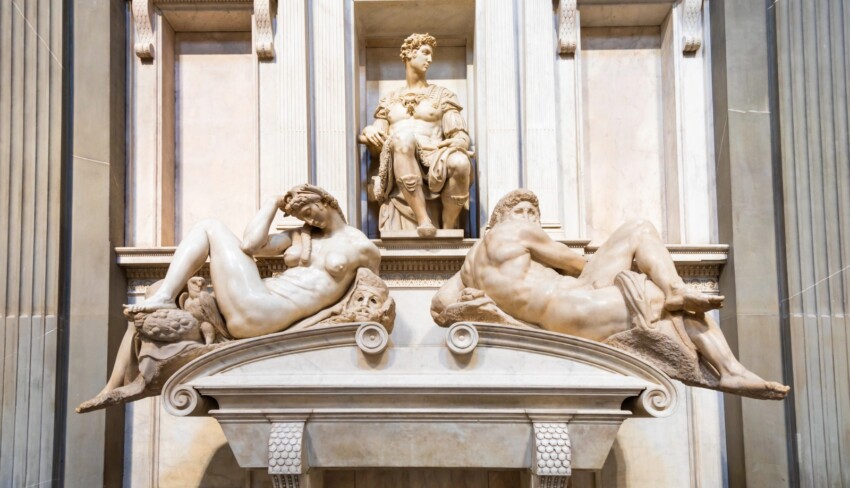
The New Sacristy is the absolute masterpiece of the complex and one of the highest achievements in the entire history of Western art. Commissioned by the Medici popes Leo X and Clement VII as a funerary chapel for their relatives, it was designed and partly realised by Michelangelo Buonarroti between 1519 and 1534, when he left Florence definitively. The space is conceived as a counterpart to Brunelleschi’s Old Sacristy, with the same square floor plan topped by a dome, but animated by architectural members and sculptures that transform the space into something living and restless.
The principal tombs are those of Giuliano de’ Medici Duke of Nemours and Lorenzo de’ Medici Duke of Urbino: their idealised portraits sit pensively on the burial chests, whilst at their feet lie the four allegories of time—Night and Day for Giuliano, Dawn and Dusk for Lorenzo. These six sculptures, among the most studied and admired in the history of art, represent the inexorable cycle of time and the fleeting nature of human glory: a message that Michelangelo entrusted to bodies of extraordinary tension, left unfinished in some parts as a conscious choice rather than through lack of time.
On the opposite side stands Michelangelo’s Madonna and Child, flanked by statues of Saints Cosmas and Damian created by Giovan Angelo Montorsoli and Raffaello da Montelupo: here lie buried Lorenzo the Magnificent and his brother Giuliano, assassinated in the Pazzi Conspiracy of 1478.
One of the most extraordinary discoveries in recent art history is the so-called Michelangelo Secret Room, a small underground space discovered in 1975 during maintenance work. On the walls over 50 charcoal drawings have been identified as attributable to Michelangelo, likely traced in 1530 when the artist hid in this secret refuge beneath the Chapels to escape the wrath of Pope Clement VII, after having defended Florence during the Medici siege.
The room is open to visitors by reservation only, in groups of no more than 4 people per time slot, with visits lasting 15 minutes. Access is via a narrow staircase of 12 steps; for this reason it is not accessible to visitors with mobility limitations, children under 10 unaccompanied by adults, pregnant women in advanced stages, or persons with heart conditions or claustrophobia.
The link between the Medici and the Basilica of San Lorenzo is as old as the family’s own fortune. Already in 1429, in the Old Sacristy—the Brunelleschian space overlooking the left transept of the basilica—the funeral rites of Giovanni de’ Medici, the banker who had launched the family’s fortunes, had been celebrated. In 1464 his son Cosimo the Elder, de facto first lord of Florence, was buried there in a crypt beneath the high altar.
The construction of the New Sacristy began in 1519 at the behest of Leo X, the first Medici pope and son of Lorenzo the Magnificent. The project was entrusted to Michelangelo, who worked on the space concurrently with the construction of the Medici Laurentian Library, also attached to the basilica. When Michelangelo left Florence in 1534 to move permanently to Rome, the sacristy was still unfinished: several figures remained incomplete and the decorative frescoing of the cupola was never realised.
The Chapel of the Princes was instead conceived a century later, in 1604, by Ferdinando I as a mausoleum for the grand dukes of Tuscany: a titanic project that engaged the Opificio delle Pietre Dure for centuries, the grand ducal manufactory specialising in the working of precious materials. Both chapels were declared national monuments in 1869 and transformed into a state museum, opened to the public at the occasion of Italian Unification just completed.
Full admission costs €9. Online booking incurs an additional charge of €3 and is strongly recommended during peak season (April–September), with advance booking of at least 2–3 weeks.
Admission to Michelangelo’s Secret Room is not included in the standard ticket and is available only by separate reservation. Entry is free on the first Sunday of the month (October–March). Special free entry days in 2025: 25 April, 2 June and 4 November.
Free guided tours are also available—included in the admission ticket—on Tuesdays and Thursdays at 4 pm and 5 pm, lasting around an hour, for groups of up to 10 people assembled directly at the entrance. The service is suspended on days with free admission.
Admission to the Medici Chapels is included with the FirenzeCard; consider purchasing one if you plan to visit multiple museums over 3 days in Florence.
The Medici Chapels are open Monday to Sunday from 8:15 am to 6:50 pm, with final entry 40 minutes before closing. The museum follows an alternating closure schedule: it is closed the second and fourth Sunday of the month and the first, third and fifth Monday of the month. It also closes for New Year’s Day, May Day and Christmas Day.
Before planning your visit, it is always advisable to check the updated schedule on the official website, as the alternating closures can create some confusion in planning.
For a complete visit including the crypt, the Chapel of the Princes, the New Sacristy and adjoining rooms, allow at least an hour and a half. Those booking the Secret Room as well should add around 20 minutes (15 minutes of viewing plus access times).
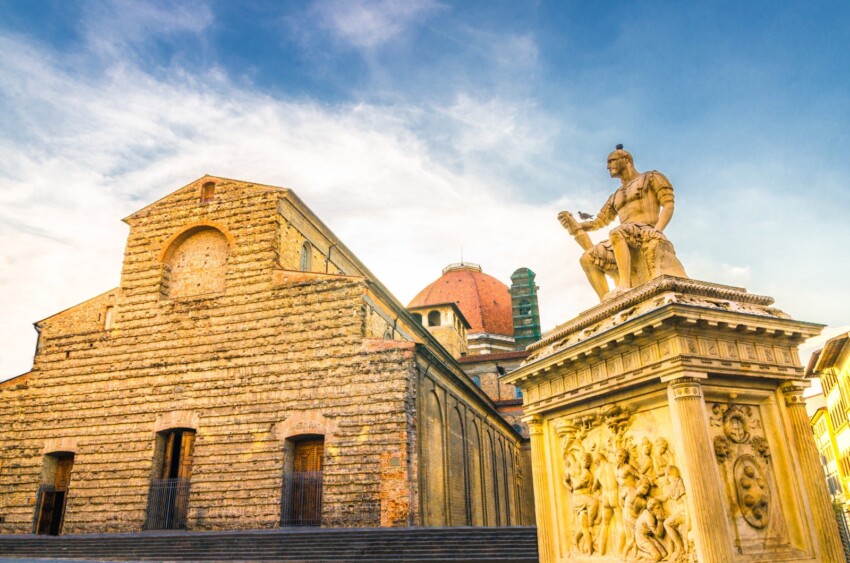
The Medici Chapels are located at Piazza Madonna degli Aldobrandini 6, in the San Lorenzo district, roughly 10 minutes’ walk from Santa Maria Novella station and 15 minutes from Piazza della Signoria. The entrance is reached by walking around the Basilica of San Lorenzo from the left side relative to the main façade.
The area falls within the historic centre’s ZTL restricted traffic zone: those arriving by car must park outside and continue on foot. The most convenient car park is the Parcheggio Centrale di Firenze on Via Cavour, roughly 5 minutes’ walk away. By bus, lines C1, C2 and 7 operated by Autolinee Toscane stop in the immediate vicinity.
The museum is equipped with an lift to reach the Chapel of the Princes on the first floor and a wheelchair lift for accessing the New Sacristy: the main route is therefore accessible to visitors with mobility disabilities. Exceptions are the Secret Room (narrow staircase of 12 steps) and the crypt (ramp).
City Card allow you to save on public transport and / or on the entrances to the main tourist attractions.

 Hotel
Hotel  Budget accommodations
  Apartments
  Family Hotel
  Luxury Hotel
  Resorts