Bestseller
Pitti Palace + Palatine Gallery Skip-The-Line Tickets + Audio Guide
From 29,50 €
Buy the ticket
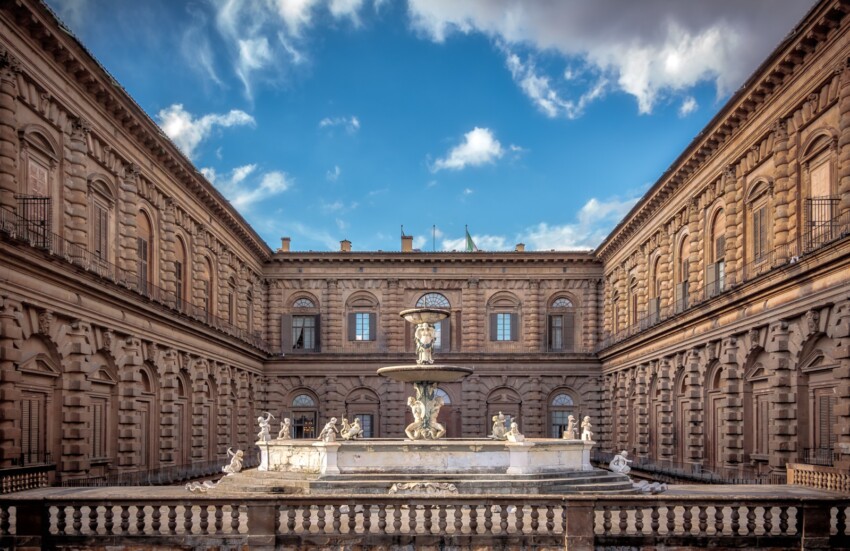
The imposing Palazzo Pitti stands proudly in the Oltrarno district, just a short walk from the Ponte Vecchio. It gained prominence in Florence as it served for centuries as the residence of the Medici, followed by the House of Habsburg-Lorraine and the House of Savoy. Today it ranks among the must-see monuments during a visit to Florence, functioning as a major state museum complex that houses numerous galleries, each more impressive than the last.
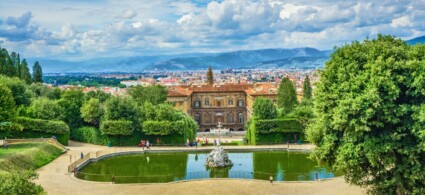
But it’s not just museums: from Palazzo Pitti you can also access the Boboli Garden, Florence’s magnificent green lung in the historic centre. Indeed, it was originally conceived as the palace’s private park, though today it welcomes both tourists and locals.
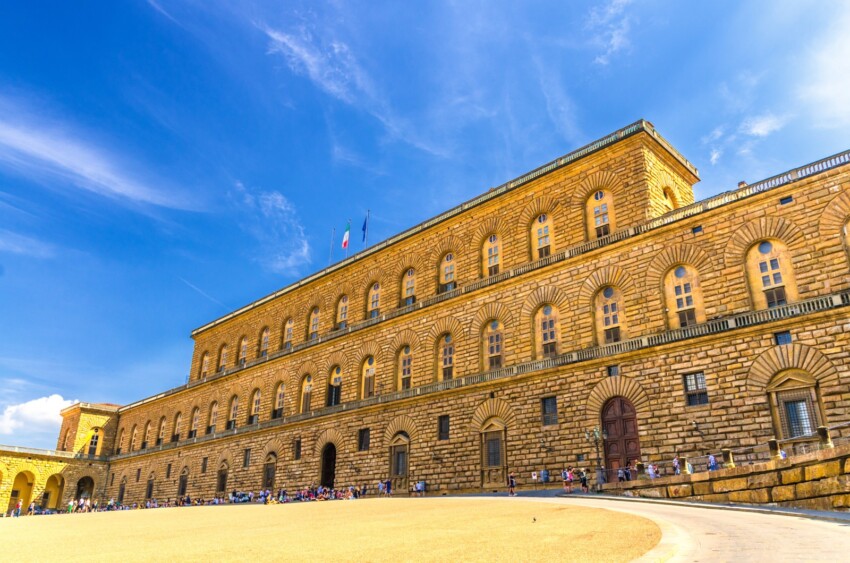
Located in Piazza de’ Pitti, at number 1, Palazzo Pitti is a rare example of a Renaissance-style urban residence. Dating back to 1458, it remains an essential stop on any Florence itinerary.
The building’s history began in the mid-15th century, when wealthy banker Luca Pitti decided to build himself a residence even larger and grander than that of the Medici, his family’s historic rivals. Unfortunately, things didn’t go to plan, as Luca and the Pitti family became heavily indebted while completing the palace.
Financial mismanagement wasn’t the only problem: due to design issues, work halted in 1465; nonetheless, the family moved in starting from 1469. The Pitti family’s financial troubles never resolved, and nearly 80 years later, heir Buonaccorso Pitti decided to sell the palace to Cosimo I de’ Medici’s wife, Eleonora of Toledo. The Medici chose to relocate to Oltrarno because the area was more salubrious and airy than the city centre, particularly given diseases like pneumonia and malaria that had already affected family members.
Without changing its name, Palazzo Pitti became the official Medici residence, and they undertook extensive restoration during their rule; it was further enlarged during the Lorraine dynasty around 1800. Eventually, when Tuscany was annexed to Piedmont, the palace became the property of the House of Savoy. When Florence became the capital of the Italian kingdom, Palazzo Pitti served as the home of King Victor Emmanuel II, until he relocated to the Quirinal Palace in Rome in 1871.
Today, Palazzo Pitti is a first-rate museum complex, so much so that in 2018 it attracted nearly 750,000 visitors. In 2014, the Ministry for Cultural Heritage and Activities consolidated the palace into a single entity called the Uffizi Galleries, which encompasses Palazzo Pitti, the Boboli Garden, and the Uffizi Gallery itself.
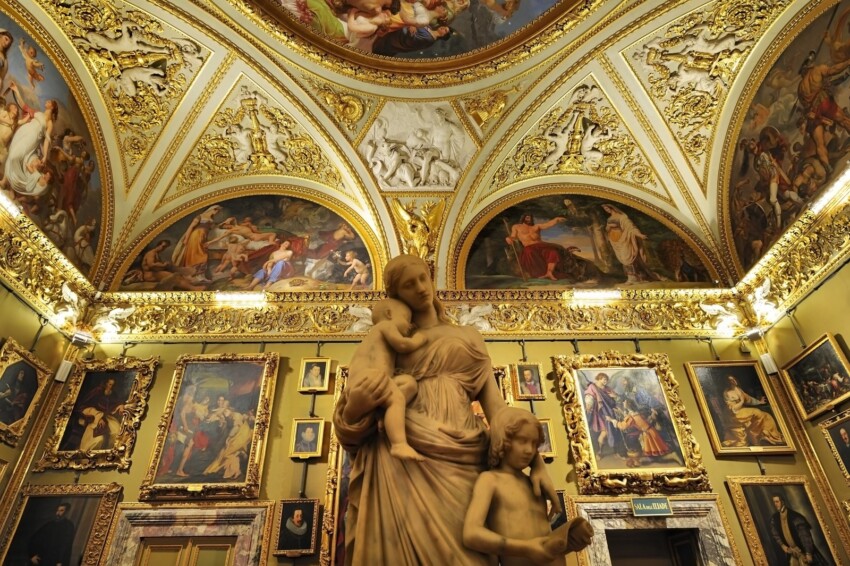
The Palatine Gallery is the main museum within the Palazzo Pitti complex. It occupies what was originally the family’s actual residence on the first floor of the palace, and comprises 28 rooms arranged according to the tastes and traditions of past centuries.
The vast collection of paintings belonging to the Grand Dukes of Tuscany is displayed here, arranged in multiple rows and organised by decorative affinity rather than historical period. The paintings on display date almost entirely from the 16th and 17th centuries, spanning the Late Renaissance through the Baroque period, while the rooms themselves are richly frescoed and stuccoed. Everything reflects the original arrangement, strongly championed by Pietro Leopoldo in the early 1800s.
In total, nearly 500 paintings by numerous artists are on display. Among them stands out the Tondo Bartolini by Filippo Lippi, housed in the Room of Prometheus, and Raphael’s Madonna della Seggiola, kept in the Room of Saturn.
The royal apartments, or ceremonial apartments, showcase the everyday life of Florence’s rulers and the Grand Dukes of Tuscany. The exhibition spans 20 rooms, of which 14 comprise the royal apartments proper, with an additional 6 forming part of the Tapestry Apartment.
The 14 royal apartment rooms were used by the Medici and their successors as living quarters, and today you can admire them in all their splendour, though not in their original state, as they were enriched over subsequent centuries with furnishings and decorations by later rulers including the House of Habsburg-Lorraine and the House of Savoy.
Despite their lavishness and decoration, the royal apartment rooms are not exceptionally large, and in a sense they have a more intimate and refined atmosphere. The royal apartments can be visited with the same ticket as the Palatine Gallery, forming a natural continuation of the museum route through Palazzo Pitti.
The Duchess of Aosta Apartment comprises 9 rooms that often remain closed to the public. Should you be fortunate enough to see them, make the most of it.
Also known as the Winter Quarters, the Duchess of Aosta Apartment consists of 2 bedrooms, a bathroom, a study, a corridor and four large halls, namely the Guard Room, Florin Room, Music Room and Red Parlour.
The Prince of Naples Quarter is another section of Palazzo Pitti that is typically closed to tourists. Connected to the Duchess of Aosta Apartment via a secondary staircase, it dates to 1871, when it was constructed in place of a service area to accommodate the apartment of Victor Emmanuel, who became King of Italy from 1900 to 1946.
This wing of Palazzo Pitti is remarkably austere, contrasting sharply with the grandeur of the rest of the museum complex. It is furnished in the Empire style, far less ornate than the Duchess of Aosta’s apartments. There are two bedrooms, the Maidservant’s Room, furnished very simply, and the Prince’s Bedroom, which features a beautiful crib, a walnut burl sofa bed and a round wooden table covered with a rug.
All rooms in the Prince of Naples Quarter are lined with wallpaper, with numerous 19th-century paintings hung on the walls.
Among Palazzo Pitti’s many museums, the Modern Art Gallery deserves special mention. Located on the second floor, it comprises 30 rooms showcasing the entire panorama of Italian art from the late 1700s through the mid-1900s.
It occupies an area of the palace that was inhabited by the House of Savoy during their visits to Florence until World War II, and consequently is less sumptuous than other sections.
Inside are displayed Neoclassical works, such as Pietro Benvenuti’s Napoleon and Giovanni Duprè’s Abel, and particularly many works by the Macchiaioli school, renowned for their innovative use of colour and their research into light effects. Notable artists represented include Giovanni Fattori, Silvestro Lega, Telemaco Signorini and Giovanni Boldini.
Florence’s Modern Art Gallery also hosts a series of temporary exhibitions dedicated to Italian and foreign painters. For the 70th anniversary of the Maggio Musicale Fiorentino, an exhibition was mounted featuring costumes, sketches, models and designs, whilst for the 150th anniversary of Florence as capital of Italy, the exhibition “Florence Capital 1865-2015” was staged.
Among Palazzo Pitti’s most interesting museums is undoubtedly the Treasure of the Grand Dukes, known until 2015 as the Silver Museum. It is a 27-room exhibition spread across two floors, established in the second half of the 19th century, containing unique and valuable pieces of horology, silverware, crystals and hardstones. Additionally, you can see cameos and engravings that belonged to the Medici.
The exhibition begins with the first 14 rooms, located on the first floor and called the Summer Apartments. Here you’ll find items from Lorenzo the Magnificent‘s private collections, Roman vases, Byzantine chalices and a series of frescoes. The next 13 rooms are on the mezzanine floor, displaying jewellery, porcelain, reliquaries and much more.
Noteworthy are the two Salzburg Treasure rooms and the intriguing Exotic Room, which showcases art treasures from distant lands.
The Fashion and Costume Museum, also known as the Costume Gallery, is housed in the Meridiana Pavilion, an elegant structure accessible also from the Boboli Garden. This pavilion was a dependency of Palazzo Pitti commissioned by Pietro Leopoldo and is located south of the main building.
The costume gallery now holds over 6,000 garments, ranging from antique clothing to accessories, from theatrical costumes to modern fashions by designers of the calibre of Valentino, Armani, Versace, Missoni and Yves Saint Laurent. This makes it one of the world’s most important fashion museums, enhanced by rare pieces of inestimable value, including the funeral garments of Cosimo I and his wife Eleonora of Toledo, and the theatrical costume collection from Umberto Tirelli’s workshop.
The Fashion and Costume Museum has set visiting hours and entry requires the same ticket as the Boboli Garden.
Inside the Knight’s Pavilion, situated in the heart of the Boboli Garden, stands the fine Porcelain Museum. Established only in 1973, it is one of the more recent museums within Palazzo Pitti.
Nevertheless, its collection is truly important, featuring rare and ancient pieces, some given to the Grand Dukes of Tuscany by other European monarchs. Much of the collection comes from the House of Savoy, who brought precious items to Palazzo Pitti from prestigious Italian royal residences such as the Ducal Palace of Parma and the Royal Palace of Piacenza when Florence was the capital.
The museum displays sets of formal ware, including cups, saucers and plates, as well as teapots, vases and numerous statuettes decorated with Rococo motifs. Many porcelain pieces come from historic manufactories such as the Royal Factory of Capodimonte or Ginori of Sesto Fiorentino, alongside Viennese, French and German creations.
The last of Palazzo Pitti’s museums is the Carriage Museum, located in the section of the building called the Porta Romana Rotunda. As the name suggests, the museum displays carriages and other vehicles used by the Grand Dukes of Tuscany, many dating from the late 18th century.
There are richly decorated carriages according to the fashions of the period, elegantly finished with drapery and leathers reflecting Florentine artisan traditions. In total there are 10 carriages and two sedan chairs, plus some horse trappings.
Among the carriages on display in this unique museum, we highlight the two-seater coupé from the Giugni family, the carriage of the Bishop of Pistoia and that of Ferdinand III of Lorraine. Also remarkable is the Sicilian carriage of the Asmundo family, adorned with rich bright red decorations.
You can purchase a single ticket for Palazzo Pitti’s collections at the counter or online in advance to avoid queues. Reduced tickets are available for visitors aged 18 to 25, while reservations incur a surcharge.
There is also a 5-day combined ticket, called Passepartout 5 Days, which grants entry to the Uffizi, Palazzo Pitti and the Boboli Garden, and an annual ticket, valid for one year from the date of issue. A family version of this ticket is also available, valid for two adults and an unlimited number of children.
Palazzo Pitti is open Tuesday to Sunday from 1:30 PM to 6:50 PM, with last entry at 5:30 PM. It closes on Mondays, Christmas Day and New Year’s Day. For visits on Saturdays and public holidays, advance booking of at least one day is required.
Palazzo Pitti is among the attractions included in the FirenzeCard. Consider purchasing one if you plan to visit multiple museums in three days in Florence.
Guided tours cannot be purchased at the entrance, however you are certainly welcome to enter the building and museums accompanied by a professional guide. You can join private or group excursions: search online to find the best option for your budget and available time.
Given the wealth of museums and attractions on offer, a complete visit to Palazzo Pitti can easily take more than a day. If your time in Florence is limited, consider focusing on just one or two museums, perhaps combining them with the Boboli Gardens.
Visiting Palazzo Pitti is a must, but it can get extremely crowded, so choose off-peak times – perhaps arriving when it opens or shortly before closing.
Disabled access is available from Piazza Pitti, with a gradient of approximately 20%. Inside the building, lifts provide access to the museums on the first and second floors.
Palazzo Pitti has a free cloakroom located to the right of the main courtyard. You’re required to leave umbrellas, large rucksacks and bulky bags here. In the basement of the main courtyard, there’s also a dedicated area for mothers with young children, where they can rest, feed their babies and attend to their needs.
Located on the southern edge of Florence’s historic centre, Palazzo Pitti is easily reached on foot or by car. Walking, allow roughly 20 minutes from Santa Maria Novella station, moving at a steady pace without stopping to browse shop windows or visit historic centre monuments. You’ll pass through Piazza Duomo and the Ponte Vecchio, giving you the chance to catch sight of Florence’s main attractions along the way.
Palazzo Pitti is equally straightforward to reach by car. Don’t misunderstand – the area is a ZTL (restricted traffic zone) and non-residents cannot enter, but given its proximity to Porta Romana, which marks the southernmost point of the historic centre, it’s relatively convenient to get there. On the outer side, the square facing Porta Romana is a major Florence traffic hub, and there’s a public car park nearby. Once you’ve left your car here, it’s just a short walk through the gate and along Via Romana; you’ll find Palazzo Pitti on your right as you arrive in the magnificent Piazza Pitti.
However, the most convenient way to arrive at Palazzo Pitti by car is to park in the private car parks on Via dè Bardi, the road running alongside the Arno immediately south of Ponte Vecchio. You can reach it by crossing the Arno on Ponte San Niccolò, which is open to traffic, and then entering the ZTL by following the southern bank of the Arno. Don’t worry – you won’t risk a fine! The car park operators have a special agreement with Florence’s municipality, so once you’ve paid for parking, they’ll take care of clearing your vehicle from the traffic detection system.
The public transport C4 bus also stops in Piazza Pitti, serving much of the historic centre including the immediate area around Piazza Duomo, the main station and several streets in Oltrarno, with its terminus at the Palagi hospital, on the road leading to Piazzale Michelangelo.
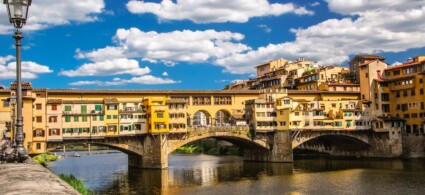
Palazzo Pitti sits in Oltrarno, on Piazza Pitti. You can reach it easily on foot by crossing Ponte Vecchio, while behind it lies the sprawling Boboli Gardens, originally the palace's private park.
City Card allow you to save on public transport and / or on the entrances to the main tourist attractions.
 Hotel
Hotel  Budget accommodations
  Apartments
  Family Hotel
  Luxury Hotel
  Resorts