Bestseller
Florence: Palazzo Vecchio Entrance Ticket & Audioguide
From 32,12 €
Buy the ticket
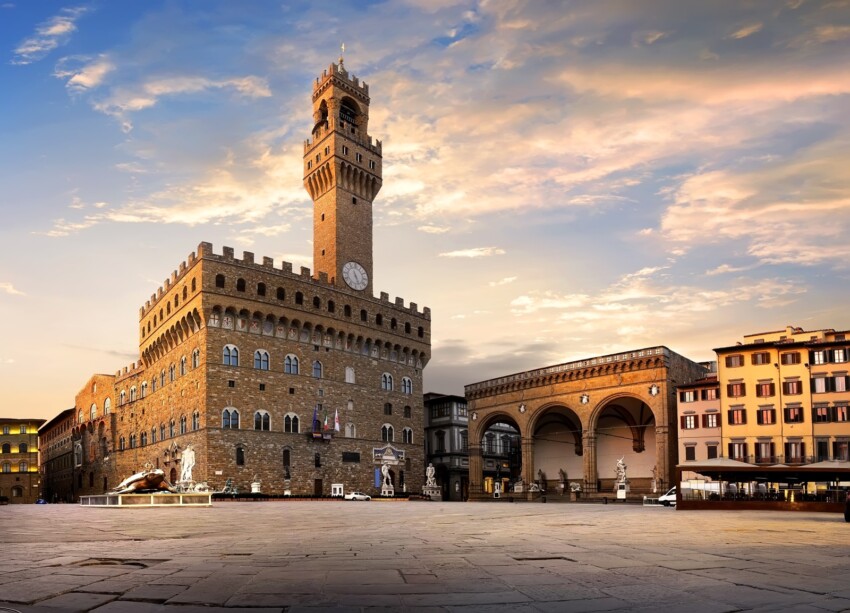
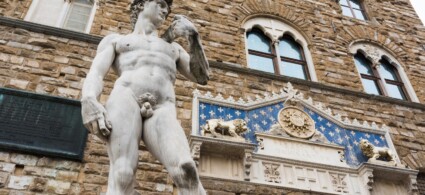
In the stunning setting of Piazza della Signoria, one of the finest and most important squares in Florence‘s historic centre, the unmistakable silhouette of Palazzo Vecchio with its magnificent civic tower dominates everything else.
This elegant palace dating from the 14th century, today home to Florence’s city council, has always been the civic palace of the city. Initially known as the Palazzo dei Priori, then as the Palazzo della Signoria and later as the Palazzo Ducale, it took on the name Palazzo Vecchio in the second half of the 16th century following the relocation of Cosimo I de’ Medici’s court to the “new” Palazzo Pitti.
Today, Palazzo Vecchio is one of the must-see monuments during a visit to Florence: its distinctive profile makes it one of the city’s absolute symbols, featured on postcards and souvenirs of every kind; admire its exterior and then venture inside, where you can access some rooms free of charge, whilst others are part of the Palazzo Vecchio museum, one of the city’s most appreciated and visited museums.
Palazzo Vecchio’s importance to Florence’s economic and social fabric is such that when Florence served as capital of Italy, it was used as the parliament of the Italian kingdom.
Beyond admiring Palazzo Vecchio from the outside and taking wonderful photographs, you can enter the building to see some magnificent rooms. Access to the ground floor, where three courtyards are located, is free and open to all, whilst climbing to the first and second floors requires an admission ticket.
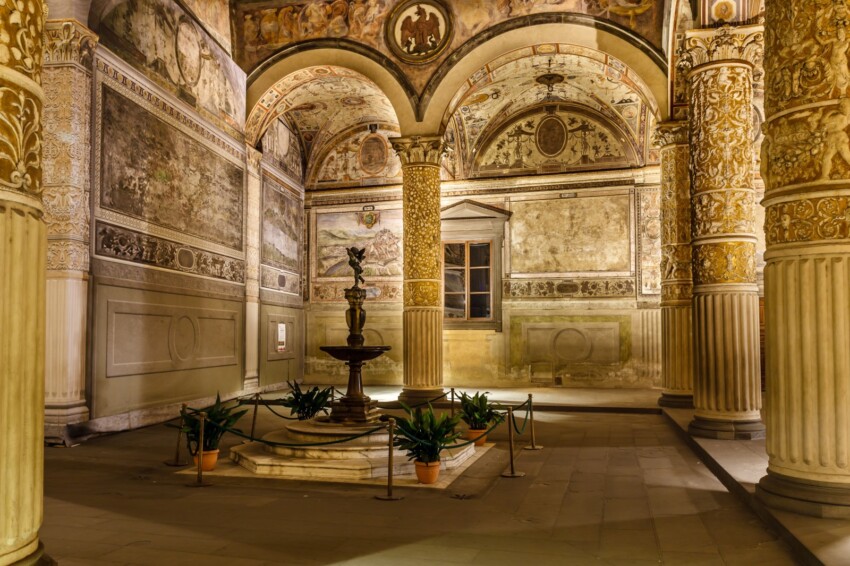
From the main entrance staircase of Palazzo Vecchio, you access the Courtyard of Michelozzo, an open space freely accessible to the public. It takes its name from the Florentine architect who designed it in the mid-15th century, but it acquired its current appearance over 100 years later, when Giorgio Vasari designed a significant expansion for the occasion of the wedding between Francesco I de’ Medici and Joanna of Austria.
The courtyard is surrounded by a magnificent portico, whose walls are richly decorated with the emblems of the churches and guilds and craft corporations of Florence; in honour of Joanna of Austria, several cities of central Europe, former possessions of the Habsburgs, are depicted, such as Prague, Graz, Linz, Bratislava, Vienna, Innsbruck and Constance. The portico vaults are further enriched with grotesque decorations.
In the centre of the Courtyard of Michelozzo stands a small bronze statue of the Putto with Dolphin, which rises from the centre of a fountain. The statue is the work of Verrocchio, but what you can admire is merely a copy: the original is carefully preserved on the second floor of the palace. The fountain itself receives its water from the Boboli hill via an ingenious system of pipes designed and conceived centuries ago.
The Courtyard of Michelozzo is also known as the “first courtyard”, whilst the other two are situated immediately behind it. They are certainly not the most beautiful part of the palace, though they are free to visit, and they too date back to the 15th century, so why overlook them? Passing through them, you can admire fine architectural elements of the era, such as broad vaults supported by massive pillars.
In the second courtyard, also called the Courtyard of the Dogana because of its original function in medieval times, you’ll find the museum ticket office and library, whilst the third courtyard, also called the New Courtyard as it was the last to be built, is the least interesting: it’s an open courtyard without arcades, overlooked by some municipal offices, and from which the staircase leads up to the office of Florence’s Mayor.
What many consider the most beautiful room in Palazzo Vecchio is called the Salone dei Cinquecento, located on the first floor with impressive dimensions: it measures 54 metres in length and 23 in width. Originally the seat of the city’s governing council of Florence, it was built at the behest of Savonarola and takes this curious name from the fact that the over 1,500 citizens who formed the council would meet in rotation in groups of 500 at a time.
When first constructed, its dimensions were more modest: subsequently, Cosimo I de’ Medici decided to enlarge the room so he could use it as a court hall. Its walls recall the triumph of Florentine military history, particularly against the republics of Pisa and Siena, with large frescoes inspired by the wars Florence waged against its historic rivals. The ceiling, meanwhile, is the work of Vasari, and consists of 39 coffered panels all finely frescoed; the subject in this case is Cosimo I, and important episodes from his life are depicted.
On the walls, between one fresco and another, there are niches housing some sculptures by Bandinelli, and a series of Medici tapestries.
At the far end of the Salone dei Cinquecento lies a small windowless room. It’s the study of Francesco I, created in Mannerist style by Giorgio Vasari. You can admire the wealth and abundance of works of art, hanging on the walls and drawn across the elegant barrel-vaulted ceiling. With paintings, stuccos and sculptures all around, your eyes won’t stop widening in wonder at the beauty that surrounds you.
Many of the paintings in Francesco I’s study are representative of the Vasari school; there are portraits of Cosimo I and his wife painted by Alessandro Allori, some bronze sculptures by Giambologna, and two small staircases leading to the so-called Tesoretto, the ancient study of Cosimo I de’ Medici.
The Monumental Quarters of Palazzo Vecchio are a series of rooms all located on the first floor, dedicated to the main representatives of the Medici family. They are richly frescoed and decorated halls that celebrate the Medici and their dynasty. Long used as state rooms by Florence’s City Council, they are now open to the public and visitable by tourists, with the exception of the Sala dei Dugento, as it is used by Florence’s municipal council as a meeting room and is therefore not open to visitors.
The Monumental Quarters of Palazzo Vecchio are the room of Leo X, the room of Cosimo the Elder, the room of Lorenzo the Magnificent, the room of Cosimo I, the room of Giovanni of the Black Bands, the scriptorium, the chapel of Saints Cosmas and Damian and the room of Clement VII. These are accompanied by the Ricetto, the Sala dei Dugento and the Sala degli Otto.
Palazzo Vecchio is part of the network of Florentine civic museums, of which it represents the jewel in the crown. The admission ticket can be purchased on site or online. Entry is via the main door of the palace overlooking Piazza Signoria or via the side entrance on Via dei Gondi. In addition to the standard route, there is also the option of undertaking the archaeological tour, dedicated to excavations of Florence’s Roman theatre, and climbing the tower and ramparts.
Palazzo Vecchio is one of the attractions with admission included in the FirenzeCard; consider purchasing one if you want to visit multiple museums over 3 days in Florence.
The museum organises guided tours lasting 50 minutes, limited to a maximum of 14 participants, fully accessible for disabled visitors. Tours run daily from 10am to 3:30pm (Thursday mornings only) and are also available in English, French and Spanish.
You can also participate in a tour dedicated to families with children aged 4 to 10, called “Life at Court”, a guided route that recalls the times of Cosimo I, his wife Eleonora and their 11 children; the tour is available in Italian and English on Fridays, Saturdays, Sundays and Mondays at 4:30pm. It lasts 50 minutes with a maximum of 7 places available.
In both cases the price is 5 euros in addition to the standard museum admission fee.
It is also possible to participate in private guided tours organised by external tour guides with proper authorisation and equally valid.
The Palazzo Vecchio museum features a bookshop, souvenir shop, café and cloakroom where you must deposit umbrellas, rucksacks and large bags, and provides services such as free wheelchair and pushchair rental. It has a lift for visitors with mobility disabilities, and a multimedia space located on the second floor.
The first tip for visiting Palazzo Vecchio is to book your visit online well in advance to avoid queuing at the ticket office or finding yourself on a particularly busy day when no more entries are available. If you can, visit Palazzo Vecchio out of season to avoid crowds and take better photographs.
Remember to allow at least a couple of hours, if not half a day. In winter, visit it in the afternoon, so you can make the most of daylight hours to spend time outside; Palazzo Vecchio is also the ideal destination to visit in Florence during a rainy day!
Let us remind you once more that the courtyards on the ground floor of Palazzo Vecchio are completely free, so don’t stop at the entrance, but go inside the building and admire the beauty of the Courtyard of Michelozzo and its frescoes dedicated to Francesco I de’ Medici and his consort Joanna of Austria.
As Palazzo Vecchio is home to Florence’s city council, the city’s civil marriages are celebrated here. Couples can say their “I do” within a truly unique setting worldwide, that of the Sala Rossa, one of the palace’s most beautiful rooms.
Celebrating a wedding in the Sala Rossa is free for residents of Florence; otherwise rates vary depending on the couple’s place of residence:
The times for wedding celebrations are very limited, so booking several months in advance is necessary: the Sala Rossa is available only on Wednesdays from 9am to 12pm, Thursdays from 9am to 12pm, or Saturdays from 9am to 1pm. There are also some halls available for hire by reservation for organising a toast, buffet or reception.
The prices listed above are valid only within these times; outside these hours an additional rather substantial sum must be paid, amounting to approximately 800 euros depending on the spouses’ residence.
As an alternative to the Sala Rossa, you can also get married in the magical setting of the Salone dei Cinquecento. In this case, the cost does not change: regardless of the prospective spouses’ residence, it amounts to 5,000 euros.
Furthermore, on the occasion of a wedding at Palazzo Vecchio, it is possible to request ZTL access to enter the centre by car; Florence’s City Council also provides decorations and plants inside the halls.
Palazzo Vecchio is located in Piazza della Signoria, one of Florence city centre‘s main squares. It is reached exclusively on foot, though distances in Florence are never too great. It takes little more than 10 minutes’ walk from Santa Maria Novella station, the same from Piazza Santa Croce and around 5 minutes from Piazza del Duomo. Of course, these are theoretical times: you could easily take several hours given the abundance of things to see along the way!
Arriving at Palazzo Vecchio by car is forbidden, as Piazza della Signoria is part of the historic centre’s ZTL restricted traffic zone, and like almost the entire area is completely pedestrianised. Residents can park on nearby Via dei Gondi or in Piazza San Firenze. If you’re staying at a hotel in this area and have arrived in Florence by car, check with your accommodation whether you have ZTL access rights or not.
Palazzo Vecchio sits in Piazza Signoria, at the heart of Florence's historic centre. It's easily reached on foot from the station or Piazza del Duomo by walking down elegant Via Calzaiuoli, the city's main shopping street.
City Card allow you to save on public transport and / or on the entrances to the main tourist attractions.
 Hotel
Hotel  Budget accommodations
  Apartments
  Family Hotel
  Luxury Hotel
  Resorts