The finest and most photographed balcony overlooking Florence bears a name: Piazzale Michelangelo, one of the city's most beloved destinations for both locals and visitors alike.
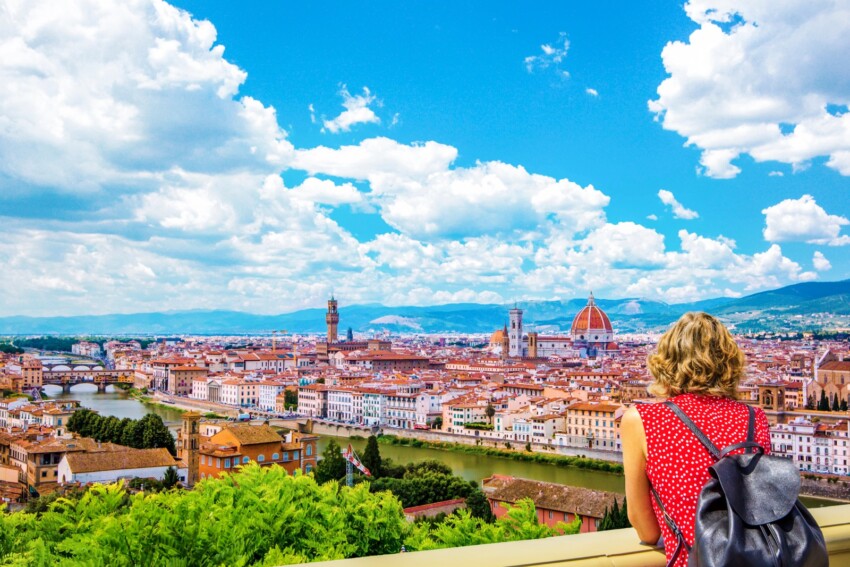
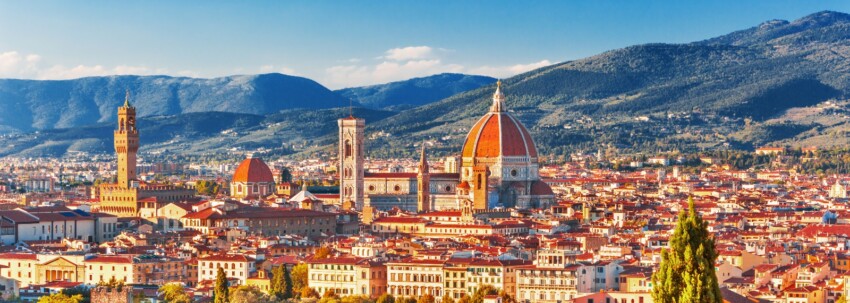
The Piazzale Michelangelo, known simply as the Piazzale by Florentines, is a terrace overlooking the city, built on the hill south of Florence’s historic centre by architect Giuseppe Poggi in 1869. From this privileged vantage point, you can admire a magnificent view of Tuscany’s capital, a truly unique panorama that encompasses all of Florence’s principal monuments, from the Cathedral to the Ponte Vecchio, from the Basilica of Santa Croce to Palazzo Vecchio.
The view of Florence from the Piazzale has been reproduced on thousands of postcards, souvenirs and merchandise, so you may already have a good idea of what awaits you. However, seeing the city from above in person is a completely different experience, which is why visiting Piazzale Michelangelo is an absolute must for anyone in the city, even if only for a weekend.
Moreover, the Piazzale is home to a range of interesting attractions, including monuments, gardens, souvenir stalls and several outdoor bars, where you can refresh yourself whilst enjoying one of the world’s finest views. It’s no wonder that Piazzale Michelangelo is often used as a venue for events and concerts, where artists perform in a truly unique setting.
You might think the sole purpose of visiting Piazzale Michelangelo is to snap a photo of Florence from above and leave. Nothing could be further from the truth: there are actually numerous attractions and monuments well worth visiting to make the most of your time in this splendid part of the city.
The Piazzale
The main attraction of Piazzale Michelangelo is… the piazzale itself! Indeed, once you’ve made it up here, the first thing you’ll naturally want to do is step onto the beautiful balcony designed by architect Poggi and admire a unique view of Florence. Unless you’ve already seen it on a postcard during a stroll through the centre, of course!
From atop the Piazzale, Florence reveals itself in all its beauty: the vista spans 180 degrees from west to east. At the far left, you can observe the Belvedere Fortress, situated on the adjacent hill, whilst gradually panning your gaze to the right, you’ll survey all the city’s principal monuments that comprise Florence’s skyline: the Ponte Vecchio, the Cathedral, Palazzo Vecchio, and the Basilica of Santa Croce, all beneath the peaceful flow of the Arno. In the distance, the peak of Monte Morello stands proudly, whilst closer to hand you can spot the settlements of Fiesole and Settignano.
Among other notable points of reference in the city, perhaps less well-known to tourists, which can be observed from the Piazzale, are the enormous Cascine park, a favourite destination for locals on sunny Sundays, and the new Palace of Justice, which sparked considerable debate in the city for its modern lines that stand in contrast to the rest of the Renaissance monuments.
You’ll certainly want to spend hours admiring Florence from above and taking wonderful souvenir photographs; however, across the expansive piazzale, there are other landmarks not to be missed. First and foremost, at the centre of the square stands a colossal replica of Michelangelo’s David (which, we should note, is a copy, as the original is preserved in the Accademia Gallery); additionally, at the northern end of the piazzale there’s a beautiful staircase, an ideal spot to watch spectacular sunsets. Sit down with a drink in hand and relax whilst watching street artists who often perform at the foot of the steps, as if it were an amphitheatre.
Behind Piazzale Michelangelo stands a handsome loggia built in neoclassical style, also designed by Giuseppe Poggi. It was intended to become a Michelangelo museum, but this never came to pass. Today it houses a restaurant and an aperitif bar; beneath the loggia, in the wall, there’s an inscription dedicated to the famous architect, which reads: “Giuseppe Poggi, Florentine architect. Turn around; behold his monument”.
San Miniato al Monte Abbey
From Piazzale Michelangelo, if you turn your back to Florence, you’ll realise you’re not at the highest point on the hill. Not everyone knows that it’s possible to enjoy a different perspective – for some, even more beautiful – by continuing uphill for just a few minutes until you reach the Abbey of San Miniato al Monte. You can reach it on foot or by car, and once you arrive at its forecourt, you can enjoy another splendid view of Tuscany’s capital.
The abbey was constructed over approximately 200 years, between 1100 and 1300. The exterior is richly decorated in white and green marble, and whilst visiting inside, you’ll pass by the relics of San Miniato, preserved in the crypt below, protected by a gate dating from the fourteenth century. There are numerous beautiful works of sacred art, such as frescoes by Taddeo Gaddi, or those by Spinello Aretino in the sacristy area.
Today, the Abbey of San Miniato al Monte is run and inhabited by Benedictine monks; it’s also open to those wishing to spend several days in spiritual retreat, though tourist stays are not permitted. The monks produce beeswax candles, sweets and biscuits, which are then sold at the adjacent monastic pharmacy, open daily from 10 to 12 and from 4 to 6 p.m.
Rose Garden
Another essential destination for those visiting Piazzale Michelangelo is the Rose Garden. It’s reached by descending a steep staircase behind the piazzale, but the effort – particularly on the way back – is more than rewarded by the beauty that awaits you upon arrival. You’ll find Florence framed by plants and flowers, including over 350 rose varieties, along with modern sculptures by Belgian architect Jean-Michel Folone donated to the city by his widow, and a series of interesting pathways, including one that winds through the Japanese garden, also a donation, this time from the city of Kyoto, with which Florence is twinned.
Bear in mind that the Rose Garden was built on the side of the hill, and approaching it from Piazzale Michelangelo will be all downhill. It’s also possible to reach the garden from the San Niccolò Gate, in the Oltrarno area. In this case, the route will be uphill all the way. Admission to the garden is free, and opening hours vary depending on the season. The roses, naturally, are present only between May and June.
Interesting fact
Before Jean-Michel Folone’s widow donated her late husband’s works to Florence in 2011, the Rose Garden was open only during the months of May and June, precisely when the roses were in bloom.
Guided tours
Piazzale Michelangelo is a completely open-air attraction and therefore free to visit. However, if you’d like to learn about its secrets and all the details of the sights you’ll be admiring, you can certainly take part in a private or group tour, departing from the city centre, which will satisfy your every curiosity.
Furthermore, be aware that virtually all guided tours of Florence include a stop at Piazzale Michelangelo.
You can visit Piazzale Michelangelo independently, but if you’re interested in learning the history and anecdotes, consider hiring a tour guide. Bear in mind, however, that guides aren’t available on-site, so you’ll need to book one from the city centre before heading up, or better yet, arrange it online beforehand.
It’s important to know that bar and restaurant prices are very high, and quality isn’t always excellent. You’re largely paying for the location and breathtaking view. If you want to save money, there are numerous food and drink kiosks at Piazzale Michelangelo: instead of sitting at a table, you can grab a drink or gelato and enjoy a break on the steps with a unique view of Florence.
Piazzale Michelangelo is completely exposed to the sun throughout the day with no shaded areas, so it can get very hot in summer. If the heat exhausts you, take shelter by sitting on the steps of the staircase leading to the Rose Garden, which is entirely shaded by centuries-old trees.
Finally, although Piazzale Michelangelo is one of the most popular destinations for tourists visiting Florence, given its size, it’s never excessively crowded. Well, it is, but you’ll certainly find a section of the balcony all to yourself for a photo, or a spot on the steps to sit down.
How to get to Piazzale Michelangelo
You can reach Piazzale Michelangelo on foot via 3 alternative routes, or by using local buses and taxis. Of course, you can always use your own car.
Viale Michelangelo, 25 min (easy)
The road from the centre leading to Piazzale Michelangelo is called Viale Michelangelo, and it’s one of Florence’s most exclusive residential areas. It branches off from Piazza Ferrucci, at the edge of the historic centre, and you can even walk it: from Santa Maria Novella station it takes about 30-45 minutes, the road runs through the entire historic centre and then from Piazza Ferrucci begins to climb with a moderate gradient; the pedestrian path is separated from the road by a hedge, so it’s suitable for children too. In total, from Piazza Ferrucci to Piazzale Michelangelo takes about 25 minutes on foot, though you can significantly shorten the route by cutting through Via dei Bastioni, which, at the cost of a much steeper gradient, allows you to cut the journey by about 10 minutes.
Rampe di San Niccolò, 15 min (moderate)
Alternatively, you can climb on foot via the Rampe di San Niccolò, or Poggi Ramps, located right beside the San Niccolò Tower in Piazza Poggi, overlooking the Lungarno Benvenuto Cellini. This way you’ll have to climb a series of staircases and it will certainly be more strenuous, but also significantly shorter and highly scenic. As you climb, the view of Florence from above becomes increasingly beautiful. Once you’ve completed the ramps, you’ll need to walk the final stretch of road with a decent gradient. The entire route from San Niccolò Tower takes approximately 10-15 minutes.
Via del Monte alle Croci, 10-15min (strenuous)
A third and final alternative for reaching Piazzale Michelangelo on foot involves exiting the centre of Florence via the San Miniato Gate, located in the small square of the same name in the Oltrarno district, and climbing Via del Monte alle Croci: you’ll find a staircase after just a few metres, which leads to the entrance of the Rose Garden, continuing up to Piazzale Michelangelo. From the San Miniato square to Piazzale Michelangelo takes about 10 minutes, but the route is very strenuous due to the many steps.
Bus, taxi and car
Finally, if you lack the inclination, time or energy for the walk, you can rely comfortably on local public transport. You can get there, for example, on bus lines number 12 or 13, or by taxi, which won’t be too expensive given the short distance. Arriving by car is also convenient, as the inner part of Piazzale Michelangelo serves as a car park.
Finally, all tourist buses make a stop at Piazzale Michelangelo.
It’s also worth noting that Viale Michelangelo, once you reach the piazzale, changes its name to Viale Galileo and continues around the hill, descending near Porta Romana, passing first by the Belvedere Fortress. For those staying in this area, it’s better to climb via this road.
Useful information
Address
Piazzale Michelangelo, 50125 Firenze FI, Italy
Where is located Piazzale Michelangelo
Piazzale Michelangelo sits along Viale Michelangiolo, on the hillside overlooking the south bank of the Arno.

 Hotel
Hotel  Budget accommodations
  Apartments
  Family Hotel
  Luxury Hotel
  Resorts