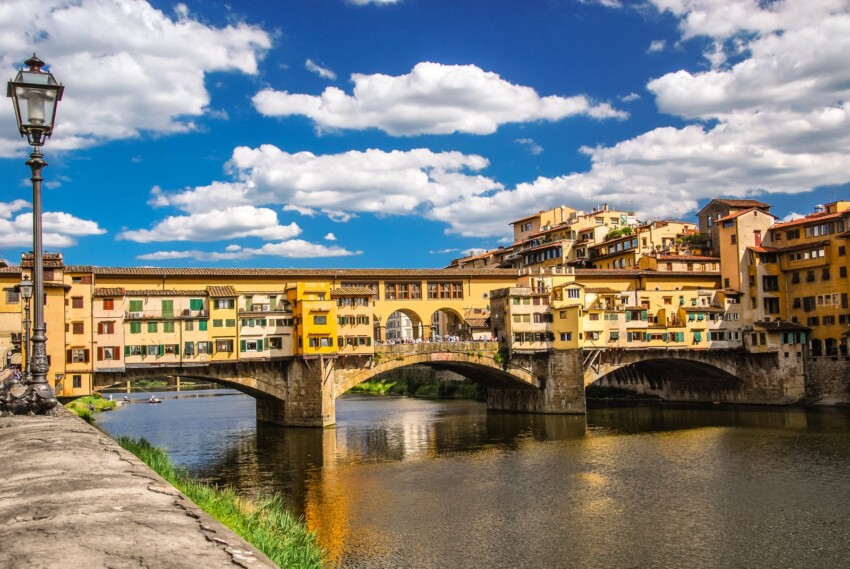
Of all the bridges that cross the Arno river in Florence, the Ponte Vecchio is undoubtedly the most striking, photographed, iconic and distinctive in Tuscany’s capital. Located right in the city centre, crossing it will transport you back in time, surrounded by historic jewellery shops and elegant statues, immersed in a medieval and picturesque setting.
Both banks of the Arno connected by the Ponte Vecchio are equally worthy of a visit: on one side lies the elegant Via Por Santa Maria, which leads to the beautiful Mercato Nuovo loggia and naturally to Piazza Duomo and Piazza Signoria; on the other side is Oltrarno, an area rich in tradition, where walking along Via dei Guicciardini brings you directly to Palazzo Pitti.
Today, crossing the Ponte Vecchio is one of the must-do experiences when visiting Florence: not only because it’s one of the city’s principal monuments, but also because from here you can admire a splendid panorama of the Arno, stretching from Piazzale Michelangelo to the south-east all the way to the Cascine park to the west.
The bridge acquired the epithet “Vecchio” (Old) following the construction of the nearby Ponte alla Carraia, which was then called the “Ponte Nuovo” (New Bridge).
The history of the Ponte Vecchio goes back centuries, to around 1100, though it didn’t have quite its present form back then. A subsequent reconstruction took place in 1345, when a bridge across the Arno was inaugurated to the design of Taddeo Gaddi, built with three arches and four crenellated buildings at each end.
The Ponte Vecchio has connected the two banks of the Arno for centuries: throughout its history it was enlarged, embellished and restructured repeatedly, eventually reaching its modern form. By 1442, for example, shops selling fruit, vegetables and meat had sprung up on the bridge: these were converted into jewellery shops and goldsmiths’ workshops in 1594 by decree of Ferdinand I, a role they continue to play today; the panoramic windows date from the Mussolini era, created for Hitler’s 1938 visit to Florence.
In the twentieth century the Ponte Vecchio was barely touched by conflict: the Germans decided not to destroy it, making it the only bridge in Florence to escape this fate. Some claim, however, that the Ponte Vecchio survived only because certain goldsmiths sabotaged the German explosives by cutting the wires. It was the Florence flood of 1966 that caused the greatest damage to the Ponte Vecchio, far more than the war: restoration wasn’t completed until 13 years later, in 1979.
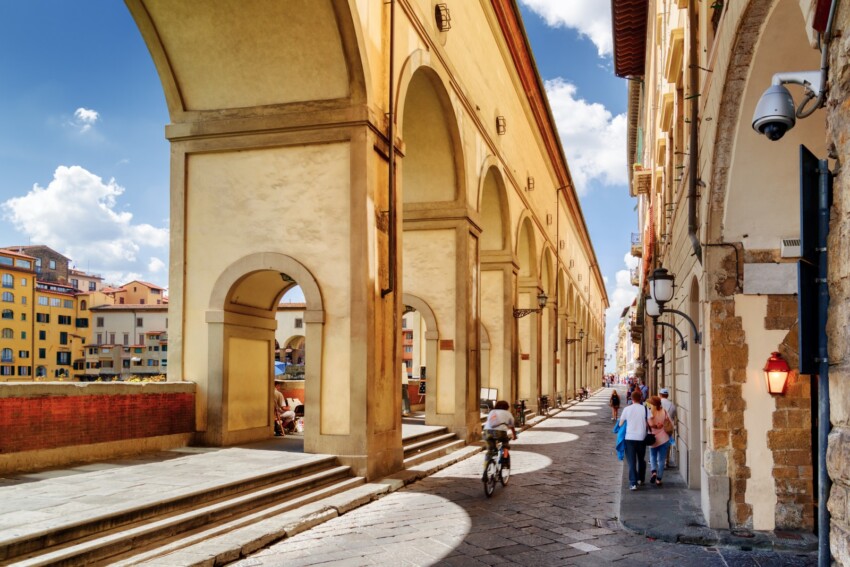
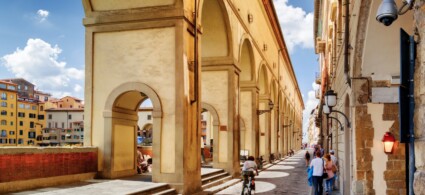
In 1565, the architect Giorgio Vasari was commissioned by Cosimo I de’ Medici to build a secure passageway between the seat of the family’s central power, Palazzo Vecchio, and their private residence, Palazzo Pitti. This gave birth to the Vasari Corridor, which you can still visit today, passing through the Uffizi and directly over the Ponte Vecchio.
Construction of the corridor, which spans approximately 760 metres, took just 5 months, and what we see today is essentially the original design, except for various restorations carried out in the nineteenth century, when some arches were filled in and other sections reinforced following a flood. In the twentieth century, windows above the Ponte Vecchio were added, but unlike the bridge itself, the Corridor was severely damaged by Second World War bombing: a section of the Vasari Corridor was completely destroyed and wasn’t restored until 1973.
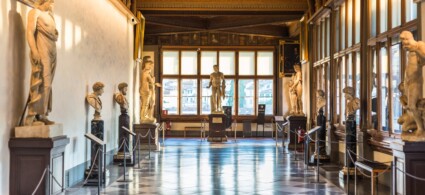
Today, the Vasari Corridor is a magnificent attraction not to be missed in Florence; along its length, entirely managed by the Uffizi Gallery, you can admire a series of self-portraits and paintings dating from the seventeenth and eighteenth centuries. Following a closure that began in 2016 for building renovations, it is scheduled to reopen in autumn 2022.
As you walk along the Ponte Vecchio, you can’t help but admire several monuments and sculptures worth highlighting:
Don’t expect to visit the Ponte Vecchio alone: we’re talking about one of Florence’s and all of Tuscany’s most important attractions, so be prepared to be literally surrounded by tourists, and to spend considerable time trying to get a photograph of the Arno without anyone photobombing your perfect shot. If you want to try avoiding the crowds, visit the bridge early in the morning or late in the evening.
The busiest day is 24 June, the feast day of Florence’s patron saint, St John. In the evening it’s the perfect vantage point for watching the fireworks launched from Piazzale Michelangelo. Unfortunately, however, you won’t be the only one with this idea, so either arrive several hours early or resign yourself to disappointment.
As a publicly accessible attraction, the Ponte Vecchio has no entrance fee and is freely accessible 24 hours a day, seven days a week.
Finally, if you want to shop for gold and bracelets at the jewellery shops, make sure the prices are in line with the market rate.
The immediate surroundings of the Ponte Vecchio are literally packed with hotels, almost all of excellent quality, four or five-star establishments. For ultimate luxury we recommend staying in a room with a view over the Arno, so you can admire the bridge from the comfort of your room, though prices are certainly not within everyone’s budget.
If you’d prefer to stay near the Ponte Vecchio but spend a bit less, on both sides of the bridge there are various side streets with small hotels, guesthouses and B&Bs.
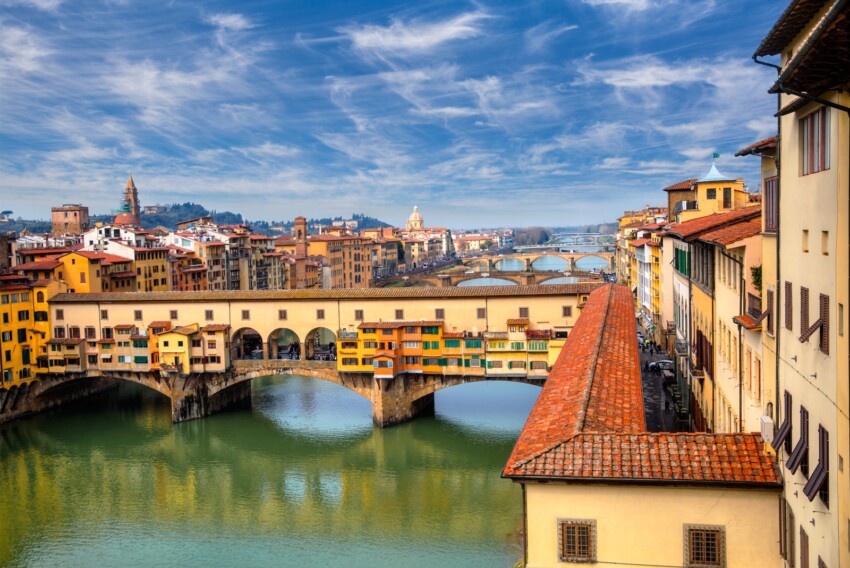
The Ponte Vecchio is reachable almost exclusively on foot. It’s about 15 minutes’ walk from Santa Maria Novella station, walking along Via Panzani, Piazza Duomo, Via Roma and Via Por Santa Maria. You can also reach it from Piazza Signoria, passing under the Uffizi loggia, or via the riverside embankments. Being such a central location in Florence, it’s no surprise that there are many routes to get there.
From the other side of the Arno, the Ponte Vecchio can be reached from Porta Romana, walking along Via Romana to Piazza Pitti, then continuing along Via dei Guicciardini.
Those wishing to arrive at the Ponte Vecchio by car can do so from the south bank of the Arno, crossing at Ponte Giovanni da Verrazzano and continuing along Lungarno Ferrucci, Lungarno Cellini and Lungarno Torrigiani, until you reach Via dei Bardi. Be aware that this area of Florence is entirely within the ZTL (restricted traffic zone), so if you’re not a resident and don’t have a hotel authorisation, you’ll need to park in one of the affiliated car parks at extortionate rates. Alternatively, once you return home you’ll receive a hefty fine as an unwelcome souvenir of Florence.
Ponte Vecchio sits in the heart of Florence's city centre. It's easily reached on foot from Santa Maria Novella railway station, a pleasant 10–15 minute walk away.
City Card allow you to save on public transport and / or on the entrances to the main tourist attractions.

 Hotel
Hotel  Budget accommodations
  Apartments
  Family Hotel
  Luxury Hotel
  Resorts