Bestseller
Florence: Uffizi Timed Ticket & Masterpieces Audio App
From 27,20 €
Buy the ticket
The Uffizi Gallery is Italy’s most visited museum and one of the world’s most important art museums. Located in Florence’s historic centre, on the Uffizi Square behind Palazzo Vecchio, it houses the world’s largest collection of Raphael and Botticelli works, alongside numerous masterpieces by artists of the calibre of Giotto, Titian, Leonardo da Vinci, Pontormo and Bronzino.
Essentially, the historical core of the Uffizi’s collection originates from the Medici family’s private collection, which was enriched over the centuries, particularly through donations from private individuals and institutions. Today, the Uffizi houses the world’s most extensive and significant collection of Florentine Renaissance art. Visiting this extraordinary museum during a Florence holiday is an absolute must, not only for art experts but also for the general public, who will find themselves immersed in such an abundance of beauty as to be almost unimaginable.
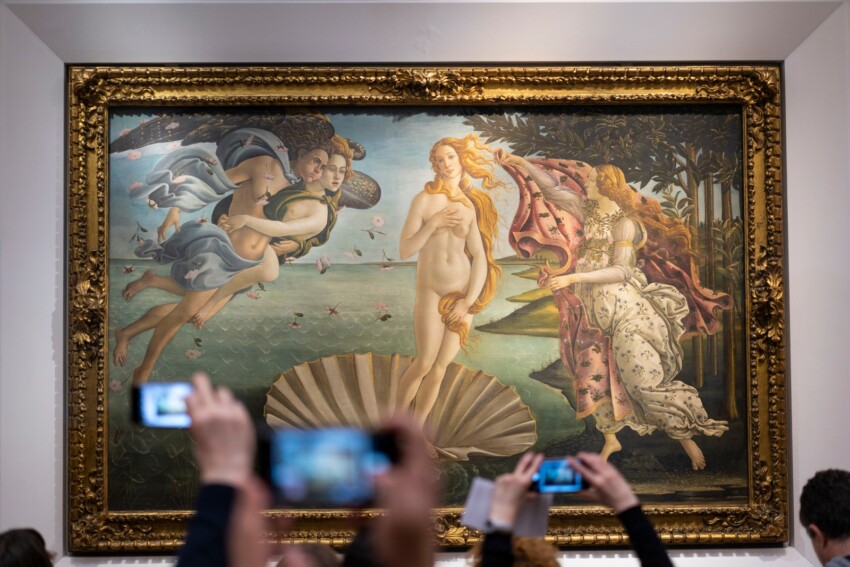
Inside the Uffizi Gallery are indeed some of the world’s most important paintings, seen and reviewed time and again in books, magazines and posters. Among these, the most famous are undoubtedly Botticelli’s Birth of Venus, Botticelli’s Primavera, Leonardo da Vinci’s Annunciation, Michelangelo’s Doni Tondo, and Caravaggio’s Shield with the Head of Medusa.
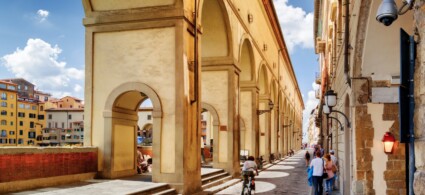
Today, the term “The Uffizi Galleries” refers to a museum complex that comprises, in addition to the Uffizi, the Vasari Corridor, Palazzo Pitti and the Boboli Garden.
The Uffizi collections are developed around 4 themes: painting, architecture, sculpture and the prints and drawings cabinet. The exhibition route is divided into a series of corridors, which form a guided path through the building’s two floors. The rooms follow a chronological order, and some are dedicated to major Renaissance artists.
Among these, here are the most important ones, those you shouldn’t miss if time is limited.
The Botticelli room actually encompasses rooms 10 to 14 of the exhibition route. Here is displayed the world’s largest collection of Sandro Botticelli works, where you can admire his two most famous masterpieces: Primavera and The Birth of Venus.
These are accompanied by other works of incredible significance and importance, including the Madonna of the Magnificat, Portrait of a Man with a Medal of Cosimo the Elder, Madonna of the Pomegranate and Coronation of the Virgin.
In room 15 of the Uffizi there is a section dedicated to Leonardo da Vinci’s early artistic period. On display is his first documented work, the Baptism of Christ. The Annunciation is remarkable, painted when Leonardo had just passed twenty, but the Adoration of the Magi also deserves attention – an unfinished work painted in oil on panel and tempera grassa.
Upon observing the Uffizi Tribune, a small octagonal room, you will certainly be amazed. It represents the Uffizi’s original nucleus, for many the first museum in the Western world, and its vivid red walls densely covered with paintings are truly unforgettable.
The room’s objects and decorations draw inspiration from the four elements air, water, earth and fire; there are many paintings hung on the walls, and a beautiful table inlaid with hard stones frames a series of ancient Medici statues arranged in a circle.
During the 2010-2012 renovation the Tribune’s floor was discovered: this prevented direct access, and today it is only viewable by looking through the entrance doors.
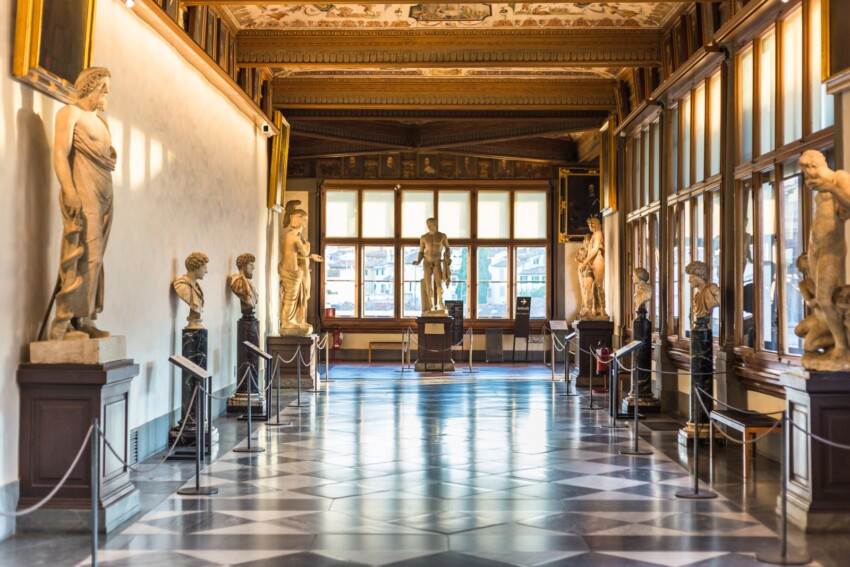
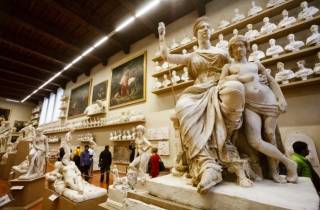
This exciting corridor, which offers unique views of the Arno, Ponte Vecchio and Piazzale Michelangelo, displays ancient statues, enhanced by excellent lighting since it faces entirely south. On the ceiling you can admire some religious-themed frescoes, commissioned by Grand Duke Cosimo III.
Among the statues, Cupid and Psyche, Dying Alexander, Olympia, Phidias’s Seated Venus, the Dancing Satyr and the Maiden Seated Ready to Dance stand out. Many of these statues date back to the centuries immediately before Christ’s birth.
Ten rooms of the Uffizi Gallery, numbered 25 to 34, are dedicated to the Sixteenth Century. Among the most representative masterpieces stands Michelangelo’s Doni Tondo, Titian’s Venus of Urbino and Parmigianino’s Madonna with the Long Neck.
The sixteenth-century rooms are organised by regions: the first are dedicated to Florentine painters, followed by the Venetian school, the Emilian, Venetan and Lombard schools.
Between 2010 and 2012, the Uffizi was expanded with a series of new rooms.
The blue rooms number 10, numbered 46 to 55, and display works by foreign painters from the 17th and 18th centuries, including the Spanish masters Velazquez, Goya and Ribera, the French Le Brun and Vouet, the Dutch Rembrandt and numerous other artists from the schools of the Southern Netherlands.
The red rooms number 9, and display works of Florentine Mannerism, alongside masterpieces of ancient art, creating a parallel. There are some monochrome works by Andrea del Sarto, masterpieces by Bronzino, Rosso Fiorentino and Pontormo, and an entire room, number 66, dedicated to Raphael.
In 1993 a series of rooms were set up within the Uffizi Gallery dedicated to Caravaggio. The celebrated painter doesn’t have many works, but those present are incredibly representative of his early creative phase, his youth. The Bacchus is noteworthy, along with the famous Head of Medusa, painted on a wooden shield.
Tickets for the Uffizi can be purchased directly at the ticket office or online; the latter remains the recommended option to avoid queues and make the most of your time. With a museum ticket you also have access to the National Archaeological Museum and the Opificio delle Pietre Dure Museum. Entry is free for disabled visitors, under-18s and a number of categories, while young people aged 18 to 25 are entitled to reduced admission.
You can also purchase a ticket valid for 5 days called Passepartout 5 Days, which also includes admission to Palazzo Pitti, the Boboli Garden and the Opificio delle Pietre Dure Museum, with priority access. To use this ticket, the Uffizi must be the first museum you visit to activate the ticket, entering from gate 3, whilst Palazzo Pitti and the Boboli Garden must be visited within 72 hours of activation.
For enthusiasts or residents, an annual ticket is available, valid for 365 days from a date of your choice. This ticket includes access to all temporary exhibitions and priority access except on free entry days. A Family version is also available, valid for 2 adults and an unlimited number of children.
The Uffizi is open Tuesday to Sunday from 8.15 am to 6.50 pm, with last admission at 5.30 pm; on Saturdays, Sundays and public holidays booking is required at least one day in advance. The museum is closed on Mondays, Christmas Day and New Year’s Day.
The Uffizi Gallery is one of the attractions with free admission included in the FirenzeCard; consider purchasing it if you want to visit multiple museums in 3 days in Florence.
There are no guided tours organised directly by the museum, but you can certainly arrange private or group visits with the help of Florence’s knowledgeable tour guides. If you don’t know them personally, search online for the one that appeals to you most, and choose based on the itinerary offered, prices and user reviews.
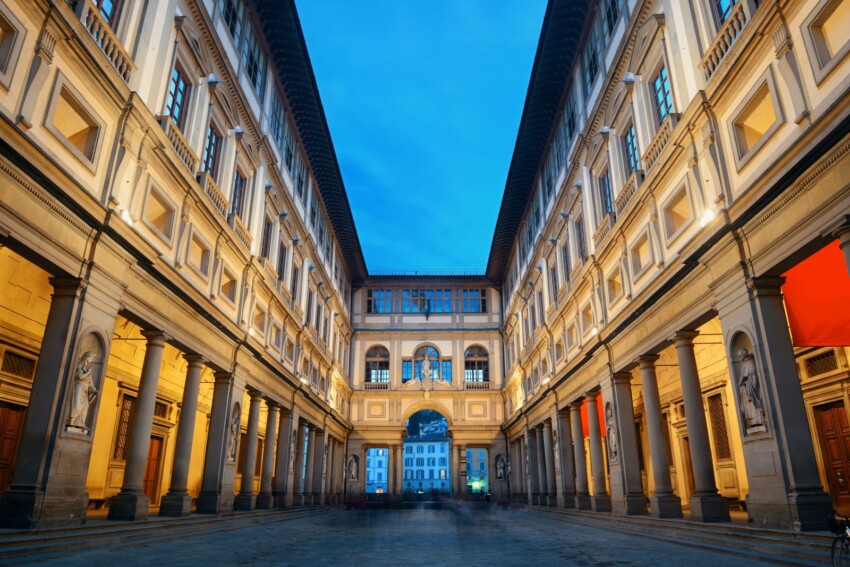
Our first tip for visiting the Uffizi Gallery is to buy your tickets in advance. The queue can become really long, and although it’s in the shade of the elegant colonnade, the wait is still exhausting, especially considering the amount of time wasted.
Being one of Europe’s most popular museums, the Uffizi is always very crowded. If you can, visit it outside peak tourist season, taking advantage of low-season periods.
A visit to the Uffizi Gallery can take up an entire day. Judge carefully how much time you have available to explore Florence, spending more or less time exploring the individual rooms.
The Uffizi can be a perfect escape from Florence’s scorching summer heat, as well as an ideal alternative on rainy days. Unfortunately, you won’t be the only one thinking this way: be prepared for crowded rooms.
Inside the Uffizi there is a convenient free cloakroom; here it is mandatory to deposit umbrellas, large rucksacks and bags. There is also a second cloakroom, reserved for groups and bulky items, located at the ticket office in the western colonnade.
The museum has a café with a panoramic terrace on the second floor; the perfect stop to relax with an extraordinary view of Palazzo Vecchio.
On the ground floor of the Uffizi, near the exit, there is a post office, which also offers museum postmark cancellation and philately services, as well as a currency exchange counter.
Two special routes are available for people with disabilities, part of the project called Uffizi for all.
The first is dedicated to deaf people, and is called “masterpieces in sign language”: it features video descriptions of the Uffizi’s most important works such as Sandro Botticelli’s Primavera, Piero della Francesca’s Portraits of the Dukes of Urbino and others, with explanations and essential information.
The second special route is dedicated to people with visual impairment, is called “Uffizi to touch” and allows independent touching of some original sculptures from the Medici collection; in addition, along the route there are numerous braille captions and appropriate signage.
The Uffizi Gallery is easily reached on foot, as it’s located right in the historic centre, just a stone’s throw from Piazza della Signoria and Ponte Vecchio. From Santa Maria Novella station, the walk takes around 15–20 minutes, assuming you don’t stop in Piazza del Duomo (which you’ll pass through en route) or pop into any of the shops along Via Calzaiuoli.
You cannot drive directly to the Uffizi unless you enter the restricted traffic zone behind it, which runs through Piazza San Firenze and Via del Proconsolo. By public transport, you can take the C1 line from Santa Maria Novella station, which stops approximately 200 metres from the Uffizi entrance.
An alternative for driving near the Uffizi is to cross the Arno via Ponte San Niccolò, which is open to traffic as it sits outside the restricted zone, then hug the riverbank as you head back towards the historic centre, travelling along Lungarno Cellini, Lungarno Serristori, Lungarno Torrigiani and Via dè Bardi. You’ll pass through the automatic cameras of the restricted zone, but don’t worry: if you park in one of the private car parks in the area, they’ll handle the necessary paperwork to cancel your passage through the electronic barriers, saving you a fine. From there, you’ll find yourself just on the far side of Ponte Vecchio—cross it and you’ll be right behind the Uffizi’s loggia.
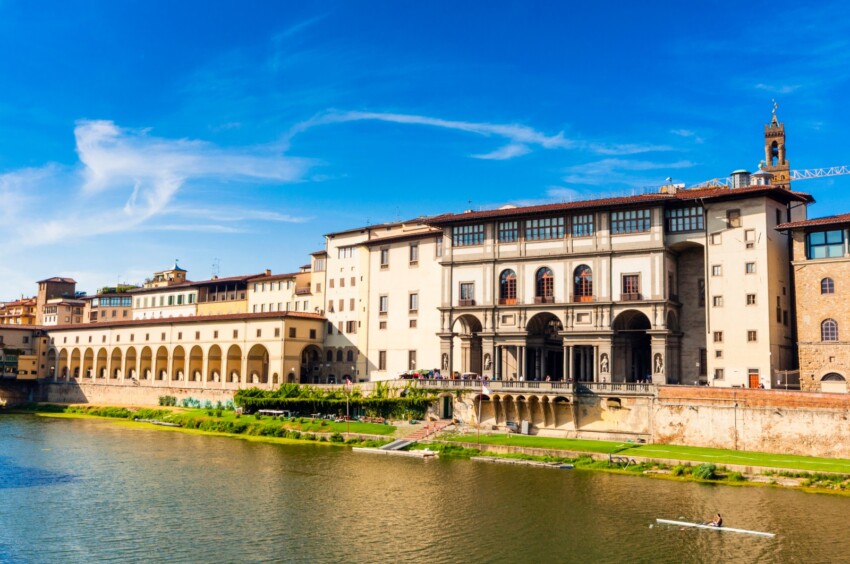
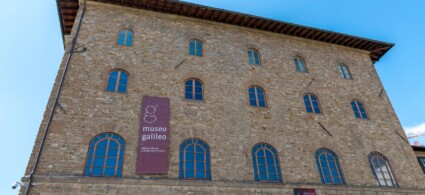
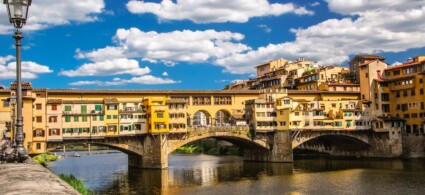
The Uffizi Gallery is situated in Florence's historic centre, just a stone's throw from Piazza della Signoria. Its lower side overlooks the Arno, a short distance from the Ponte Vecchio.
City Card allow you to save on public transport and / or on the entrances to the main tourist attractions.

 Hotel
Hotel  Budget accommodations
  Apartments
  Family Hotel
  Luxury Hotel
  Resorts